
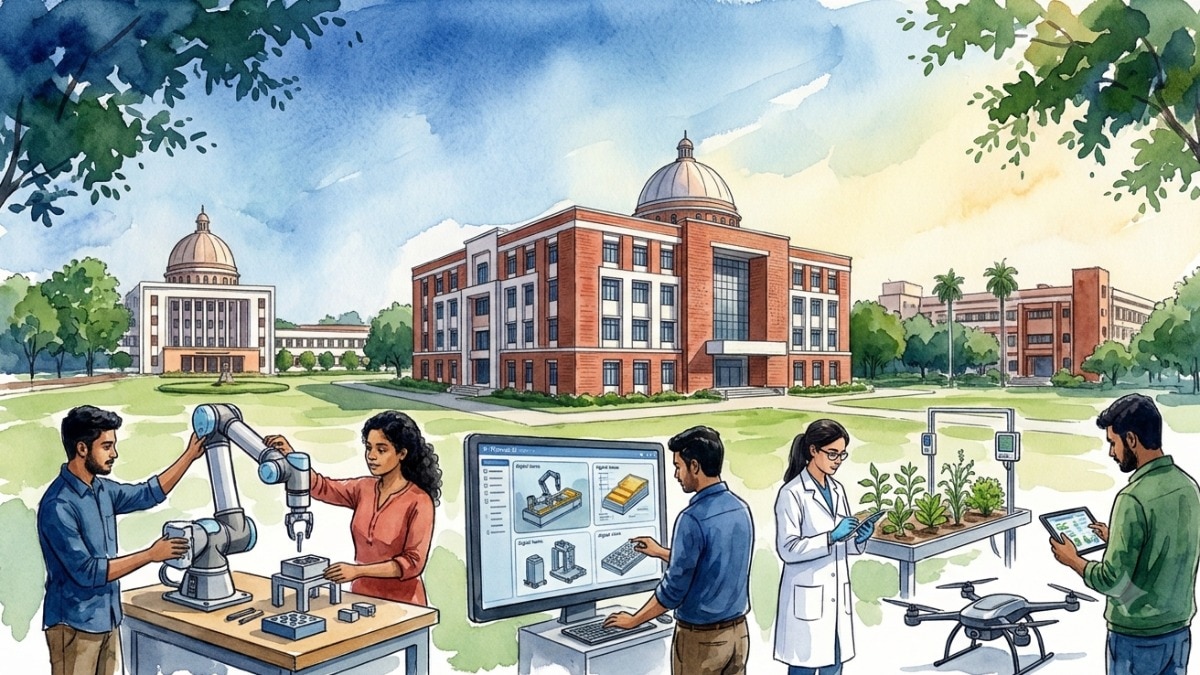
IIT Kharagpur plans to establish a Rs 35-crore Benjamin Gupta School of Physical AI to advance real-world AI applications across engineering, healthcare and manufacturing, while offering interdisciplinary education and professional upskilling programmes. IIT Kharagpur to launch Physical AI school, plans hybrid Master's programmes (AI-generated image)Artificial intelligence is already writing code, generating images and answering questions on screens. But what happens when AI has to do more than process information? When it must understand how materials behave, help machines navigate the physical world or support doctors in making clinical decisions?The Indian Institute of Technology (IIT) Kharagpur is betting on that next frontier with a Rs 35-crore initiative to establish the Benjamin Gupta School of Physical AI, a dedicated academic school aimed at bringing AI closer to the physical world.Announced through a tripartite memorandum of understanding (MoU) involving IIT Kharagpur, its alumnus and philanthropist Vinod Gupta, and IITKGP Foundation USA, the initiative seeks to bring artificial intelligence together with physics, engineering, biological systems, and scientific knowledge.The institute envisions the school as a step towards developing AI systems that do not merely learn patterns from data but can also understand physical principles and interact with the world more reliably. FROM CHATBOTS TO MACHINES THAT UNDERSTAND THE PHYSICAL WORLDMuch of the public conversation around AI has focused on chatbots, image generators and other digital tools. Physical AI, however, seeks to extend these capabilities to systems that operate in the real world, where material properties, physical laws, uncertainty and safety constraints matter.For instance, an AI system used in manufacturing must account for how materials behave and how machines respond to changing conditions. In healthcare, AI-assisted systems need to work alongside biological and clinical understanding rather than rely solely on algorithmic predictions. IIT Kharagpur plans to pursue this approach through research in physics-informed machine learning, scientific AI, digital twins, intelligent robotics, autonomous systems, advanced sensing and AI-enabled experimentation.The proposed applications span advanced manufacturing, energy, agriculture, climate and environmental technologies, healthcare, medical devices and intelligent infrastructure.The central idea is to develop AI systems that can do more than identify patterns: they must also account for the physical principles governing the problems they are designed to solve.WHERE WILL THE RS 35 CRORE COME FROM?The initiative will be supported by a total investment of Rs 35 crore. According to the institute's announcement, the Vinod Gupta family will contribute Rs 12.5 crore, while an anonymous alumnus will contribute Rs 10 crore. IIT Kharagpur will fund the remaining amount.The investment will support dedicated infrastructure to house the Department of Artificial Intelligence and associated interdisciplinary academic and research activities.The school will be named the Benjamin Gupta School of Physical AI in memory of Vinod Gupta's late son, Benjamin Gupta.The initiative is intended to draw on IIT Kharagpur's expertise across engineering, basic sciences, medicine and computing, bringing together researchers, engineers, clinicians and industry practitioners to develop AI applications for real-world use.The institute has also identified safe, trustworthy and responsible AI as a priority, particularly in applications where reliability, explainability and accountability are essential.AI EDUCATION BEYOND ENGINEERING CLASSROOMSResearch is only one part of the proposed school. IIT Kharagpur also plans to use it to reshape how students and working professionals learn and apply AI in their respective fields.Academic programmes are expected to begin in the upcoming academic session, subject to the necessary approvals. Proposed offerings include hybrid-mode Master's programmes, executive education, professional certifications and specialised interdisciplinary learning modules.These programmes are expected to cater to students, researchers, working professionals and graduates from engineering, physical sciences, life sciences and medicine.The institute envisages the school as a finishing school for engineers, scientists and medical professionals, helping them combine their existing domain expertise with contemporary AI capabilities.The distinction is important. An engineer working with AI should understand how physical laws, material properties, and system dynamics influence a solution. Similarly, a medical professional should be able to assess AI-assisted diagnostics in the context of clinical and biological knowledge, rather than rely uncritically on an algorithm's output.Through hybrid learning, interdisciplinary projects, industry-linked problem-solving and laboratory exposure, the school aims to equip professionals to apply AI with a deeper understanding of the systems they work with.IIT KHARAGPUR'S BET ON THE NEXT PHASE OF AIThe proposed school reflects a broader ambition to connect AI research with practical applications across industries. IIT Kharagpur plans to build collaborations involving industry, healthcare institutions, research laboratories, startups and international partners.The institute believes this approach could help address a skills gap between the rapid growth of AI capabilities and the specialised knowledge needed to translate them into dependable technologies.Prof Suman Chakraborty, director of IIT Kharagpur, said the next major advance in AI would involve transforming how people understand, engineer and interact with the physical world.He said the institute aims to move beyond treating AI as a black-box solution, with engineers, scientists and medical professionals combining algorithmic capabilities with a deeper understanding of their respective fields.For IIT Kharagpur, the Rs 35-crore investment is therefore not just about creating another AI research facility. It is an attempt to prepare for a future in which artificial intelligence is expected to work not only on screens, but also in factories, laboratories, hospitals and other complex physical environments.Whether that vision translates into reliable technologies and industry-ready skills will depend on how effectively the school turns its research ambitions and proposed academic programmes into practice.- Ends
Rs 35 crore to take AI out of the screen? IIT Kharagpur plans new school
Full Article
Original Source
Read the full article at Indiatoday →KhanList aggregates and links to publicly available news content. We do not host full articles from third-party sources. Always verify important information with original sources.