
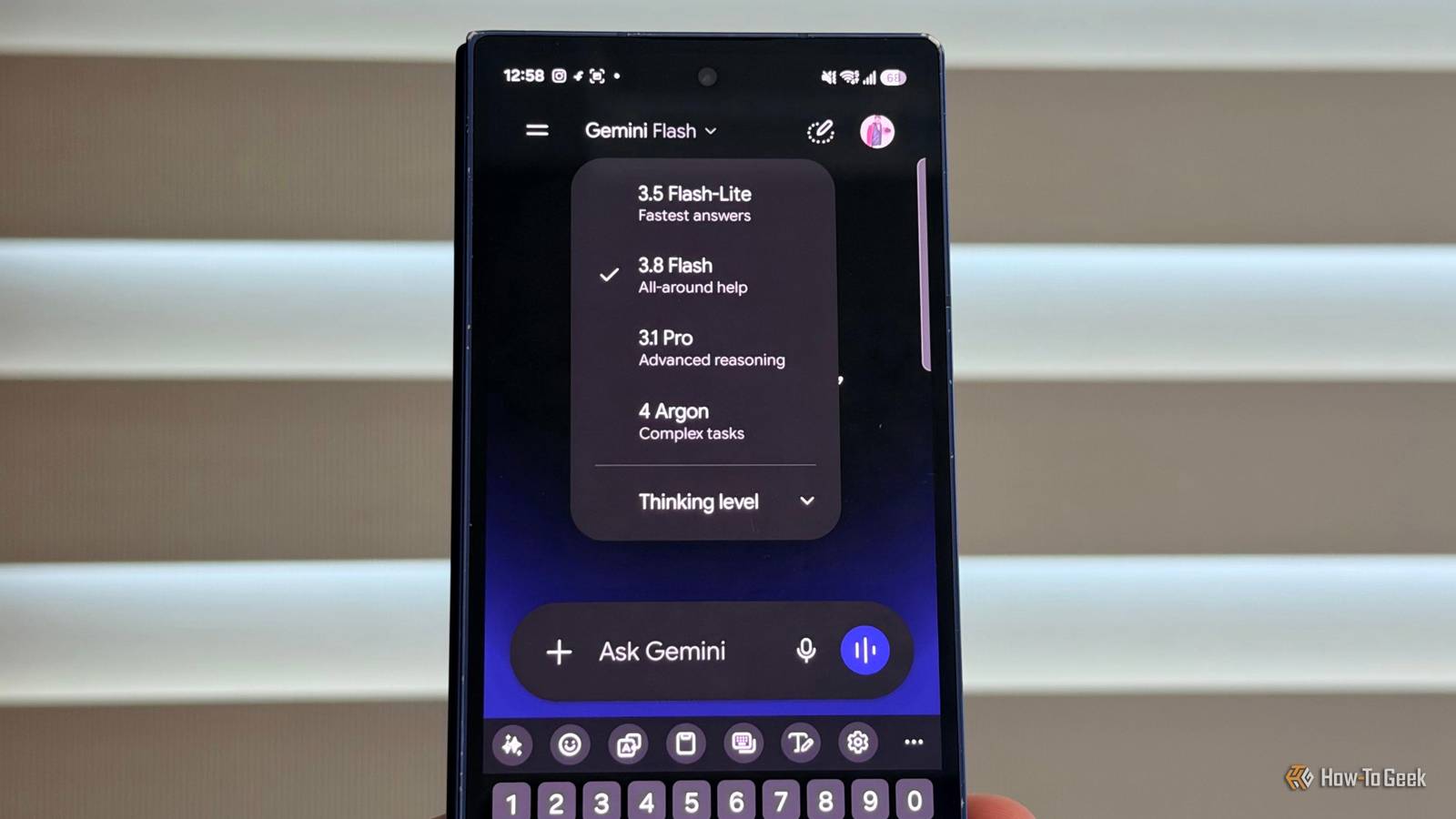
Published Nov 7, 2026, 10:30 AM EST A Computer Engineer turned tech-savvy. Sanya is part of the How to Geek team, and she covers Android, Samsung, Google, apps, and everyday technology, combining hands-on experience with thorough research. She helps readers understand technology without getting lost in technical jargon. I get comfortable with things a little too easily. Once I find something that works for me, I rarely feel the need to try something new. Google isn’t making that any easier with Gemini, though. It keeps introducing new models, each promising to be better at something, and I’m starting to lose track of which one I should be using. Its latest addition, Gemini 4 Argon, is also Google’s most capable model yet. That got me curious enough to revisit the entire lineup. I decided to try four models, see what each brings to the table, and find out whether Argon 4 can finally convince me to change my usual Gemini pick. Gemini 3.5 Flash-Lite I don’t need deep thinking for everything Gemini 3.5 Flash-Lite I don't want a lengthy answer or complicated reasoning from Gemini every time I search. My usual prompts are to fix an awkward sentence or turn messy notes into something readable. And sometimes I shorten my email. That’s where Gemini 3.5 Flash-Lite comes in. It’s Google’s lightweight model, designed to prioritize speed and efficiency over advanced reasoning. I tried asking it to turn a few grocery items I had in mind into a simple shopping checklist, grouped by category, so I wouldn’t keep going back and forth between supermarket aisles. It handled the request without making things unnecessarily complicated. However, I wouldn’t turn to it for something that needs detailed planning or several connected decisions. Flash-Lite is useful when I want quick results without overthinking, like remembering what I need to pick up before heading out and inevitably forgetting one thing anyway. Gemini 3.8 Flash is my sweet spot I don’t need to keep switching models Gemini 3.8 Flash While Flash-Lite is handy for quick tasks, Gemini 3.8 Flash is the one I’d turn to when things get complicated. For my upcoming Finland trip, I have hotel check-in details, train timings, sightseeing spots, and activities to fit into a limited number of days. Instead of simply organizing these details into a checklist, I wanted Gemini to build a proper itinerary, arrange activities around my travel schedule, and make sure I wasn’t squeezing too much in one day. Flash is better suited to this kind of multistep request because it can work through several requirements together. I also like that I don’t have to break my requests into smaller questions. I can give it the bigger picture and let it work through the details. Whether I’m planning a trip, researching something, or comparing information, Flash offers a useful balance of speed and reasoning without needing Google’s most powerful model. Gemini 3.1 Pro It takes things up a notch Sometimes, I don’t just want Gemini to give me an answer; I want it to help me make sense of something complicated. Imagine me comparing several smartphones before an upgrade. I want to look beyond camera specs and battery capacity and understand which one makes more sense for my daily use, what compromises I’d be making, and whether the expensive option is actually worth it. Gemini 3.1 Pro is designed for this kind of deeper analysis. It focuses on advanced reasoning and handling complicated instructions where overlooking one small detail can change the outcome. I don’t need to compare phones or dig through complicated information every day, though. For most of my regular tasks, Gemini 3.8 Flash is still my go-to. I’d save Pro for those occasions when I need to slow down and look at something more closely. Gemini 4 Argon Google says it’s best, but is it? Gemini 4 Argon Gemini 4 Argon is Google’s most capable model, but after trying Flash-Lite, Flash, and Pro, I started wondering whether I actually needed something this powerful. Google built Argon for demanding tasks that require deeper reasoning, from complex coding projects and scientific problems to analyzing lengthy documents. Gemini 4 Argon is available only to Google AI Pro and Ultra subscribers, so it’s not exactly an option everyone can casually switch to. I also tried using it for my Finland trip planning. Argon is designed to handle this kind of multistep work, but Gemini 3.8 Flash had already given me a useful itinerary. I didn’t find enough reason to make the switch for a task I could already handle with Flash. Argon’s strengths make more sense when you’re working on complicated projects that need sustained analysis or several connected steps. Complex projects that need Argon’s advanced reasoning are never on my plate. Most of my Gemini tasks involve everyday research and planning, and Flash 3.8 handles those just fine. Argon is highly impressive, but I don’t see a reason to pay more for capabilities I rarely need. I think Argon would be perfect for my brother, who works as a data analyst. I tried them all, but went back to Flash AI is useful, but I sometimes worry about how easily we start depending on it for everything. It’s tempting to let Gemini make every decision, organize every plan, and find answers before I’ve even tried figuring things out myself. I don’t want to become so comfortable with AI that I stop using my own brain. After trying all four models, I’ve realized I don’t need the most powerful option sitting in front of me. I just need Gemini 3.8 Flash to help out without doing everything for me.
Out of all Google's Gemini models, this is the one I can't stop reaching for
Full Article
Original Source
Read the full article at Howtogeek →KhanList aggregates and links to publicly available news content. We do not host full articles from third-party sources. Always verify important information with original sources.