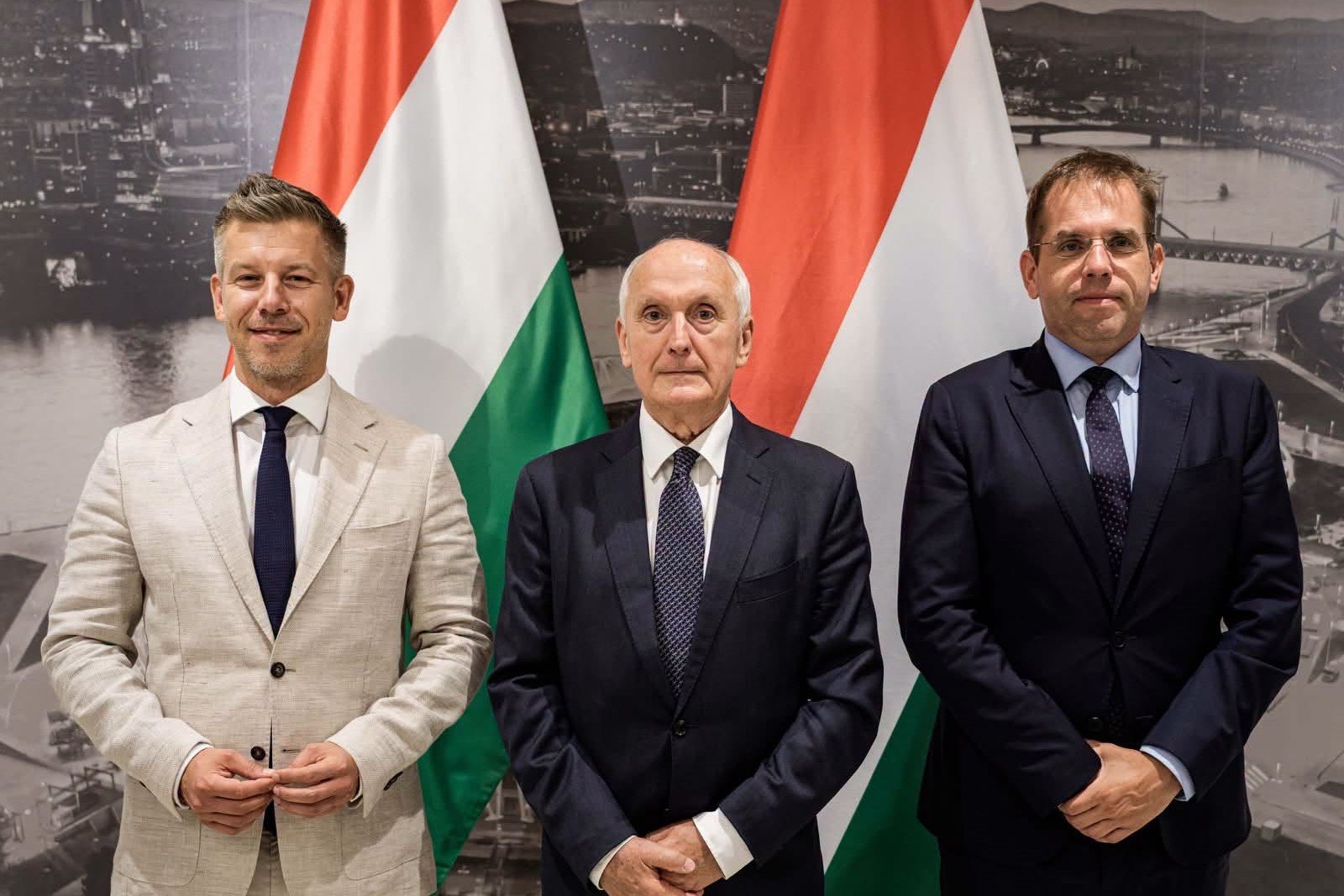
In a secret ballot on Tuesday (11 August), the Hungarian parliament elected András Baka, a legal scholar and former president of the Supreme Court, as the country’s president with the votes of 140 MPs, presumably from the Tisza parliamentary group. The opposition Fidesz and KDNP parliamentary groups did not take part in the vote, while the six MPs from the far-right Mi Hazánk party presumably voted against. Baka’s term will last until a new constitution is adopted, but for no more than five years. András Baka (1952), lawyer In 1978, he obtained a doctorate from the Faculty of Law at ELTE. Until 1990, he worked as a research fellow at the Institute for State and Legal Sciences of the Hungarian Academy of Sciences; from 1990 to 1998, he was director-general of the College of Public Administration. From 1990 to 1991, he briefly served as an MP as a member of the parliamentary group of the then-largest governing party, the centre-right conservative Hungarian Democratic Forum. He left parliament after being elected Hungary’s judge at the European Court of Human Rights (ECHR) in 1991. He held this post until 2008. In 2009, on the proposal of then-president László Sólyom and with the backing of Fidesz, then still in opposition, he was elected president of the Supreme Court. In 2011, three and a half years before his term was due to expire, the Fidesz government removed him from the leadership of the Supreme Court — subsequently renamed the Kúria — under the pretext of reforming the judicial system. Baka took the case to the ECHR, which found in 2016 that the Hungarian authorities had violated his right to freedom of expression and unlawfully removed him from office. After 2011, he continued to work at the Kúria as a judge. From Polgár to Baka The Tisza parliamentary group had nominated Baka for the post of president last Saturday, knowing he would be elected, given its two-thirds majority in the parliament. One of Tisza’s election promises was to remove senior constitutional office-holders politically appointed by Fidesz, including president Tamás Sulyok. Since Sulyok did not resign voluntarily, Tisza inserted an amendment into the constitution that ended his term. Sulyok ultimately signed the amendment, bringing his mandate to an end. The process of finding a president brought prime minister Péter Magyar’s first major political mistake. Magyar promised a public debate about who should be the new president, but instead quickly announced that he would ask the world-renowned chess player Judit Polgár to accept the post. Magyar’s announcement triggered a serious backlash within the Tisza camp. Some criticised the prime minister for the lack of consultation, while others argued that the president should be a lawyer. Polgár ultimately declined the offer and Magyar apologised. Since then, the selection of the president has proceeded more slowly and carefully. Magyar and minister Bálint Ruff, who heads the prime minister’s office, publicly reported on three meetings. They met lawyer Botond Fülöp, who played a major role in Fidesz’s downfall and in launching Magyar’s political career by exposing a peadophile-pardon scandal, which led to the resignations of president Katalin Novák and justice minister Judit Varga, who is Magyar’s ex-wife. Tisza also met historian Ignác Romsics and Baka. One of the most important questions surrounding the election of a president was whether it would choose a president who would not automatically sign everything — thereby making the government’s own work more difficult, while meeting voters’ expectations — or find a candidate who could both support the change of regime and act as a counterweight to the government. There may also have been another consideration: ensuring that Hungary had a president who would not become Magyar’s rival, either in politics or on social media. András Baka (second from right) at a parliamentary session before his election as president. Source: Screenshot from the parliament’s live broadcast By electing Baka, Tisza chose the more difficult route from a purely power-political perspective. Based on his career to date, the new president would certainly not sign just anything without objection, even though he has made no secret of his satisfaction at Tisza’s victory and his agreement with the aims of the change of regime. At the same time, Magyar need not fear that the president will become more popular than him or overshadow him. According to Dániel Róna, director of the 21 Kutatóközpont research centre, for example, parliamentary speaker Ágnes Forsthoffer would have been a far more popular president.
Ousted by Orbán, back with a vengeance: Hungary’s president András Baka to restore rule of law
Full Article
Original Source
Read the full article at Euobserver →KhanList aggregates and links to publicly available news content. We do not host full articles from third-party sources. Always verify important information with original sources.