
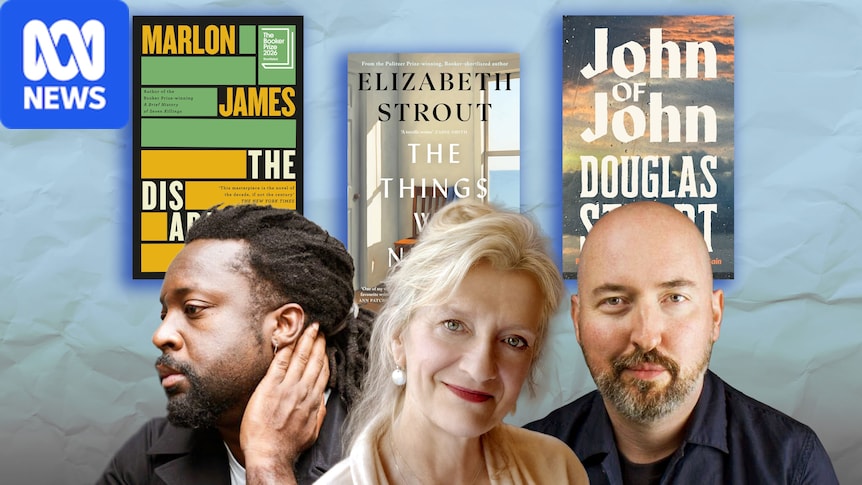
For an author of literary fiction, having a novel shortlisted for the Booker Prize is career-changing.The result is a frenzy of international attention, endless interview requests, invitations to writers' festivals the world over, and, crucially, a boost to book sales.Last year, the award went to Hungarian-British author David Szalay for his novel Flesh, a darkly humorous story described by the judges as "hypnotically tense and compelling … an astonishingly moving portrait of a man's life".In 2026, classicist Mary Beard leads a judging panel featuring poet Raymond Antrobus; musician Jarvis Cocker; editor and critic Rebecca Liu; and Booker Prize-shortlisted novelist and essayist Patricia Lockwood. After reading 163 books in seven months, the judges have settled on a shortlist of six novels.This year's half dozen features books by two past winners: The Disappearers by Jamaican author Marlon James, whose A Brief History of Seven Killings won in 2015, and John of John by Scottish wordsmith Douglas Stuart, whose moving debut novel, Shuggie Bain, took out the prize in 2020.Another strong contender is The Things We Never Say by literary powerhouse Elizabeth Strout, previously shortlisted in 2022 for Oh William! Strout won the Pulitzer Prize for Fiction for her novel Olive Kitteridge in 2009, before eligibility for the Booker Prize opened up to US authors in 2014.Of the first-time nominees, two are poets: Luke Kennard, shortlisted for Black Bag, and Rebecca Perry, shortlisted for her debut novel, May We Feed the King.An outside chance, but no less worthy for it, is The End of Everything by M John Harrison, a storied sci-fi and fantasy author representing genre fiction on the shortlist."I knew I wanted to write historical fiction somewhat outside of the genre," shortlisted author Rebecca Perry told The Booker Prizes. (Supplied: Robin Christian)Cutting down a longlist of 13 titles to just six results in tough decisions.Fans of Emma Cline's buzzy novel Switzy, about a man with dementia travelling to Zurich to access assisted dying, can feel justified in their disappointment at its omission from the list.Many, too, were surprised to see Gwendoline Riley, a recipient of the Windham-Campbell Prize in 2026, miss out on a call-up for her novel The Palm House.Together with the reading public, the authors of the six books to make this year's shortlist will find out who will take home the £50,000 ($95,000) prize in a ceremony in London on November 9 (November 10 in Australia).To take a closer look at the list, we've enlisted a team of critics to review the six shortlisted titles.The End of Everything by M John HarrisonThe Disappearers by Marlon JamesBlack Bag by Luke KennardMay We Feed the King by Rebecca PerryThe Things We Never Say by Elizabeth StroutJohn of John by Douglas StuartThe End of Everything by M John HarrisonSerpent's TailM John Harrison is known for his Viriconium series and the Kefahuchi Tract trilogy, which included the Arthur C Clarke Award-winning Nova Swing. (Supplied: Allen & Unwin)Phillip Tennent is a beachcomber who makes his living picking scraps from the shoreline of the English Channel. One day, the sea coughs up an "artefact" that strikes him as valuable; his "ticket out" of this marginal existence.He takes it — a baby-sized bundle, wrapped in rags — to his aunt Marnie's house in a once thriving arts community known as the Strip. Her house overlooks the wreckage of an airliner, from which she can see attack helicopters flying among plumes of smoke to the north.South-eastern England has been occupied by the iGhetti, an amorphous enemy that seemed to descend upon, or erupt from, the Square Mile, London's financial centre. Decades on from the invasion, everything is degraded; the landscape strewn with litter and the government no longer functioning. Refugees queue at ports seeking escape by boat. With no notion of what might await them, it is a "passage to nowhere", but it's a risk they are willing to take.Much in The End of Everything pushes the boundaries of comprehension. A grotesque act of violence early on, one of several similarly shocking episodes, signals that something is deeply awry in the world.Unsettling imagery only entrenches the sense of unease. Children play in a snow flurry that turns out to be falling ash, "feathery as the waste from a chicken factory". But there are glimpses of beauty among the junk and debris in M John Harrison's arresting descriptions of the coastal terrain: the mudbanks, estuaries and chalky soil.Meanwhile, the artefact, one of innumerable "biological gadgets" discarded by the iGhetti, becomes more humanoid as it hovers close to Phillip and Marnie like a faithful dog.Surreal and satirical, The End of Everything reads like a hallucinatory elegy. As one character observes: "The world's over. But that doesn't matter. Because another one will be along soon enough."— Nicola HeathThe Disappearers by Marlon JamesHamish HamiltonThe Disappearers is "a gasp-inducing work of fiction", Kate Evans told ABC Radio National's The Bookshelf. (Supplied: Penguin Books Australia)Certain ways of writing about violence are described as unflinching: the crunch of bone and blood spattered across the page. But The Disappearers, Marlon James's sixth novel, is, instead, all about the flinch.It takes aim at homophobia and Jamaica, and encompasses many other things too: the erotic, explicit, harsh, intimate and painful.The Disappearers begins in 1988 in Kingston, as a group of gay men gather to rehearse a queer play. They argue and tell stories as they begin to know each other, always understanding what they're hoping to do is risky. Performing and appearing as gay men, telling gay stories, is in itself dangerous. Even so, they have no idea what's coming for them.As the novel opens, the youngest of the group tells the story. But one day he skips a rehearsal — and misses something truly terrible.A ravening mob attacks the men in homophobic glee. The violence is told from the perspective of the perpetrators, the Blackjacks, and while some of them are appalled at what they're a part of, none of them stop. One man is killed; what's done to the others is unspeakable, but James doesn't so much speak as yell it in a fury; others disappear.The rest of this book is about the aftermath. Not just scars, but haunted stories and lives, and terrible silences. Some of the mob members were policemen; another was a well-known singer. The shape and quality of the cover-up, the blaming of the victims, goes on for years.This is a powerful and difficult book, whose narrators and perspectives shift with bloody and bruised agility. It's poetry of the worst kind, for the worst reason. And because of that, you really can't look away.— Kate EvansBlack Bag by Luke KennardJohn MurrayLuke Kennard is an award-winning poet who teaches creative writing at the University of Birmingham. (Supplied: Hachette Australia)Imagine if Bridget Jones's Diary was narrated by a middle-aged male slob and you'd have something like Luke Kennard's second novel, Black Bag. Sure, Bridget Jones for men already exists — it's called Nick Hornby — but Kennard, whose poetry collections and 2017 debut novel established him as an author with a fondness for wry self-awareness, fashions satirical oddity from middle-class disaffection.A 37-year-old mostly unemployed actor longs for Ibsen and Chekhov but resigns himself to dinner party murder mystery roles. One day, he gets the part he may have been born for: a black leather bag.Our actor is enlisted by a local university professor to attend lectures encased head-to-groin in the bag. He is instructed to neither speak nor gesture during the lectures. The actor grows fond of his role, putting on the bag and going about daily life.His rise-and-grind flatmate thinks it's time to monetise. BagFans? MyBag? Bagcoin?! Meanwhile, post-humanism professor Justine wants to sleep with him, but only while he is bagged up. (She imagines eros as a kind of erasure; goodbye gender binary, hello orgasm!)Inspired partly by the real-life 60s experiments of Charles Goetzinger, themselves designed to explore how people adapt to change and relate to things through exposure — even the presence of a person draped head to toe in a bag — Black Bag recalls Japanese author Kobo Abe's 1973 novel Hako Otoko (literally, Box Man) in which a man decides to live every day with a box over his head in order to learn who he truly is (with squeamishly disastrous results).Kennard's novel is more comic and less broodingly cerebral than Abe's, but it shares Abe's concern with the ultimate existential question: what actually makes you, you?— Declan FryMay We Feed the King by Rebecca PerryGrantaRebecca Perry is the author of two poetry collections, Beauty/Beauty and Stone Fruit, and a non-fiction work, On Trampolining. (Supplied: Allen & Unwin)In May We Feed the King, British poet Rebecca Perry's debut novel, a curator receives a commission to create an installation commemorating the 750-year anniversary of a former royal palace. The curator's job, as they see it, is to not only give the viewer a sense of what life was like in a period of history, but to communicate something specific about the person who once lived in the room.In Part I, the curator documents the project as it unfolds, explaining the nature of the work, much of it related to replica food, and their process. The tone is matter of fact and attuned to detail; little is shared of the curator's personal life save for allusions to a traumatic relationship break-up.On day five, a "scant entry" in the palace ledger captures the curator's interest: a single page dedicated to a king's reign. The record gives "no sense of the man" and in this absence of "colour or context" — or perhaps because of it — the curator becomes fixated with this shadowy figure, who they soon think of as "my King".Part I ends as the curator enters the King's chambers "like thread through the eye of a needle". On the other side is Part II, a vivid and sympathetic re-imagining of the King's life as he resided in the palace. From a brief historical record blooms "a whole world" as Perry animates characters and scenes long lost to history in meticulous and poetic detail.In Part III, set once again in the present, Perry considers the question of what we can know of history: what the records can tell us of the past and what is lost to time. "There are no answers," the curator says. As Perry so expertly shows, what brings history to life is imagination.— Nicola HeathThe Things We Never Say by Elizabeth StroutViking FictionElizabeth Strout is known for writing books featuring recurring characters, including Olive Kitteridge and Lucy Barton. (Supplied: Penguin Books Australia)If Elizabeth Strout's previous works sting like a paper cut, The Things We Never Say punctures like a hypodermic needle administered by an expert hand, a smooth glide of pain and remedy in one.The story follows a well-intentioned but existentially angsty 57-year-old teacher, Artie Dam, living a comfortable life in coastal Massachusetts. Despite all the outward markers of middle-class status, Artie feels isolated from his wife and adult son, which may or may not be the result of a decade-old car accident.On top of that, his best friend moved away, leaving him with plenty of time to spin out with rage and grief, fluctuating between memories of his traumatic childhood and the hostile realities of America under Trump.In one way, The Things We Never Say feels essentially Strout, scratching at the psyches of repressed older white folks living in small towns. In another way, it feels like an instrument for railing against a world that's lost its way. Some scenes feel a little heavy-handed, but for the most part, it's a compelling rallying cry for decency.A word of warning: The Things We Never Say is not a book to read if you're feeling tender. Or perhaps it's a wonderful book to read if you're feeling tender and want to stay submerged in that state.— Bhakthi PuvanenthiranJohn of John by Douglas StuartPicadorDouglas Stuart could become the fifth author to win the Booker twice, following in the footsteps of Peter Carey. (Supplied: Pan Macmillan Australia)Scottish American author Douglas Stuart's third novel, John of John, is a book about fathers and sons, and the secrets they keep from each other and themselves. As John of John opens, John-Calum, aka Cal, is a heavily indebted art school graduate, exploring his sexuality and couch-surfing in Edinburgh as the UK crawls out of recession in the 90s. He's called by his father, John, to return home to an isolated island in the Outer Hebrides, to care for his ailing maternal grandmother, Ella.On the island, Cal is confronted by the life he left behind, the school friends struggling in jobs soon to be made obsolete by globalisation, on an island where everyone knows each other's business. He's also met with his father's barely contained feelings of injustice and "quiet, loch-deep rage". John is pious and ruled by a sense of obligation to tradition, whether in religion or weaving, which drives him to repress his desire for his neighbour and best friend Innes.He feels abandoned by Cal and resents the "life that he had tied himself to", living and working at his mother-in-law Ella's croft, even though Cal's mother, Grace, left when Cal was a boy. He takes it out on Ella by speaking Gaelic, a language he knows she doesn't understand. Stuart's vivid and moving prose, laden with cultural references and wry humour, brings to life the brutality, and unexpected comforts, of the island and the people on it, as both Cal and John reckon with what has kept them stuck for so many years. — Hannah Story
Our critics review the six books vying for the $95,000 Booker Prize
Full Article
Original Source
Read the full article at Abc →KhanList aggregates and links to publicly available news content. We do not host full articles from third-party sources. Always verify important information with original sources.