
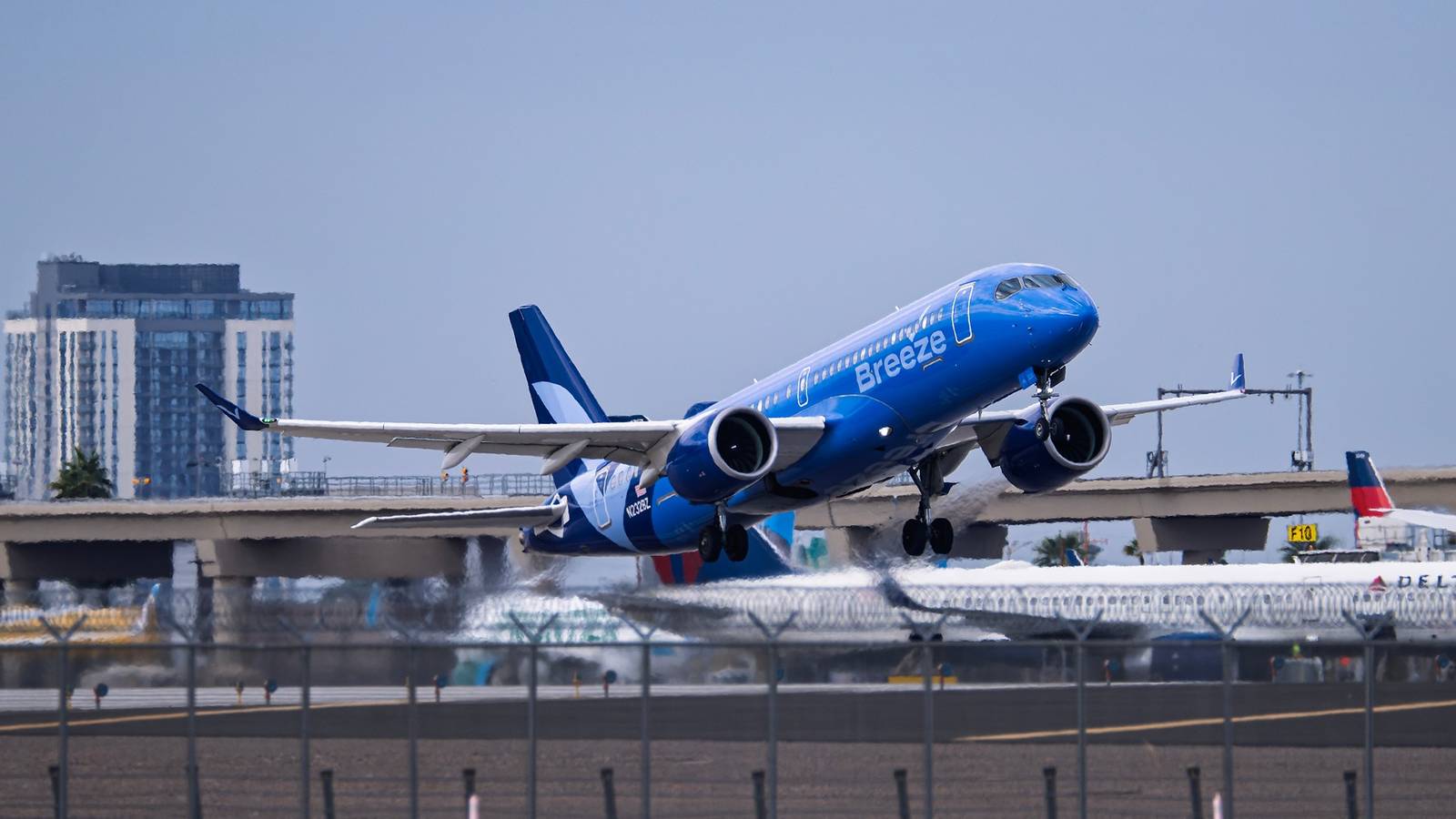
Credit: Robin Guess | Shutterstock Published Nov 26, 2026, 3:22 PM EST Journalist – Aaron is an aviation and travel journalist with 14 years of experience in the travel and tourism industry. His background spans airport operations, aviation infrastructure, and travel consulting, having worked with global organizations across New Zealand, Europe, and North America. Combining industry expertise with firsthand travel experience across more than 52 countries and five continents, Aaron covers airlines, airports, aviation policy, and the wider travel sector. He is based in Canterbury, New Zealand. His work has been published in Simple Flying and featured by MSN, SAM CHUI Aviation & Travel, EIN News, Pakistan Defence, and Climate Depot. Sign in to your Simple Flying account Utah-based Breeze Airways has carved out a niche for nonstop flights in secondary markets across the US. The low-cost carrier offers a unique point-to-point market on underserved domestic routes and operates a fleet of modern Airbus A220-300s. Reviewing data from the Bureau of Transportation Statistics (BTS) suggests that a number of its routes are flying below the 'sweet spot' of 80% load factor. This is a target most airlines set to ensure that all operational costs are covered and that the route turns a profit. Overall, the average Breeze load factor sits at 77.9%. Comparing The Lowest And Highest Load Factor Routes At Breeze Airways Credit: Robin Guess | Shutterstock Despite Breeze's rapid expansion across the US since the airline's launch in 2021, the airline's primary focus has been connecting secondary cities with nonstop flights. Reviewing the data from BTS, it suggests the airline's poorest performing routes flew with an average of less than 46% during the period of January to August 2026. Credit: GCMap These low numbers are the polar opposite to the airline's fullest routes, which average more than 91% load factor, with the most popular route for the airline being that of Atlantic City (ACY) to Orlando (MCO), achieving a 93.8% average load factor. As a comparison, the poorest performing route was between Orange County (SNA) and Montrose (MTJ), which averaged load factors of just 22.4%, which forced the carrier to suspend the service in April of this year. From To Average Load Factor (Between January and August 2026) Notes Orange County (SNA) Montrose (MTJ) 22.4% Ended in April 2026 Atlantic City (ACY) Orlando (MCO) 93.8% Served year-round Breeze Airways Poorest Performing Routes Credit: Robin Guess | Shutterstock With Orange County and Montrose having the poorest load factors, which led to the route being suspended, a number of other routes in the Breeze network are still performing with low patronage, questioning whether the airline may reconsider these routes. Simple Flying reached out to Breeze for comment on the below routes' load factors; however, an airline spokesperson could not immediately be reached. For Breeze, its second-worst-performing route is between Charleston (CHS) in South Carolina and Richmond (RIC) in Virginia. The route continues to operate, despite a load factor averaging 38.5%. This is followed by Louisville (SDF) and Pittsburgh (PIT), which began in April and have only been able to achieve a 42.8% load factor. This route is expected to end in January. Flights from Washington Dulles (IAD) nonstop to Ogdensburg (OGS) in upstate New York are another route that was forced to end due to load factors, with Breeze operating at just 45.6%. Full details of the airline's poorest-performing routes are in the table below: From To Average Load Factor (Between January and August 2026) Notes Charleston (CHS) Richmond (RIC) 38.5% Continues to operate Pittsburgh (PIT) Louisville (SDF) 42.8% Began in April, will end January 2027 Washington Dulles (IAD) Ogdensburg (OGS) 45.6% Ended in September Cancun (CUN) Providence (PVD) 49.8% Ended in April Fort Lauderdale (FLL) Salisbury (SBY) 50.4% Launched in July Charleston (CHS) Cancun (CUN) 51.8% Began in January, seasonal pause from September to December) Washington Dulles (IAD) Tri-Cities (TRI) 51.8% Began in December last year; ends this November. Raleigh (RDU) Tallahassee (TLH) 52.2% Launched in July Washington Dulles (IAD) South Bend (SBN) 52.5% Continues to operate Airlines will typically aim for an 80% passenger load factor, to cover high fixed costs and historically thin profit margins. Aiming for 80% helps cover the operating costs and turns the flight profitable. This can fluctuate between airlines, but this is the industry benchmark. Breeze Airways' Most Popular Routes By Load Factor Credit: Markus Mainka | Shutterstock After Atlantic City to Orlando remains the airline's most popular route by load factor, the carrier's transcontinental services continue to pull high patronage. The airline's second most popular route is that of Norfolk (ORF) to San Diego (SAN), which during the period of January to August of this year recorded a 93% load factor. Los Angeles (LAX) to Richmond is another popular link, which during the same period achieved 92.3% load factor. Los Angeles to Norfolk followed with 92.2%, and Los Angeles to Jacksonville (JAX) reached 91.7%. Full details below, excluding Atlantic City to Orlando as already outlined in the first table. From To Average Load Factor (Between January and August 2026) Norfolk (ORF) San Diego (SAN) 93% Los Angeles (LAX) Richmond (RIC) 92.3% Los Angeles (LAX) Norfolk (ORF) 92.2% Los Angeles (LAX) Jacksonville (JAX) 91.7% Charleston (CHS) Myrtle Beach (MYR) 91% This outlines that the transcontinental services offered by Breeze are a good money maker, with many of the top routes reaching coast to coast. This comes as more travelers look to avoid legacy hub connections and opt for nonstop services to and from secondary airports.
Only 22% Full: Breeze Airways' 11 Emptiest Routes Revealed
Full Article
Original Source
Read the full article at Simpleflying →KhanList aggregates and links to publicly available news content. We do not host full articles from third-party sources. Always verify important information with original sources.