
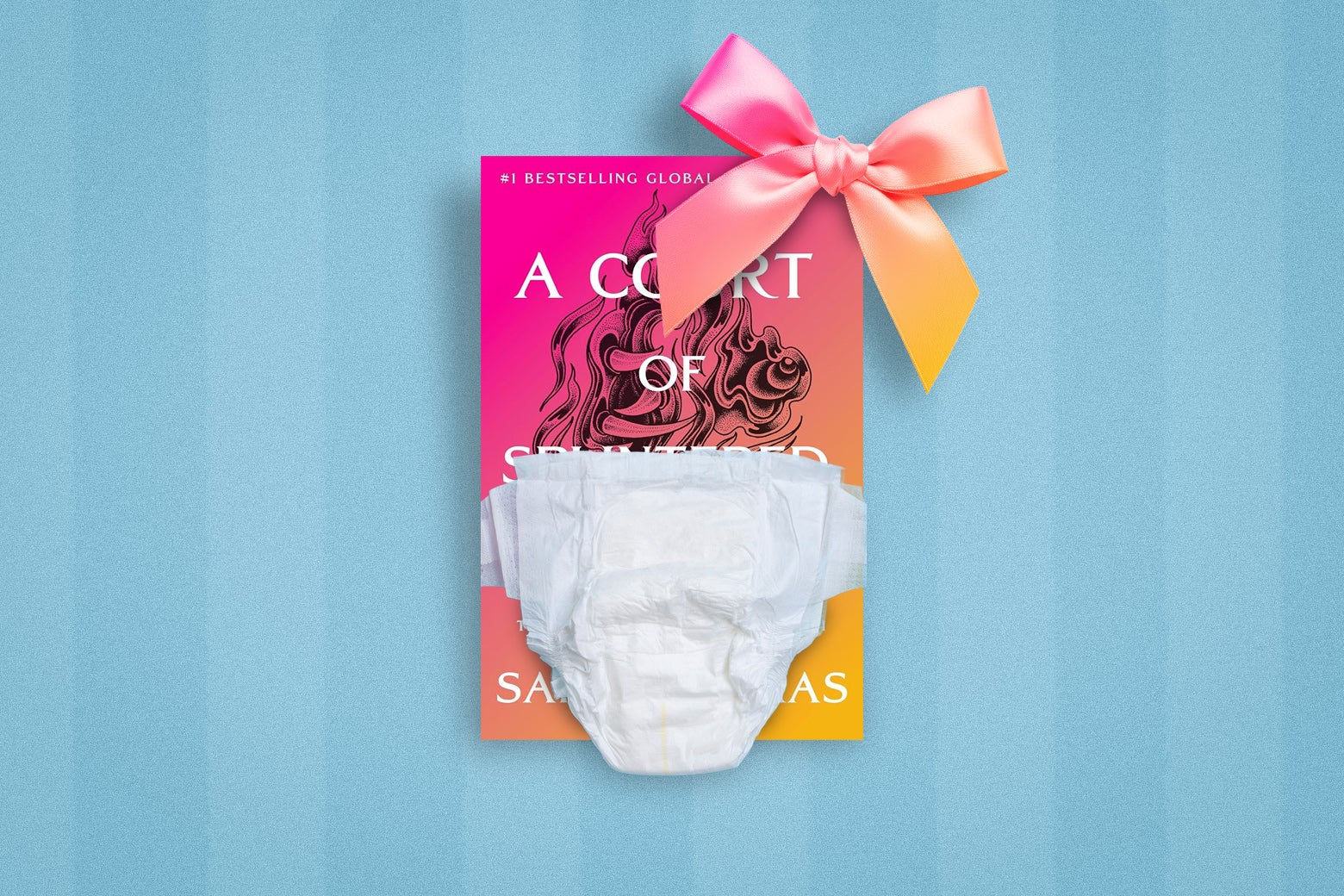
Books Do Babies Belong in Romantasy? The latest ACOTAR book is putting that question to the test, to some readers’ displeasure. By Enter your email to receive alerts for this author. Sign in or create an account to better manage your email preferences. Unsubscribe from email alerts Are you sure you want to unsubscribe from email alerts for Rebecca Onion? Nov 07, 20265:50 AM Photo illustration by Slate. Photos by Amazon and Getty Images Plus. Sign up for the Slatest to get the most insightful analysis, criticism, and advice out there, delivered to your inbox daily. It’s too hard to explain what happens in A Court of Thorns and Roses (ACOTAR), one of the most popular book series in publishing these days, to people who haven’t read it. In these romantasy novels, written by Sarah J. Maas, there is politics, there is history, and there are many, many rules about magical objects, the possession of which will change the course of events. And everyone has a funny name that’s a little bit hard to remember. (Maas, unlike A Song of Ice and Fire’s George R.R. Martin, never seems to run out of steam and just name someone “Catelyn.”) But there’s one part of the series’ sixth and most recent installment, A Court of Splintered Harmony, that feels, controversially, all too realistic: Protagonist Feyre Archeron—a former human turned fae married to Rhysand, High Lord of the magical territory called the Night Court—has a 6-month-old infant, whom she adores with a powerful love. And Feyre, to some readers’ vocal displeasure, has very human mother-of-a-baby problems, even if that baby is anything but. We first realize what we’re in for when Feyre, in one of the new book’s first-person chapters, explains that she has gotten her gowns outfitted with the equivalent of nursing pads. When her baby, Nyx, was a month old, she explains, she’d gone in her capacity as the “High Lady” of the Night Court to deliver what she describes as a “get in line or there will be hell to pay speech” at another court, and “breast milk began darkening the front” of her gown, “somewhat lessening” the effect. Yes, she’s having trouble balancing her duties with motherhood: “Nyx needed to eat every few hours. Sometimes every hour, depending on the day.” Feyre loves to feed Nyx, and we get many scenes illustrating it: In a third-person chapter, we see Feyre hook a finger in his mouth to unlatch; in another first-person chapter, Feyre reflects that the “rush of milk letting down” is a “tangible release I felt through my body.” Maas writes Nyx falling asleep nursing, in the condition some call “milk-drunk.” Feyre brings bottles along if she needs to “hand-express” while she’s away from the baby. And the breastfeeding follows the couple into the bedroom: Rhys, who has spent most of the previous books extremely randy for Feyre, seems to get turned on by his wife breastfeeding, following her into the bedroom after she nurses Nyx and “growling” that he wants to lick her breasts. (He’s in a romance novel. Of course he growls.) All of this baby stuff is annoying certain ACOTAR fans who’ve already found quite a lot in this installment of Maas’ blockbuster series to irk them. Why, they wonder, if we’re escaping to a magical realm, does following Feyre’s life feel so much like we’re watching Instagram Reels made by a bog-standard mom influencer? “Wealthy 2026 American baby” things Nyx is spoiled with include a nanny, a nursery “bedecked in variations of cream and sand” (apparently the “sad beige” trend has reached the fae realm of Prythian) and furnished with a black cradle and a blue armchair, a crib with nothing in it because the parents have been advised to keep it bare to avoid suffocation, and, yes, tummy time. In one scene I absolutely hated, Nyx has a diaper blowout while sitting on his father’s lap. Feyre describes it as “a horrific, bubbling splat” that leaves a “giant, reeking wet patch” on Rhys’ pants. Rhys, a dream of a man, simply changes the diaper: “I bet that felt good to get out,” he says to Nyx. Reading scenes like this, you can sort of understand why some fans feel the way they do: People have spent years reading these books to enjoy time in a fantasy realm, not to be brought back to smellier realities. Feyre’s motherhood was also a late-series addition to ACOTAR—though she was only 21, a veritable baby in fae years, when she got pregnant—so Day 1 readers might not have expected this sort of turn to come later on. Hardcore fans may know that Maas is drawing from her own experience—the author, who has two youngish kids, has said on the Call Her Daddy podcast that she “hated being pregnant” and was traumatized by an emergency C-section during the delivery of her first baby—in writing Feyre’s motherhood arc, particularly the part where Feyre almost dies giving birth to Nyx because the baby has wings. But that doesn’t mean they want to read it the way she’s written it. “Why would you create a world and still include SIDS?” asked someone in the “annoyed fan” camp on Threads. “Talking about keeping Nyx on a nap schedule took me outttt like why is this necessary,” someone else replied. There’s a case to be made that in writing Feyre’s maternal arc so realistically, Maas phoned it in. We get at least one glimpse of what it would look like to conjure up a magic-assisted style of parenting: Instead of needing a baby monitor, Feyre and Rhys use their “daemati skills” (they have a type of fae telepathy … don’t think too hard about it) to listen in on what’s going on in the nursery. This choice shows that Maas could have let her imagination fly a bit more when it comes to the biology and culture of fae/Illyrian infancy. Why create a world where people are constantly dying and coming back to life, and not an enchanted diaper that vanishes baby poop—or an enchanted microbe you can feed your baby so its poop comes out smelling like lavender? Think big, Sarah J. Maas! I get the objections, I really do. But, disgusting blowout aside, I have to say I liked the baby stuff in Splintered Harmony. The books need a bit of recognizable biology to ground them, lest we get too bogged down in other stuff. See: the sex in the ACOTAR series, “wing play” aside, which has always been just the same as human sex (if more athletic and terrifyingly epic), and which always feels like a huge relief to encounter after wading through pages and pages of politicking and allegiance-making. Plus, maybe more romance novels should have real, living babies in them—and not just in the epilogue. I find it a welcome change from the genre’s most common plot, in which a 20-year-old girl (who’s usually, improbably, a virgin) goes about meeting a 27-year-old (or 500-year-old, sometimes) man, having hot sex, and getting married. Parenthood can be a trial, but it can also change a couple’s love, setting them apart from one another and bringing them back together, in infinities of interesting ways. There’s plot gold in them hills, even if Maas hasn’t quite yet managed to mine it for all it’s worth. Books Motherhood Parenting Romance Fantasy
One of the Biggest Books of the Year Has Proved Polarizing for an Unexpected Reason. I Have to Defend It.
Full Article
Original Source
Read the full article at Slate →KhanList aggregates and links to publicly available news content. We do not host full articles from third-party sources. Always verify important information with original sources.