
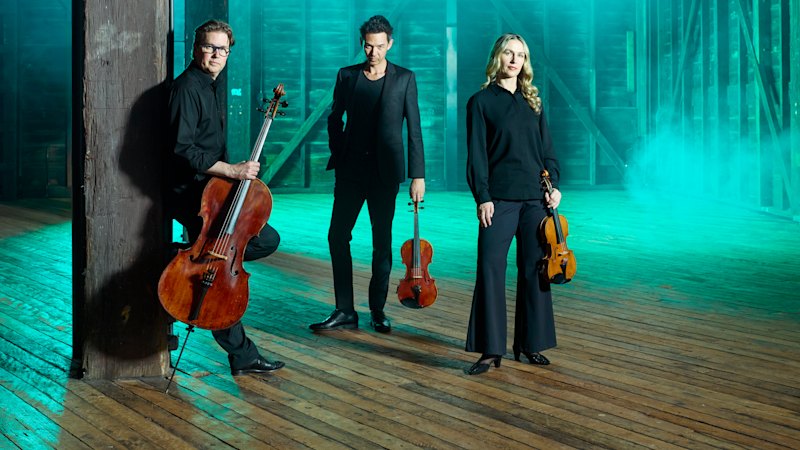
November 22, 2026 — 7:00pmThe promotional photography for Omega Ensemble’s one-night-only program drips with rock-star cool: brooding good looks, all-black attire, and violins and a cello slung low against an industrial backdrop bathed in a late-night green glow.Next year, the ensemble will collaborate with Nico Muhly, the award-winning American composer currently bringing David Hockney’s artworks to life at Sydney’s Carriageworks, where he has also signed on for a three-year residency.Omega Ensemble’s Future Pulse players, from left, Paul Stender, Neil Thompson and Emma McGrath.Keith SaundersLast week, Omega collected an ARIA for best classical album for its collaboration with didgeridoo virtuoso William Barton, joining a winners’ circle that included Tame Impala. Muhly has worked with Beyoncé and Björk and contributed to the 2018 re-recording of David Bowie’s Never Let Me Down; Omega is hoping some of that pop-culture lustre rubs off on its 2027 season.Framed around the theme of Risk and Radiance, the program reflects a deliberate repositioning across Australia’s fine music sector: embracing international collaborations and nurturing young composers, while building financial independence in an era of tightening public funds.The past two years have been a period of struggle, introspection and, at times, hibernation for chamber outfits nationwide. Few admit it publicly, yet many have reduced performance schedules and conserved limited government funding while courting philanthropists. The June collapse of The Song Company, Australia’s premier vocal ensemble, chilled the sector.Last year, Musica Viva Australia stepped back from managing the Melbourne International Chamber Music Competition after Creative Victoria pulled funding, and doubled down on its Strike A Chord program for school students.US composer Nico Muhly will be collaborating with ARIA Award-winning Omega Ensemble next year. James BrickwoodHistorically known as the “music of friends,” chamber music dates back to the 18th-century court of Hungarian Prince Nikolaus Esterházy, where Joseph Haydn composed intimate works for four to six musicians in private salons. Today, while the Australian Haydn Ensemble showcases giants such as Haydn, Mozart, and Brahms for a new generation, others are creating experimental arrangements in contemporary music.For Muhly, stepping outside the traditional concert hall is common sense.“I’m 45 years old,” he says. “At a certain point in my early 20s, I realised that you’re not just going to turn into a composer who gets performed by all these big organisations.“I just started saying yes to doing everything. All my friends are in rock bands or make electronic music, and it wasn’t like I was trying to blur lines between things. I more just exist as a citizen in the world as it is, rather than some theoretical, Esterházy-funded 18th-century operation.”The Australian String Quartet performs at the Melbourne Recital Centre.Laura ManaritiMuhly sees Australia as a hothouse for adventurous work unburdened by European or American traditions, and dismisses perennial hand-wringing over classical music’s survival.“I’m seeing a lot more young faces in contemporary concerts than in meat-and-potatoes classical concerts,” he says. “People have been freaking out about this since the beginning of time – ‘The audience is dying!’ – but the audience is changing, we’re all changing. The reason people lose their minds if you stage Mozart in a shopping centre is because they love Mozart so much they’re willing to behave like crazy people to defend something they genuinely value.”Pushing boundariesEnsemble Offspring specialises in the avant-garde and music of composers written in their lifetimes, having long ago ditched concert black for vibrant colour. Percussionist Claire Edwardes founded the ensemble in 1995, two years before graduating from the Sydney Conservatorium and was recognised this week by the University of Sydney for her cultural contribution.“We try and present new music by living composers, and that can be overwhelming to audiences because they’ve never heard of the composer or don’t know the music, so we try for a friendly kind of feel,” says Edwardes, whose ensemble performs in private homes, warehouses and pubs.“We never wear black and white. I find it too formal and connected to that western orchestral tradition, which is presented as highbrow. Our music is not for everyone, but it resonates with the curious as culture that is not standing still, as culture that is moving forward.”Claire Edwardes, artistic director of Ensemble Offspring.Jordan AdamsTheir April concert at the ACO, Pure Bliss, is pitched for “maximum sensory expansion” and sonic mischief and “perpetual state of unseriousness”.Boundaries between music genres – and even art forms – are crumbling for younger performers and audiences, says Musica Viva’s artistic director Paul Kildea.That’s reflected in Musica Viva’s national tour and Opera Australia collaboration A Winter’s Journey, which reimagined Schubert with video projections by David Bergman (The Picture of Dorian Gray) and the painterly landscapes of Fred Williams. Its 2027 program pairs international stars like the Choir of King’s College, Cambridge and multi-instrumentalist William Barton.“I still love a piano recital, I still love hearing repertory and appreciating it, but the barriers are disappearing or, let’s say, they are blurred for a young generation of performers and audiences and that’s where there is huge opportunity,” Kildea says.“They want an experience rather than a recital and recitation. All the hierarchies and expectations in place for 150 years are being replaced. The contract between performer, composer, organiser and audiences is changing.”Pressing financial realitiesBehind the artistic evolution lie pressing financial realities and the search for philanthropists willing to nurture young musicians who might never otherwise experience fine music – such as Berliner Philharmoniker violinist Harry Ward, identified by Musica Viva’s FutureMakers mentoring program.Chamber ensembles sit outside the 39 major performing arts companies – such as state symphony orchestras – that receive guaranteed national funding. Those larger institutions carry heavy fixed costs, yet also capture much of the mainstream philanthropic dollar.“We’ve always had patrons, but we need them more now when the signal from inside government is to look more broadly as ministers are sent on the hunt for savings,” says Omega CEO Michael Napthali. “History shows artists need their patrons, be it Beethoven, Bach, or the next generation of Aussie composers we nurture with CoLAB.”Under Napthali, Omega has expanded into Melbourne, widened its donor network to include Kerr and Paris Neilson, David Gonski, Sam Meers, Fiona Menzies, and Jonathan Mills, and named ABC chair Kim Williams as patron of CoLAB.Omega has also introduced an independent ticketing system, a move recently adopted by Pinchgut Opera. By bypassing venue box offices that hold revenue until after performances, Omega retains higher margins, captures real-time audience data, and bridges the cash-flow gap needed to fund productions upfront. Musica Viva, meanwhile, now draws 29 per cent of its total income from donors.Across the sector, leaders are looking to perpetual endowments, a model borrowed from the US. “The US historically provides limited public support for the arts, preferring to tap well-endowed trusts and foundations for life-sustaining – and in many cases life-saving – support,” Napthali says. “This is a model which in my view offers great promise for Australia, which is lucky to possess its own proportion of wonderfully generous donors.”Arts leaders often point to that American culture of civic responsibility as the mindset needed here if private foundations are to offset shrinking public grants.“The lesson I learned years ago is not that US individuals give more; they get asked more. They get asked to be part of a dream.”Sheena Boughen, Australian String QuartetThe Adelaide-based Australian String Quartet has become the envy of the sector with its $15 million Future Fund, anchored by a $4 million lead gift from the Wright Burt Foundation.Designed as a perpetual endowment whose capital is never spent, the fund has already reached $4.725 million in gifts and pledges, closing in on its initial $5 million milestone to draw down up to 5 per cent annually in investment income.ASQ chair Sheena Boughen says the endowment is a game-changer for a 41-year-old organisation previously trapped in short-term grant cycles, with reserves lasting less than a year.“The lesson I learned years ago is not that US individuals give more; they get asked more. They get asked to be part of a dream. They get asked to be part of a vision, and they get asked to join a wild ride towards a better world for the future.”ARIA winners: William Barton, left, and David Rowden. Getty ImagesDespite chamber music’s unfair reputation for stuffiness, Boughen notes university conservatorium interest is thriving, with players drawn to the intimacy and autonomy of small ensembles – many crying tears of joy when they pass auditions.Unlike full orchestras, chamber ensembles are nimble enough to work in any generous acoustic space, though smaller audiences make breaking in even harder. Muhly notes that unconventional spaces – from London’s Bold Tendencies to Tasmania’s Mona and, in 2027, Future Pulse with Omega at Carriageworks – offer exciting possibilities. Writing a work for New York’s Metropolitan Opera, and Muhly has written two, requires a vastly different approach to writing for a “windowless basement room”.Some in the sector believe necessity is driving a modern Medici model, where patronage fuels artistic flowering. While Richard Tognetti’s Australian Chamber Orchestra – backed by instrument funds and learning endowments – remains the commercial benchmark, boutique ensembles often rely on a single CEO to juggle fundraising, governance and operations. At Ensemble Offspring, Edwardes leads from the stage while constantly cycling through grant applications.Encouraging philanthropy was central to reforms proposed at the September 2025 arts tax summit, including live production rebates. Unable to wait, Musica Viva held just its second-ever giving day, raising more than $677,000 for its In Schools program – its most successful fundraising effort yet. As Kildea says, the music is ready; the kids are just not in the room yet.From our partners
Once confined to princely courts, chamber music chases rock-star cred
Full Article
Original Source
Read the full article at Smh →KhanList aggregates and links to publicly available news content. We do not host full articles from third-party sources. Always verify important information with original sources.