
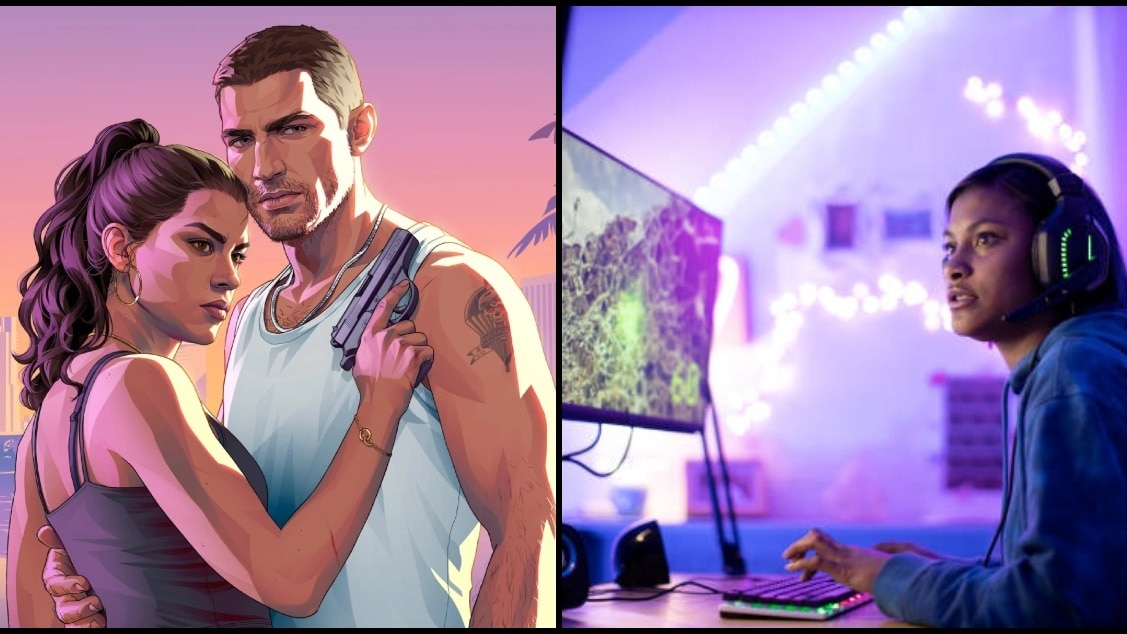
When Grand Theft Auto VI (GTA) finally arrived on November 19, the internet had plenty to say about it. There were gameplay discussions, memes, character theories and, of course, the familiar jokes about men asking their wives or girlfriends for permission to play the much-awaited game.But tech journalist and gamer Divyanshi Sharma noticed something about the conversation that was harder to laugh off."Most of the reels I have come across are about men asking their wives or girlfriends for permission to play the game. And honestly, that breaks my heart because the narrative is once again that this is a boys' game and they are the ones enjoying it," she says.It is an interesting observation, particularly at a time when women are no longer a fringe presence in India's gaming ecosystem. They are playing, streaming, competing and, increasingly, making careers out of gaming. Yet, when conversations turn to titles such as GTA, Valorant or Counter-Strike, the default image of a gamer is still overwhelmingly male. And that raises a fairly obvious question. If women are playing games, why do we still struggle to picture them playing the ones traditionally associated with men?The numbers, at least at first glance, suggest that the perception and reality might be quite different.Perception vs the numbers A 2025 report by the All India Game Developers Forum (AIGDF), Coral Recruit and M-League found that women account for 44 per cent of India's gaming audience, amounting to more than 260 million gamers. Yet, they make up only 12–14 per cent of the country's gaming workforce. Their representation in technical roles, where they account for just 6–9 per cent, and leadership positions, where participation remains below 10 per cent.The numbers reveal an interesting imbalance. Contrary to the perception women are a substantial part of the gaming audience, but their presence is considerably smaller in the industry that creates and shapes these experiences. And this is not just an India problem, it’s mostly the same abroad.Of course, the 44 per cent figure does not mean that women make up an equal proportion of players across every gaming platform or genre. India's gaming audience includes mobile, PC, console, casual and competitive players. But this nuance is important because it also explains why women can be a sizeable part of the overall audience and still remain relatively invisible in certain gaming communities.Krutika Ojha, popularly known as Krutika Plays, a gaming content creator and BGMI streamer associated with S8UL Esports, believes visibility is a big part of the problem."I think women are definitely playing these games. I have many friends who do play these games, but they're not always as visible. There's still this perception that gaming, especially PC and console gaming, is a boys' space. If a girl says she plays Candy Crush or Subway Surfers, nobody really questions it. But if she says she plays GTA or Valorant, people are suddenly surprised," she says.It is a distinction that Sheek Gaming, whose real name is Tarushika, has experienced firsthand. Having competed in the BGMI circuit, including becoming the only female player to qualify for the BGIS 2025 LAN Grand Finals with Team Versatile, she knows what it is like to enter a competitive environment where most players are men."I've played competitively as the only girl in a team full of boys, competing against teams that were entirely male. So I know women are interested in competitive gaming. The problem is that we're still treated as an exception rather than a normal part of the scene," she says.She adds that when a woman enters a competitive lobby, her gender can become a bigger talking point than her gameplay. A male player joins a team and is simply another player. A female player joins, and suddenly her presence becomes a conversation.No, women don't have a separate gaming playlistThere is also a persistent assumption that women gravitate towards casual games while men prefer competitive shooters, action-adventure titles and open-world games.But speak to women who actually play these titles, and that neat division begins to fall apart.Divyanshi says she has spent hours playing games such as Elden Ring and Call of Duty, titles that are often associated with male gaming audiences."As a female gamer myself, I can tell you that women are definitely playing the same games as men. There is an idea that women gravitate towards casual or less competitive games, but it is more of an outdated stereotype. We play everything from first-person shooters to RPGs," she says.Krutika echoes the sentiment. Women play GTA, Valorant, Minecraft, FIFA, RPGs and horror games, she says. There is no such thing as a gender-specific gaming playlist.What differs, however, is often the kind of exposure players receive and the platforms they have access to.Mobile gaming, for instance, has a much lower entry barrier than PC and console gaming. A smartphone can introduce someone to gaming without requiring a separate gaming setup, expensive peripherals or a dedicated space at home.And while mobile gaming is sometimes treated as a less serious category, that assumption does not hold up either. BGMI, for instance, has a competitive ecosystem of its own, with professional players dedicating hours to mastering a game played on a phone."Gaming is gaming, irrespective of the device," Sheek says. The distinction, she believes, lies in access to structured competitive gaming rather than the device someone uses.A gaming PC at home. Who gets to own it?Access is perhaps one of the less-discussed reasons behind the gender divide in PC and console gaming.A decent gaming PC, console, monitor, stable internet connection and accessories can be expensive. But the question is not simply who can afford them. It is also about who gets encouraged to own them.Krutika has noticed that in many Indian households, if there is one gaming PC or console, it often becomes the brother's or son's setup."He's the one who gets to spend hours on it, while the girl might be expected to prioritise studies, household responsibilities or other things. And I think we need to stop assuming that every girl who doesn't play on a PC or console simply isn't interested. Sometimes she just doesn't have access to the same resources," she says.Divyanshi recalls how even something as ordinary as buying a gift for a child can reinforce these expectations.Ask for a gift for an eight-year-old boy, and a store might direct you towards remote-controlled cars or gaming consoles. Mention that the child is a girl, and the recommendations might suddenly shift towards dollhouses and kitchen sets.Her own experience, however, was different. She grew up playing games with her father on their home PC and with her grandmother on retro cassette-based consoles. On her 13th birthday, her father gifted her a PlayStation 2."That honestly changed my life because that is what got me into gaming. Fifteen years later, here I am, reviewing games for a living. I still wonder what would have happened if I didn't grow up in a family where gaming was encouraged," she says.It is a telling example of how early exposure and encouragement can shape an interest into something much bigger. A girl who gets access to a console is just as capable of growing up to become a gamer as a boy who gets one.'Go back to the kitchen': The ugly side of online gamingEven when women make it into these spaces, staying there can be another challenge.Online gaming is supposed to be about teamwork, strategy and the occasional friendly rivalry. But for women, particularly in multiplayer games that rely on voice communication, the experience can change the moment other players realise there is a woman on the team.The comments can range from unwanted attention and personal questions to outright sexist abuse.Krutika says some women have learnt to make small adjustments to their gaming experience simply to avoid becoming targets."To escape the 'Go back to the kitchen!' comments, we just have to. Using an anonymous username, keeping the mic off or avoiding voice chat can make the gaming experience much more peaceful for us. It's a sad reality because sometimes the moment people realise there's a girl playing, the entire conversation changes," she says.Divyanshi has also experienced this. Before she met her husband, she would often play Counter-Strike with voice chat switched off.It helped her avoid unwanted comments, but it came at a cost. Multiplayer gaming is built around communication, coordination and being part of a team. Turning off the mic meant losing an important part of that experience."You never know how someone will react once they realise you're a woman. I've dealt with unwanted comments, personal questions and a lot more. Ultimately, you either end up being cautious or give up FPS titles altogether. And in my case, the latter happened," she says.Sheek, meanwhile, says she has never felt the need to hide that she is a woman, but understands why others might choose to. There is also the additional scrutiny that comes with being the only female player in a team.If a woman performs well, people can act surprised. If she makes a mistake, it can become an excuse to generalise about female gamers.The problem, then, is not simply getting more women to enter gaming communities. It is making sure they can participate without having to think about their gender every time they switch on a microphone.There is another curious divide in the way women participate in gaming.Streamers, yes. Professional gamers, not quite as much?There is another curious divide in the way women participate in gaming. Female gaming content creators and streamers have become increasingly visible, but their presence in the upper echelons of competitive esports remains relatively limited.That is not to suggest that content creation is an easy career. Building an audience, streaming consistently and maintaining a community requires considerable effort. But the route into professional esports comes with a different set of demands.Competitive players need regular practice, access to teams, coaching, tournament exposure, scouting opportunities and financial support. They also need organisations willing to invest in their talent.For women, the challenge can begin even before they get an opportunity to prove themselves.Krutika believes content creation offers a comparatively lower entry barrier. It allows women to build their own communities, explore different games and connect with audiences on their own terms. Professional esports, on the other hand, requires a much more structured ecosystem.She would like to see more women in actual competitive rosters, leading teams and winning tournaments, rather than being limited to hosting events or appearing in gaming-related content.Sheek makes a similar point about the need for more mixed-gender competitive opportunities."I'm not against women-only tournaments. They can be a great starting point. But they shouldn't become the only space where women are welcome," she says.More mixed teams, open trials, better scouting and organisations willing to invest in female talent are necessary if women are to become a regular part of the larger competitive gaming ecosystem.GTA 6 has Lucia. But is that enough?Which brings us back to Grand Theft Auto VI.The latest instalment in Rockstar Games' hugely popular franchise has introduced Lucia Caminos, its first female protagonist in the mainline GTA series, alongside Jason Duval. The two characters are central to a story set in Leonida, with their lives becoming increasingly intertwined following a botched robbery.Lucia's presence is significant. She isn't simply a female character occupying a supporting role in someone else's story. She is one of the two central playable protagonists, with her own backstory and place in the game's narrative.For women who have spent years watching gaming conversations revolve around male characters and male players, that matters."I think we're getting there, and GTA 6 is a pretty interesting moment for that conversation. Having Lucia as a major playable protagonist is a big deal because we're finally getting to experience the GTA universe through a fully developed female character," Krutika says.Sheek, too, sees it as a positive development. But both believe that representation on screen cannot be the only measure of progress."You can have the coolest female character in the world, but if we women who are playing that game are still being mocked, harassed or treated like outsiders, then we're missing the bigger picture," Krutika says.Divyanshi also points to how the conversation around the game has been shaped by familiar gender stereotypes. While Lucia is an important step forward, she believes there is still a tendency to frame GTA as something men enjoy, with women appearing on the sidelines of that excitement.In other words, having a woman in the game does not automatically mean women feel included in the culture surrounding it.Perhaps the biggest misconception about women and gaming is that they need a special invitation to participate. They don't. They need the same access, encouragement and opportunities that have long been available to their male counterparts.- Ends
GTA 6 has Lucia. But gaming still has a boys' club problem
Full Article
Original Source
Read the full article at Indiatoday →KhanList aggregates and links to publicly available news content. We do not host full articles from third-party sources. Always verify important information with original sources.