
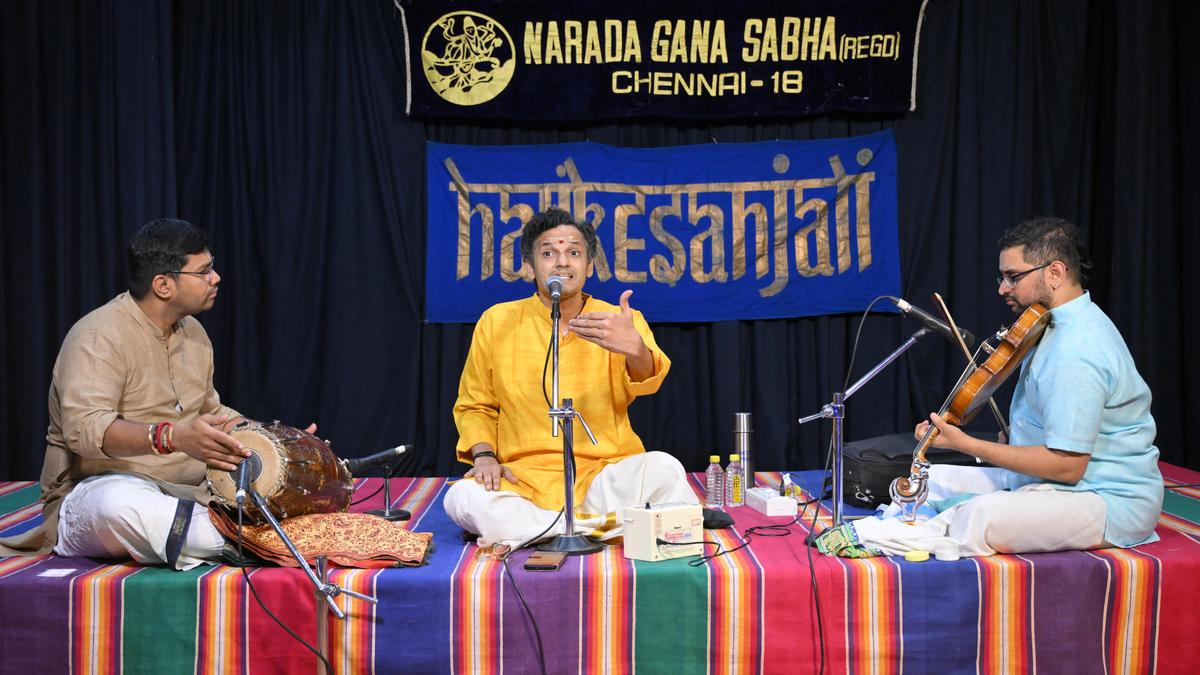
T.V.S. Mahadevan (vocal), R. Raghul (violin) and Sai Raghavan (mridangam) performing at the 149th Jayanthi celebrations of Harikesanallur Sri Muthiah Bhagavathar Day, organised by Narada Gana Sabha in association with Harikesanjali Trust. | Photo Credit: V. Umesh Kumar On the 149th birth anniversary of Harikesanallur Muthiah Bhagavatar, his compositions were rendered by T.V.S. Mahadevan, the grand nephew of his well-known disciples Madurai Mani Iyer.The story goes that Madurai Mani Iyer once sang a single composition for an entire week in Kutralam. Fellow sishyas carried this news to their guru. Bhagavatar summoned Mani Iyer, and after hearing him sing, said something generous: “You are singing it better than I taught you.”The song was Bhagavatar’s own English notes in Sankarabharanam. Nearly 150 years after his birth, the song resurfaced at the end of an evening devoted entirely to his compositions, and one understood why Mani Iyer had practised it for a week.The tribute, presented by Narada Gana Sabha and the Harikesanjali Trust, was thematic in the strictest sense — every piece was by Bhagavatar. This was a man who composed in Sanskrit, Tamil, Telugu and Kannada, who was a Harikatha exponent and a gottuvadyam player, the first musician in India to receive a doctorate, and who is also credited with introducing 20 new ragas.The concert by Mahadevan, son of the legendary T.V. Sankaranarayanan, featured R. Rahul (violin), a disciple of M. Chandrasekar, and Sai Raghavan (mridangam), who trained under Kumbakonam Rajappa Iyer and later Patri Satish Kumar.The opening, ‘Sakti ganapatim bhajeham’ in Nattai set an invocatory tone. ‘Valli nayaka neeve’ in Shanmukhapriya, the raga the Bhagavatar did so much to popularise, followed, with its brisk, briga-laden contours and a spirited round of kalpanaswaras at the charanam. Harikesanallur Muthiah Bhagavatar. | Photo Credit: The Hindu Archvies The evening gradually revealed another dimension of Bhagavatar’s contribution: he was as much a creator of ragas as he was a composer of kritis. Mohanakalyani, a raga whose antecedents are traced to the Tamil treatise Mahabharata Choodamani, found greater definition and presence in the Carnatic repertoire through his compositions. An alapana in the raga, marked by lively exchanges between Mahadevan and Rahul, led to ‘Bhuvaneshwariyam’, followed by an energetic round of kalpanaswaras in melkalam.Thodi came next, with Mahadevan exploring its contours through sustained notes and precise phraseology. Rahul’s response was seamless, particularly in the faster brigas and swara passages. ‘Meenalochani amba’, a composition popularised by Madurai Mani Iyer, followed with attractive kalpanaswara passages adding to its appeal. The Saraswati alapana traversed all three octaves, with the exploration of the lower register being particularly evocative. Rahul’s gliding phrases complemented the vocal delineation. This was followed by ‘Vagishwari vani saraswati’, with a niraval at ‘Neera jeeva shakti’.The main piece was ‘Adityam devadi devam’ in Mayamalavagowla. A well-rounded alapana established the raga’s contours before the kriti unfolded. Kalpanaswaras at ‘Sakala charachara’ were followed by an engaging koraippu. Sai Raghavan’s tani avartanam was marked by sollu suddham and clarity of articulation.The latter part of the concert brought into focus Bhagavatar’s engagement with Hindustani music. He introduced ragas such as Gowda Malhar and Hamsanandi into the Carnatic idiom. ‘Sarasa mukhi’, popularised by Madurai Mani Iyer, and ‘Needu mahima’ followed, offering further glimpses of his compositional range. A brisk Mohanam thillana on Muruga brought rhythmic verve to the proceedings, followed by the distinctive Sankarabharanam English Notes. The concert concluded with the virutham ‘Arivum aatralum’, leading into the mudra charanam of ‘Mangalam ponga’, Bhagavatar’s Madhyamavati composition on Maavur Manonmani Amman.A mangalam is the customary conclusion to a concert. But this evening offered something more enduring: A tribute not merely to Bhagavatar’s compositions, but also to the lives and traditions they continue to connect. Published - November 22, 2026 01:56 pm IST
How Muthiah Bhagavatar’s songs connect lives and musical lineages
Full Article
Original Source
Read the full article at Thehindu →KhanList aggregates and links to publicly available news content. We do not host full articles from third-party sources. Always verify important information with original sources.