
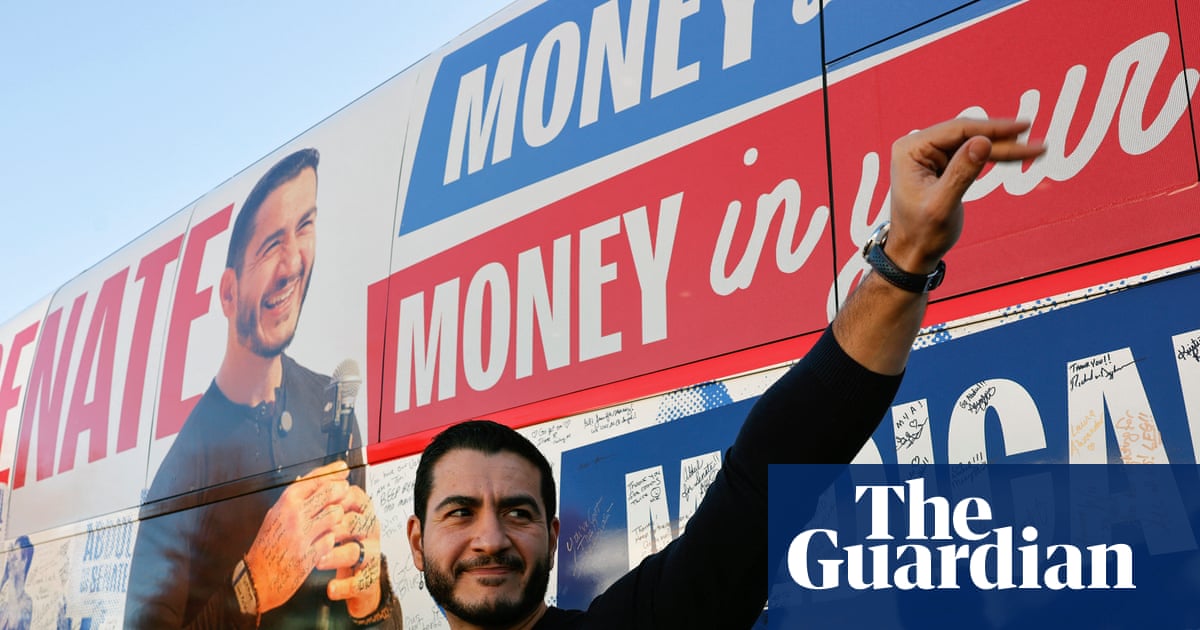
Abdul El-Sayed, the Democratic US Senate candidate, starts this day on the campaign trail in Escanaba, Michigan, where nearby Wisconsin dairy country spills into dense forests and the sandy shores of Green Bay.This is the upper peninsula – the “UP” – a rural slash of land north of Michigan’s mitt. Electorally, it’s crimson. Donald Trump won some districts near Escanaba by more than 41%. But at the county fairgrounds, past sheds labeled “Beef” and “Swine”, hundreds of locals on the political left have gathered in the hangar-size 4H Club meeting hall to hear El-Sayed speak.“We built this campaign on three simple things. Y’all remember what they are?” El-Sayed stokes the audience, leading them to a call-and-response.“Money out of … ”“Politics!”“Money in your … ”“Pocket!”“Medicare for … ”“All!”As Americans prepare for historic cuts enacted in the Republican-led “One Big Beautiful Bill Act”, which is expected to push 17 million people from their health insurance plans, El-Sayed appears to have caught a rising tide of interest in Medicare for All.A Latinos for Abdul rally at Western International high school in Detroit, Michigan, on 16 October. Photograph: Michael M Santiago/Getty ImagesThis election season, Troy Jackson, the Democratic US Senate candidate from Maine, who’s in a dead heat with Republican Susan Collins, said Medicare for All would be “great coverage”. Angie Nixon, Florida’s Democratic US Senate candidate, has made it a part of her “working families guarantee”. Chris Van Hollen, current US senator for Maryland, added Medicare for All to his platform last December after “listening to his constituents”.El-Sayed’s supporting act in this series of stops is influential Democratic congresswoman Alexandria Ocasio-Cortez, a longtime Medicare for All proponent and the subject of whispers about a 2028 presidential run. And, according to an October poll by the health policy thinktank the Kaiser Family Foundation, two-thirds of Americans support the idea.Technically, Medicare for All is an insurance reform. Proposals currently before Congress would make the federal government into the nation’s health insurer, a “single-payer” system more closely aligned with health systems in peer-developed democracies, such as Canada.Sounds simple. However, in the US, one in every five dollars goes to healthcare. The existing health insurance patchwork fuels profits of world-leading, resource-unlimited corporations and powerful local monopolies. Democrats also worry that replacing private insurance, as Medicare for All advocates call for, would provide fodder for Republicans, who have made stoking popular resentment against government into an electoral strategy.Those enormous barriers have repeatedly relegated Medicare for All to the political hinterlands. Centrist Democrats worry that, in a nation where me-but-not-thee politics has reigned for many years, Medicare for All is nothing more than a decades-old tried-and-failed idea.Then again, in a nation where healthcare prices are the highest in the world and climbing, when even the insured find themselves in medical debt, and where the broad-daylight assassination of an insurance executive elicits catharsis and not mourning – the yearning for change is personal and visceral.“Not enough doctors, not enough healthcare,” says El-Sayed, who ran both the Detroit and Wayne county health departments, and received a medical degree from Columbia University.A shout from the crowd: “Not enough psychiatrists!”“Not enough mental healthcare,” El-Sayed answers, tossing out a campaign slogan: “It shouldn’t be this hard.”Later, a shout from the same corner: “What about our teeth!”El-Sayed’s campaign comes as the Trump administration enacts the largest federal healthcare cut in the nation’s history – extracting $1tn from the system primarily by through severe cuts to Medicaid, the federal-state health insurance program for low-income and disabled people. Medicaid cuts are expected to close hospitals, particularly those in rural outposts like Escanaba, and the urban core.At the same time, some of the most popular health policies of recent years – such as reigning in medical debt collections – spring directly from the policy work of Medicare for All advocates. Add to this a counterintuitive reality: almost half of all healthcare today is already paid for by federal, state or local government, according to the federal Centers for Medicare and Medicaid Services.Supporters of Abdul El-Sayed square off against supporters of Republican Senate candidate Mike Rogers in Grand Rapids, Michigan, on 8 October. Photograph: Chip Somodevilla/Getty Images“I’ve been at this for a while, and we have dips and peaks in the single-payer movement,” said Dr Stephanie Woolhandler, a professor of public health at the City University of New York, and a decades-long advocate for Medicare for All. Support “always comes back”, she said.“And the reason it always comes back is because the healthcare system has not been fixed – and it may not be fixable at all without single-payer,” said Woolhandler.To understand this system, and Republican enmity toward it, it pays to go back a century when the idea of tying health insurance to employment was born of entrepreneurial innovation and historical accident. In 1929, Baylor University hospital offered insurance to cover hospital bills for $6 per year to a group of 1,500 schoolteachers in Dallas. The idea caught on across the country and Blue Cross came to life.This arrangement was institutionalized during the second world war. Amid government price controls, health insurance was one of the few ways businesses could compete for workers. The federal government made the benefit tax-exempt, as it still is today, according to the foremost history on the subject by author Paul Starr.Since then, Democrats have pushed for reform and expansion – with their failures to reach universal coverage shaping the contours of the patchwork system that exists today.In 1965, Democrat Lyndon Johnson passed Medicare, for people older than 65, and its sister program Medicaid, together providing insurance for more than one-third of Americans today. While the reform was a momentous triumph over segregationist opposition – Medicare desegregated hospitals – it came up short against its architects’ vision.“We expected Medicare to be a first step toward universal national health insurance,” said Robert Ball, a top official in the Kennedy and Johnson administrations, according to an article in Health Affairs.Lyndon B Johnson signs the Medicare bill as Hubert Humphrey, vice-president, and former president Harry S Truman both check the time, on 30 July 1965. Photograph: Bettmann/Bettmann ArchiveIt also created important knock-on effects: it pushed the hospital industry to commercialize in the 1980s, according to Dr Luke Messac, an emergency room doctor at Mass General Brigham, and author of Your Money or Your Life, a history of medical debt. Hospitals, the majority of which are non-profit in the US, argued they could drop the explicit charitable missions many were founded with because Medicare paid patients’ bills. As a result, the hospital industry pushed the IRS to loosen its definition of community benefit, at the same time keeping their nonprofit status and scaling up billing.This yielded “a lot of middlemen in our system that do not provide a benefit to the public”, said Messac. “One of the things Medicare for All is intended to do is take some of the power back from those actors.”“That poses a huge threat, so the fact that there would be opposition is like the most predictable thing in the world,” he adds. “It doesn’t mean it’s a bad idea – it may mean it’s a good idea.”Since Johnson’s Medicare bill, the only law to rival it in scope is the Affordable Care Act (ACA), passed in 2010. Better known as Obamacare, a version of the market-based reform was first proposed by scholars at the conservative Heritage Foundation. Democrats sought to reach across the aisle; to do so, they developed a bill to subsidize insurance for individuals. But that plan for bipartisan support didn’t work out.Obamacare was passed on a party-line vote – one of the first signposts of the new era of polarization. Republicans incessantly targeted it for more than a decade. Today, it is etched it into the minds of conservative voters as the source of all that ills healthcare.Democratic US House members during an event at the US Capitol unveiling the Affordable Health Care for America Act, on 28 October 2009. Photograph: Scott J Ferrell/CQ-Roll Call Inc/Getty ImagesJust ask the pro-Trump protesters outside El-Sayed’s rally in Escanaba.“We should almost go back to square one and start analyzing what caused this,” says Bonnie, a 70-year-old Republican in Delta county, who declines to give her last name. “When the socialistic ideas started coming in, like Obamacare, that’s what threw everything in a tailspin.”“I want everything privatized,” says Lisa Pieczyski, a woman in her 60s from near Escanaba, who carries a homemade anti-green-energy sign. “We’ve mandated too many things under insurance that have made the premiums outrageous.” She adds that she can’t trust the government because “Obamacare did all this”.“I’m middle class, I’ve always been middle class, and what I have done to ensure I have medical insurance is give up something else like a fucking Cadillac and pay for it, all right? OK?” said Delta county’s Republican spokesperson, Michael Glass, 77, who gets insurance through a privatized version of Medicare called Medicare Advantage.“It is the individual who should take responsibility for their own healthcare, period.”As El-Sayed stumps through the UP, his supporters repeat a set of ideas they believe run parallel to Medicare for All: kindness, respect and shared responsibility. In Iron Mountain, he greets an overflow crowd at the local ski lodge – one of the few public meeting places in this rural town. One “lifelong Democrat” says there hasn’t been this much excitement since Bernie Sanders came to town a few years back.After El-Sayed’s speech – his condemnations of US support for Israel’s war in Gaza, his calls for cheaper gas, groceries and healthcare, criticisms of Islamophobia – a woman asks about how to bring people around to Medicare for All.Abdul El-Sayed at a rally in Port Huron, Michigan, on 6 October. Photograph: Jeff Kowalsky/AFP/Getty Images“I was a registered nurse for 40 years,” she says. “Can you make a video or some kind of something explaining – some easy way for people to understand how great and easy it’s going to be?” El-Sayed answers – but it’s Ocasio-Cortez that captures the room.“Raise your hand if you have waited or delayed getting a treatment or seeing a doctor because you felt you couldn’t afford it,” says Ocasio-Cortez.Every single person raises a hand.“Right now, we are waiting weeks, months, years – to wait until we can afford to see a doctor one day. Healthcare has become a luxury,” says Ocasio-Cortez. “Medicare exists – we provide a healthcare system for every American above the age of 65.”Finally, she adds: “There is this idea that I don’t want to pay for someone else’s thing. First of all, does that mean you don’t want someone else to pay for your care? Does that mean we shouldn’t have Medicare today? Because I’m a young person and I gladly pay, because I want to live in a society where seniors” – then, she is drowned out by the cheers of people excited to share the cost.At the end of the one-day, 131-mile trail, El-Sayed is in the gymnasium of Northern Michigan University with enormous pictures of athletes looking out at the audience. A physician assistant who is running for state representative opens the rally and – all of a sudden – public health is on the offense.“All it took was the closure of my little Planned Parenthood clinic about 18 months ago,” says Anna Aho Rink, a Democratic candidate for Michigan’s 109th US House district, “and me being completely fed up with the system that is not working well for any of us to get me up here today and running for office.”The rally is at a college, but students are a minority in the audience; there are elderly residents and middle-aged parents with children in tow on a school night.Alexandria Ocasio-Cortez speaks to supporters of Abdul El-Sayed in Rochester, Michigan, on 16 October. Photograph: Michael M Santiago/Getty Images“You don’t need a medical degree to recognize the symptoms of a broken economy,” says Ocasio-Cortez as she warms up the crowd. “Michigan, corruption is making this country sick.”El-Sayed ticks off his public health victories: he got 16,000 kids free reading glasses; used vending machines to distribute Narcan, the overdose reversal medication; tested daycares and preschools for lead in the water, and then remediated dozens.“You deserve to have a long, healthy life in the United States of America,” El-Sayed calls.For many, this politics is in perfect relief to the worldview of the Trump administration – one where there is not enough to go around, where someone needs to lose, the government must be gutted, loyalty ranks much higher than fact.The loudest chants of the day fill the gymnasium:“Money out of … ”“Politics!”“Money in your … ”“Pocket!”“Medicare for … ”“All!”
On the campaign trail in Michigan, Abdul El-Sayed rides a wave of support for Medicare for All
Full Article
Original Source
Read the full article at Theguardian →KhanList aggregates and links to publicly available news content. We do not host full articles from third-party sources. Always verify important information with original sources.