
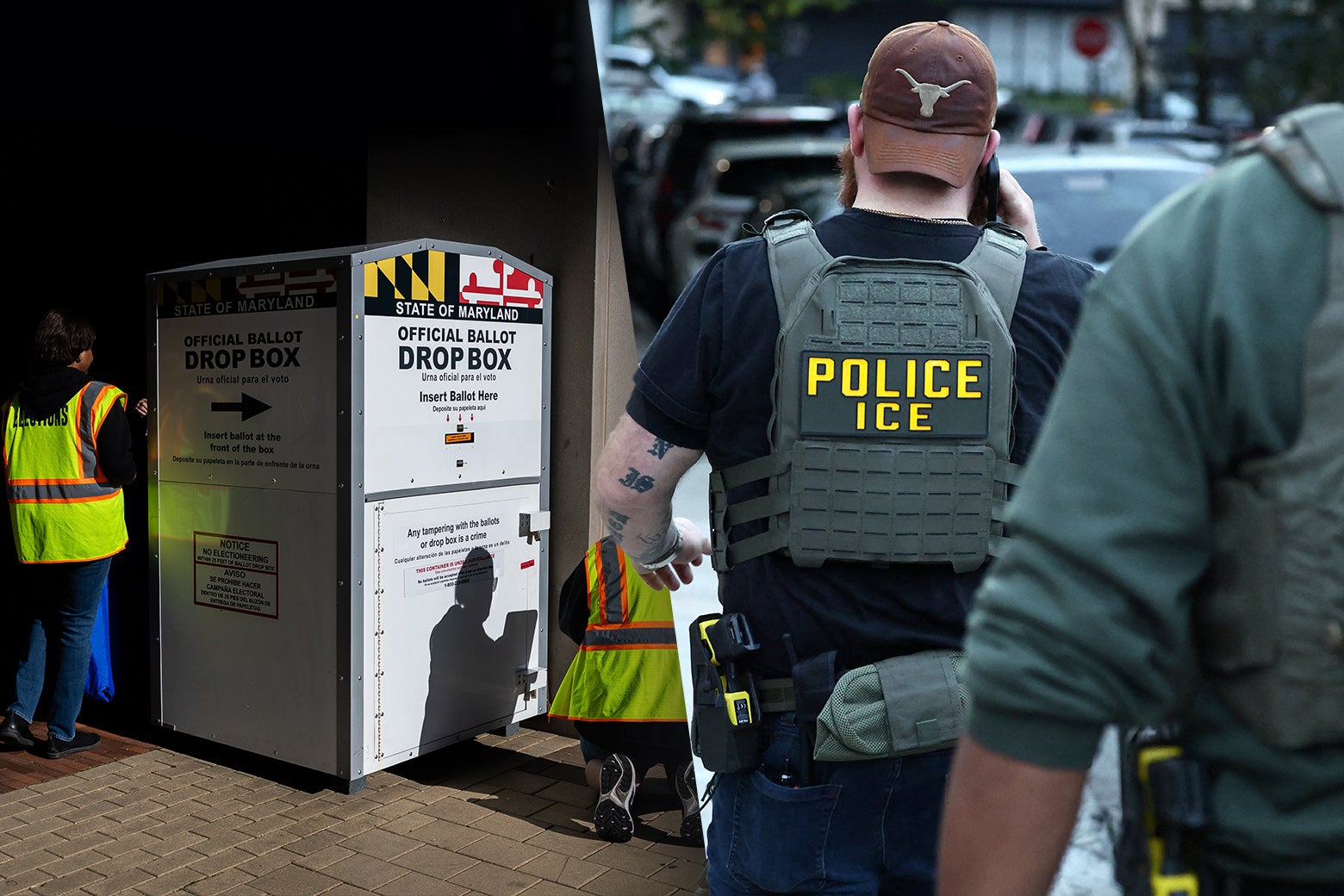
Jurisprudence A study of elected prosecutors shows what happens when voters reward “tough” politics. More ICE or less is on the ballot. Photo illustration by Slate. Photos by Finn Gomez/Getty Images and Charly Triballeau/AFP via Getty Images. Sign up for Executive Dysfunction, a weekly newsletter that highlights one under-the-radar story about how Trump is changing the law—or how the law is pushing back—and keeps you posted on the latest from Slate’s Jurisprudence team. Next week, America votes in the midterms. And as Election Day approaches, a new rhetoric of crime and illegality has emerged with familiar implications. While the “tough-on-crime” era of the 1980s and 1990s may have passed, similar dialogue today is anchored in “tough-on-immigration” policies. For example, Republicans and allied groups spent $53 million on immigration ads across 27 states from January to June. And even old tough-on-crime era rhetoric has reemerged as campaign strategy, with “soft on crime” being a lead attack of the Republicans, and President Donald Trump invoking the notorious 1988 Willie Horton ad at a campaign rally against Democrats. The enforcement behind this rhetoric has also grown: The Department of Homeland Security says Immigration and Customs Enforcement hired 12,000 new officers and agents last year, ICE arrests have more than doubled in 15 states and D.C. this year, and many sheriffs are partnering with ICE to perform functions of federal immigration agents through the 287(g) Program. It is worth noting that when the public supports such rhetoric in elected officials, that rhetoric becomes real—it affects lives. My new study of elected prosecutors, published in the Journal of Public Economics, provides evidence of exactly that. District attorneys are among the most influential actors in the criminal legal system, with nearly unfettered authority over whether to charge people with crimes and which charges to file, and in the vast majority of districts they are elected. I set out to understand whether DAs were influenced by the desire to be viewed as tough on crime. My study suggests they were, finding that across nearly 40 states during the era of rising incarceration (from 1986 to 2006), the admissions rate to state prisons increased by 3 percent during election years for district attorneys. Over those two decades, this translates to 63,000 additional prison admissions, more than a sold-out Soldier Field. But this figure only measures the election year bump; it does not capture how political incentives may have affected criminal sentencing throughout the entire election cycle. The political incentives DAs faced may have included running currently for reelection, discouraging future challengers, and positioning for future higher office. Crime and arrest rates did not go up in DA election years, suggesting the election year increases reflected DA behavior in raising the level of criminal sentencing. The increases were notably stronger in the South and in Republican counties. So it appears the criminal legal system became tougher on crime when and where the political stakes were highest. When voters began asking less for harsher courts, however, the election year effect declined. The General Social Survey, a survey of public opinion, finds that after about 1994, Americans’ preference for harsher courts softened. This is when the election year effects fell. So it also appears elected prosecutors were listening to voters in both directions. This holds for today’s immigration debate. Granted, the two eras bear important differences. Tough-on-crime policies held near consensus from the public and were often bipartisan in support; tough-on-immigration policies largely are not. Consider immigration enforcement, with 50 percent of Americans in February supporting the deportation of all immigrants lacking permanent legal status and 48 percent opposing it. Such support is politically polarized. This has translated to mixed signals—with protests and local opposition in blue states contrasting with $70 billion in Republican-backed congressional funding to ICE and the Border Patrol. Still, the deliberate stoking of fear of criminality today mirrors that of the past. Yet, public opinion toward harsh immigration enforcement is softening as well. For example, 62 percent of Americans in February opposed ICE tactics, and approval of the president’s handling of immigration had fallen 10 points from a year earlier. Also, last year, Pennsylvania voters ousted a Republican sheriff in favor of a Democrat who ran on ending the local partnership with ICE. With control of Congress and immigration enforcement on November’s ballot—and with those elected responding to voter preferences—how we vote signals the direction our nation will decide to go. On Election Day, we will all be called to make a choice both on how we view ourselves as Americans and on how we view our neighbors—whether they have permanent legal status or not. And these stakes are not abstract; they could mean more Americans killed by federal immigration agents, more children left without their parents, more human beings sent to prisons in countries that are not their own. Both my research and our recent times point to a deeper, sobering lesson. This lesson serves as both warning and promise: What we reward when we elect is what grows. Immigration Jurisprudence Politics 2026 Midterms
These Midterms, ICE Is Truly on the Ballot
Full Article
Original Source
Read the full article at Slate →KhanList aggregates and links to publicly available news content. We do not host full articles from third-party sources. Always verify important information with original sources.