
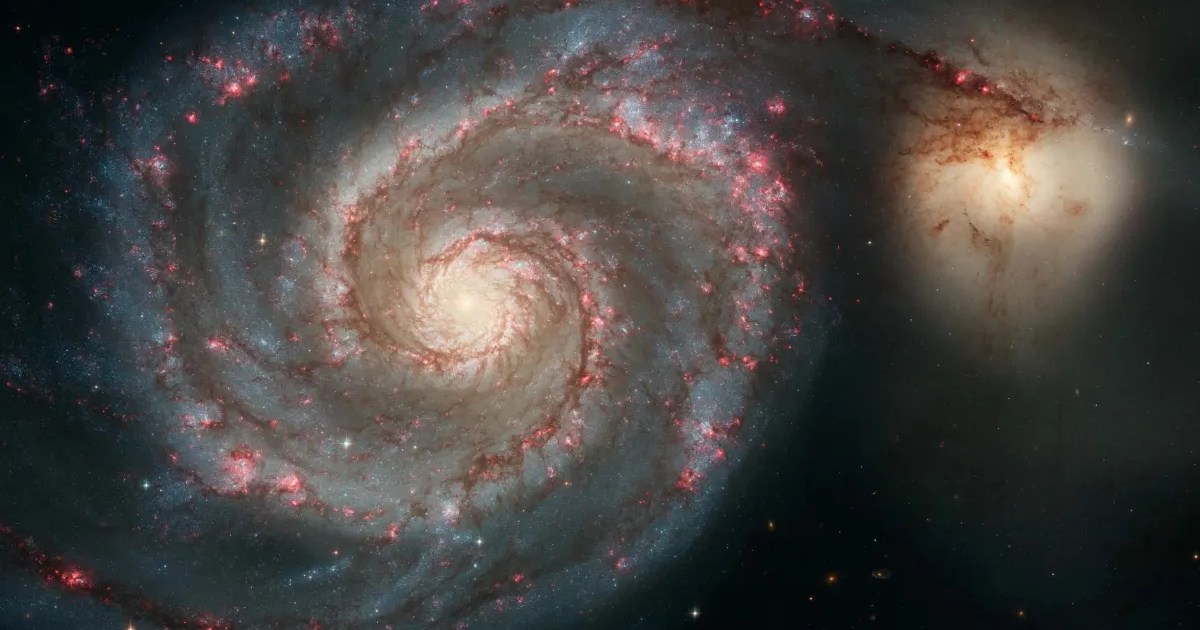
Today in the history of astronomy, Charles Messier spots the first known spiral galaxy. | Published: October 13, 2026 With its sweeping arms, the Whirlpool Galaxy is a classic example of a spiral galaxy. Credit: NASA, ESA, S. Beckwith (STScI) and the Hubble Heritage Team (STScI/AURA) On Oct. 13, 1773, Charles Messier spotted the Whirlpool Galaxy (M51) for the first time. Writing of it a few months later, he described the object as a “very faint nebula without any stars”; it would become the 51st entry in his famous catalog of non-comets. In 1781, Messier’s friend and fellow astronomer Pierre Mechain observed that the object appeared to be a double galaxy with two nuclei (seeing M51’s companion NGC 5195). Messier didn’t realize it, but he’d been the first to discover a spiral galaxy. It wasn’t until 1845 that the galaxy’s spiral nature was detected: Using his 72-inch reflector, William Parsons, Earl of Rosse, observed a pinwheel-like structure to M51, and labeled M51 a “spiral nebula.” Astronomers of the day theorized they were seeing a solar system in mid-formation, and the true nature of “spiral nebulae” — including the importance of the spiral arms for star formation — wouldn’t be discovered until the early 20th century. Today, M51 is recognized as a classic example of a spiral galaxy, situated about 27 million light-years away in Canes Venatici. Elisa Neckar is senior production editor of Astronomy magazine, and the editor of the Today in the History of Astronomy feature on Astronomy.com.
Oct. 13, 1773: The discovery of the Whirlpool Galaxy
Full Article
Original Source
Read the full article at Astronomy →KhanList aggregates and links to publicly available news content. We do not host full articles from third-party sources. Always verify important information with original sources.