
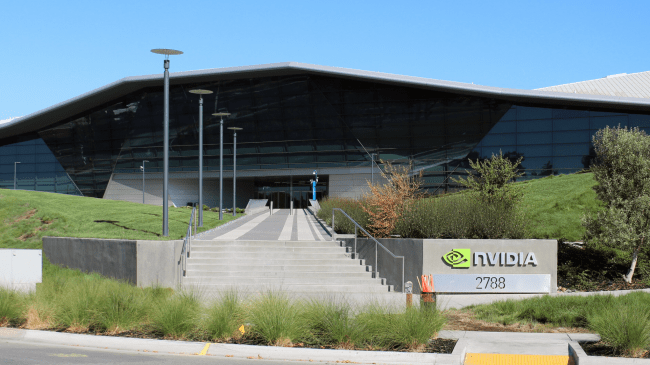
The artificial intelligence boom is creating an almost insatiable demand for computing power. Behind every chatbot, image generator and reasoning model are specialized chips performing vast numbers of calculations within seconds. Nvidia controls much of this market, but it is no longer running the race alone. Huawei, Cambricon, Moore Threads and Biren Technology are building alternative processors as China works to reduce its dependence on foreign technology. 1. Nvidia Wikimedia Commons Nvidia is the undisputed leader to beat in the global AI chip industry. Its graphics processing units, originally developed for gaming, have become the primary hardware used to train and operate many of the world’s most advanced AI models. However, Nvidia’s greatest advantage extends beyond processor performance. Its CUDA software platform, high-speed networking technology, and extensive developer ecosystem make shifting workloads to competing hardware expensive and technically difficult. This advantage remains particularly visible in China, despite years of American export restrictions. The country’s leading AI developers continue using Nvidia processors for advanced model training because replacing the complete hardware and software environment requires significant engineering work, according to SCMP. 2. Huawei Huawei has emerged as China’s most credible answer to Nvidia. Its Ascend processors are designed for AI training and inference, while its SuperNode systems combine numerous chips to handle the computing demands of increasingly complex models. The Shenzhen-based technology giant is also developing the software needed to support its hardware. Its Compute Architecture for Neural Networks, better known as CANN, aims to provide a domestic alternative to Nvidia’s widely used CUDA platform. Huawei recently demonstrated this hardware-software strategy through its collaboration with DeepSeek. The company’s Ascend 950PR and 950DT processors received immediate support for DeepSeek V4, allowing the model to perform inference across Huawei’s Ascend SuperNode systems. 3. Cambricon Technologies Cambricon Technologies is another major force in China’s expanding AI chip sector. Unlike diversified technology companies, Cambricon primarily develops processors and accelerator cards for artificial intelligence applications in servers, data centers, and smart devices. Its machine-learning units are built to perform the parallel calculations needed to train models and generate responses. Demand for such domestic hardware has increased as export restrictions limit Chinese companies’ access to Nvidia’s most advanced processors. Cambricon and Huawei now lead the domestic expansion inside China’s AI server market. 4. Moore Threads Moore Threads is developing general-purpose GPUs capable of supporting artificial intelligence, graphics rendering and scientific computing. This broader approach could allow its processors to handle multiple workloads instead of operating solely as specialized AI accelerators. Founded in 2020, the company has quickly become one of China’s most closely watched semiconductor start-ups. It is positioning its GPUs as domestic alternatives for organizations that previously depended on processors supplied by Nvidia and other foreign companies. Demand for its technology appears to be rising rapidly. 5. Biren Technology Biren Technology is targeting one of the industry’s toughest challenges: developing powerful GPUs for AI training and high-performance computing. These workloads require enormous processing capacity, fast memory, and efficient connections between thousands of individual accelerators. The company has faced obstacles after American restrictions disrupted its access to advanced semiconductor manufacturing. Even so, China’s push for technological self-reliance is creating new opportunities for Biren and other domestic processor developers. Biren projected that its first-half revenue could rise by as much as 2,107 percent amid booming demand for home-grown chips. However, soaring sales do not necessarily mean its processors have closed the performance and software gap with Nvidia. A race involving more than processing power Nvidia still has the industry’s most complete combination of powerful processors, networking equipment and developer software. Its competitors must therefore create entire computing ecosystems rather than merely produce chips with impressive performance figures. China’s enormous demand for AI infrastructure could still provide enough space for several domestic suppliers to grow. Huawei currently leads that charge, but Cambricon, Moore Threads and Biren are also emerging as significant players in an increasingly fragmented global chip race.Get the latest in engineering, tech, space & science - delivered daily to your inbox.Atharva is a full-time content writer with a post-graduate degree in media & amp; entertainment and a graduate degree in electronics & telecommunications. He has written in the sports and technology domains respectively. In his leisure time, Atharva loves learning about digital marketing and watching soccer matches. His main goal behind joining Interesting Engineering is to learn more about how the recent technological advancements are helping human beings on both societal and individual levels in their daily lives.
Nvidia’s new rivals: 5 companies building next-gen compute silicon
Full Article
Original Source
Read the full article at Interestingengineering →KhanList aggregates and links to publicly available news content. We do not host full articles from third-party sources. Always verify important information with original sources.