
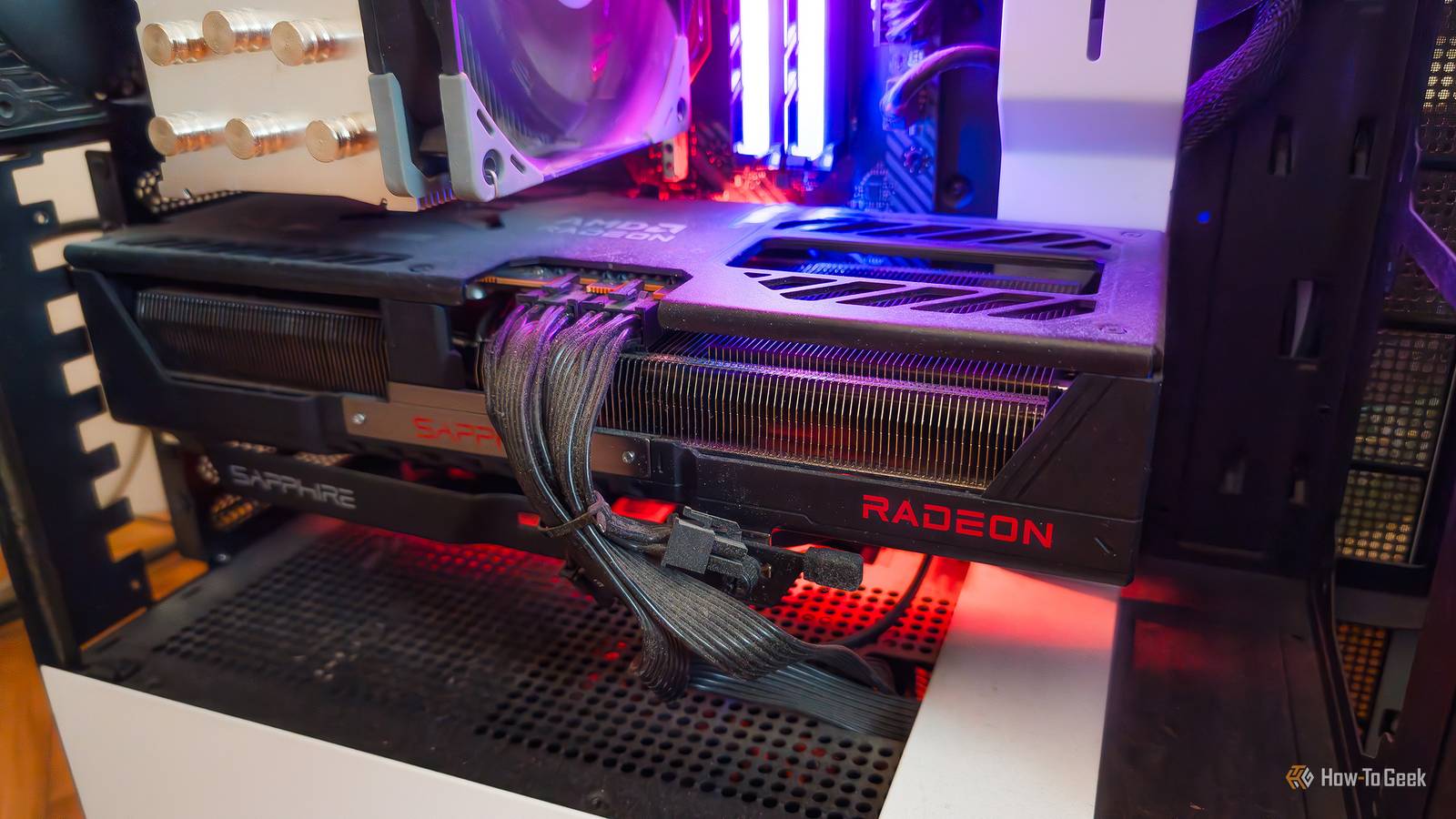
Credit: Goran Damnjanovic / How-To Geek Published Aug 21, 2026, 10:45 AM EDT Monica J. White is a journalist with over a decade of experience in covering technology. She built her first PC nearly 20 years ago, and she has since built and tested dozens of PCs. PC hardware is her main beat, and graphics cards and the GPU market at large are her main area of interest, but she has written thousands of articles covering everything related to PCs, laptops, handhelds, and peripherals. From GPUs and CPUs to headsets and software, Monica's always willing to geek out over all things related to computing. Outside of her work with How-To Geek, Monica contributes to TechRadar, PC Gamer, Tom's Guide, Laptop Mag, SlashGear, Whop, and Digital Trends, among others. Her ultimate goal is to make PC gaming and computing approachable and fun to any audience. Monica spends a lot of time elbow-deep in her PC case, as she's always making upgrades, testing something, or plotting out her next build. She's the go-to tech support person in her immediate circle, so she's never out of things to do. Whenever she has spare time, you'll find her gaming until the early hours and hanging out with her dog. Sign in to your How-To Geek account The writing has been on the wall from the moment Nvidia introduced DLSS, and then followed up with DLSS Frame Generation. The company is all-in on AI, and ever since we got frame gen, hardware upgrades have stopped being the sole focus of every new release. Instead, DLSS and Multi-Frame Generation drive the hype. AMD has FSR, of course. But its more straightforward approach is starting to look really appealing now, when you need a degree in Google search to figure out what your GPU is capable of. Nvidia's DLSS stack gets bigger and bigger, but not for everyone What can your GPU actually do? I remember when we were all excited by hardware-level upgrades. More VRAM, more cores ... Stuff that actually makes a difference in nearly every workload. But these days, the upgrades hinge heavily on AI, and DLSS is Nvidia's ultimate ace. It's not that these GPUs no longer get hardware upgrades; obviously, they do. It's more that a lot of the advertised performance relies on DLSS being toggled on, and each new iteration of the tech—especially the frame gen bit—is more impressive than the previous one. Some call frame generation a crutch for poorly optimized games, or an easy out for Nvidia to focus more on software rather than hardware, but either way, DLSS is what it's all about. We're now up to DLSS 5. The thing is though, that DLSS 5 is not just universally available to everyone who's ever laid their hands on an Nvidia card. Obviously not. And now, with the rising number of different iterations of Nvidia's signature tech, many GPU owners are left scratching their heads as they wonder whether their GPU is capable of a certain feature or not. Right now, it's all pretty segmented. Super Resolution and Ray Reconstruction (including the second-gen transformer model that came in with DLSS 4.5), work on every RTX card from the 20-series until now. That's lovely and generous and all well and nice, but these days, most people think of frame gen when thinking of DLSS, and that's not universally available. Frame generation needs an RTX 40 or 50, but Multi-Frame Generation (the 6x mode) is RTX 50 only. So is DLSS 5's neural rendering. AMD gave its older cards an unexpected upgrade After it initially held back the newer stuff Credit: Ismar Hrnjicevic / How-To Geek Nvidia's been gatekeeping DLSS since the beginning, but AMD used to be pretty open-minded about FSR, making the feature available on most of its newer cards. That changed with FSR 4.1, the machine-learning upscaler that launched as an RDNA 4 exclusive. And now, AMD's changed its mind yet again, expanding FSR 4.1 to RX 7000 cards. RX 6000 owners still have that to look forward to next year, so that expansion is supposed to continue. Lighter models are reportedly in the works for RDNA 3 APUs. Unsurprisingly, like Nvidia, frame gen remains locked to RDNA 4, so this isn't a full backport. There's a cost (of course). RDNA 3 lacks the hardware for the FP8 model that RDNA 4 runs, so it gets an INT8 version instead. Some reviewers report a performance hit based on that difference, and I'm not at all surprised. You can't easily (or at all) overcome major hardware differences. Still, I was surprised that AMD chose to expand FSR 4.1 after initially locking it to a single generation. Full or not, the backport is great to see, and it does bring it a little more on par with Nvidia. AMD does have other versions of FSR available, too, and some are much more widely available, to the point where even non-AMD cards can run them. But if we zoom out and look at just the best of the best, AMD's stack is less segmented right now. Quiz 8 Questions · Test Your KnowledgeGPUs: Past to present and beyondTrivia challengeFrom early framebuffers to AI-powered rendering — how well do you really know the GPU?HistoryHardwareAI & GPUsPioneersTechnologyBegin Which company released the GeForce 256 in 1999, marketing it as the world's first GPU?AAMDBIntelCNVIDIAD3dfxThat's right! NVIDIA coined the term 'GPU' (Graphics Processing Unit) with the release of the GeForce 256 in 1999. It was notable for offloading transform and lighting calculations from the CPU, marking a major shift in how graphics were processed.Not quite — it was NVIDIA that launched the GeForce 256 and trademarked the term 'GPU' in 1999. This card was a landmark release because it moved transform and lighting calculations off the CPU and onto dedicated graphics hardware for the first time.Continue Which company produced the Voodoo graphics card, one of the most iconic early 3D accelerators of the 1990s?AS3 GraphicsBMatroxCATID3dfx InteractiveCorrect! 3dfx Interactive's Voodoo cards dominated 3D gaming in the mid-to-late 1990s. The original Voodoo released in 1996 was so popular that 'Voodoo' became synonymous with PC gaming performance for several years, before 3dfx was ultimately acquired by NVIDIA in 2000.The correct answer is 3dfx Interactive. Their Voodoo line of 3D accelerator cards were the go-to choice for PC gamers in the mid-to-late 1990s. 3dfx was eventually acquired by NVIDIA in 2000, ending one of the most beloved names in early GPU history.Continue What does VRAM stand for, and what is its primary purpose in a GPU?AVariable Random Access Memory, used to adjust clock speeds dynamicallyBVideo Random Access Memory, used to store image and texture data for renderingCVirtual RAM, used to extend system memory when neededDVoltage Regulated Accessible Memory, used to stabilize power deliveryExactly right! VRAM stands for Video Random Access Memory, and it serves as the GPU's dedicated pool of memory for storing textures, frame buffers, and other rendering data. More VRAM generally allows higher resolutions and more detailed textures without performance penalties.The correct answer is B. VRAM stands for Video Random Access Memory, and it's the GPU's own dedicated memory used to hold textures, frame buffers, and rendering data. Having more VRAM is especially important for gaming at high resolutions or with demanding texture packs.Continue What is ray tracing in the context of modern GPU rendering?AA method of upscaling lower-resolution images using AI algorithmsBA technique that traces the path of light rays to simulate realistic reflections, shadows, and lightingCA process that reduces aliasing on the edges of rendered polygonsDA compression method used to reduce the size of textures stored in VRAMSpot on! Ray tracing simulates how light physically behaves by tracing the path of individual rays as they bounce around a scene. This produces highly realistic reflections, shadows, and global illumination, though it's computationally expensive — which is why dedicated RT cores on modern GPUs are such a big deal.Not quite — ray tracing is a rendering technique that simulates the physical behavior of light by tracing rays through a scene. It creates strikingly realistic reflections, shadows, and ambient lighting. Modern GPUs from NVIDIA and AMD include dedicated hardware cores specifically designed to accelerate ray tracing calculations.Continue What is NVIDIA's DLSS technology, and what AI technique does it primarily rely on?ADeep Learning Super Sampling — it uses AI to upscale lower-resolution frames to a higher resolutionBDynamic Lighting Shader System — it uses machine learning to improve shadow renderingCDirect Load Streaming Service — it uses AI to preload game assets fasterDDedicated Latency Suppression Software — it reduces input lag using neural networksCorrect! DLSS stands for Deep Learning Super Sampling. It renders frames at a lower internal resolution and then uses a trained AI model running on Tensor Cores to intelligently upscale the image, producing near-native quality visuals with significantly better frame rates.The right answer is A. DLSS stands for Deep Learning Super Sampling. NVIDIA's technology renders games at a lower resolution and uses AI — specifically trained neural networks running on dedicated Tensor Cores — to upscale the image. The result is better performance without a dramatic loss in visual quality.Continue In what decade did GPUs begin to be widely used for general-purpose computing tasks beyond graphics, a practice known as GPGPU?A1980sB1990sC2000sD2010sThat's right! GPGPU (General-Purpose computing on Graphics Processing Units) became a serious field in the 2000s. NVIDIA's launch of the CUDA platform in 2006 was a watershed moment, allowing developers to harness GPU parallelism for scientific computing, simulations, and eventually AI workloads.The correct answer is the 2000s. While GPUs existed before then purely for graphics, the concept of using them for general computing — known as GPGPU — gained real traction in the mid-2000s. NVIDIA's CUDA platform, released in 2006, was instrumental in opening up GPUs for tasks like scientific research, physics simulations, and AI training.Continue What interface do modern discrete GPUs primarily use to connect to a motherboard?AAGP (Accelerated Graphics Port)BPCIe (Peripheral Component Interconnect Express)CISA (Industry Standard Architecture)DUSB4Correct! PCIe (Peripheral Component Interconnect Express) has been the standard interface for discrete GPUs since the mid-2000s, replacing AGP. Modern high-end GPUs typically use PCIe x16 slots, with PCIe 4.0 and 5.0 offering substantial bandwidth improvements over earlier generations.The answer is PCIe (Peripheral Component Interconnect Express). AGP was the predecessor that was common through the early 2000s, but PCIe took over around 2004 and has been the dominant standard ever since. Today's GPUs use PCIe 4.0 or 5.0 slots, which provide massive bandwidth to keep up with ever-growing GPU performance demands.Continue Which of the following best describes AMD's answer to NVIDIA's DLSS upscaling technology?AFreeSync — an adaptive sync technology that eliminates screen tearingBFSR (FidelityFX Super Resolution) — an upscaling technique that works across a wider range of hardwareCSAM (Smart Access Memory) — a feature that gives the CPU full access to GPU VRAMDRSR (Radeon Super Resolution) — a driver-level sharpening filter applied after renderingWell done! AMD's FSR, or FidelityFX Super Resolution, is their upscaling technology designed to compete with NVIDIA's DLSS. A key differentiator is that FSR is open-source and hardware-agnostic, meaning it works on GPUs from AMD, NVIDIA, and even Intel — making it far more accessible than DLSS, which requires NVIDIA Tensor Cores.The correct answer is FSR (FidelityFX Super Resolution). AMD developed FSR as their competitive response to NVIDIA's DLSS. One of its biggest advantages is that it's open-source and not limited to AMD hardware — unlike DLSS, FSR can run on GPUs from NVIDIA and Intel too, making it a more universally accessible upscaling solution.See My Score Challenge CompleteYour Score/ 8Thanks for playing!Try Again Neural rendering can't fix Nvidia's weakest point Apart from the pricing, that is Credit: Justin Duino / How-To Geek Let's face it: All GPUs, Nvidia or otherwise, have a glaring flaw right now. They're overpriced. Majorly so. But unlike some AMD cards, Nvidia has another issue, an ongoing issue that AI still can't fix. I'm talking about a lack of VRAM. If you want more than the RTX 5060 can offer, and you most likely do, you're looking at a huge expense: the RTX 5060 Ti does have a 16GB version, but it's far from ideal with a 128-bit bus. You'll need an RTX 5070 or RTX 5070 Ti to get a solid balance of VRAM with a wide enough interface, and those cards are expensive. AMD's stack is a little cheaper, and AMD also has fewer cards to even choose from, which is both good and bad, I suppose. Nvidia's RTX 50 Super refresh could've fixed some part of this problem, much the way the RTX 40 Super did in the previous generation. But rumor has it that it's been canned, so we'll remain VRAM-starved for another year or two (or more). AMD is far from winning the GPU market But you shouldn't forget about it Credit: Andrew Heinzman / How-To Geek Nvidia controls about 94% of the GPU market right now. AMD's share has dropped over the years, and I don't see that changing. But AMD's doing some things right, and its simpler, more hardware-based GPU strategy feels like a breath of fresh air. I'm not delusional; both companies bet heavily on AI, and that's going to stay. However, Nvidia's biggest selling point is DLSS, scattered across generations of GPUs in many different versions. FSR can't keep up, but it's a little bit more straightforward. AMD's ample VRAM and slightly more palatable prices both help the company offer a solid alternative to Nvidia. Do the pros outweigh the cons? I've been building PCs for 20 years, and I've had both AMD and Nvidia cards during that time. AMD always came with some cons, and these days, they feel severe: DLSS pulls ahead of FSR and is more widely supported at its highest level; ray tracing continues to be better; Nvidia maintains the upper hand with the RTX 5090 (but who's going to buy it for $4,000-$5,000?). But for someone gaming at 1440p on a budget that isn't limitless, AMD simply asks fewer questions. You get a GPU that just works, with enough VRAM to last you for years, and maybe you do use frame gen, or maybe you don't, but usually, you just don't need to. There's something nice about that now, when frame gen and AI are truly the future of GPUs. PowerColor Hellhound AMD Radeon RX 9070 XT Graphics RAM Size 16GB Brand PowerColor The RX 9070 XT is the best AMD GPU you can buy right now, and it gives you 16GB VRAM.
Nvidia is all-in on DLSS, but AMD’s simpler GPU strategy is starting to look smarter
Full Article
Original Source
Read the full article at Howtogeek →KhanList aggregates and links to publicly available news content. We do not host full articles from third-party sources. Always verify important information with original sources.