
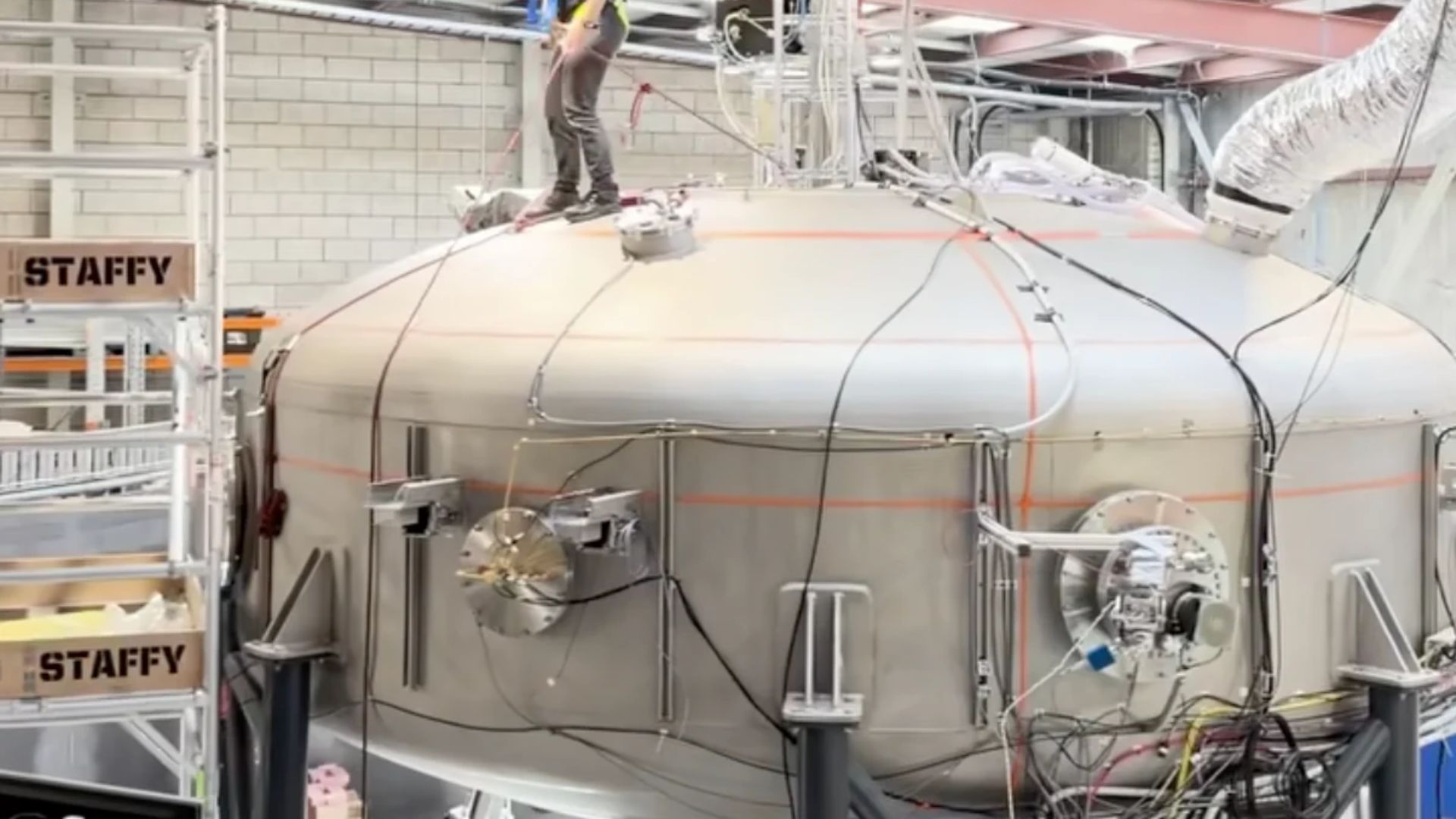
Key TakeawaysOpenStar and Columbia University will design the world’s first levitated dipole fusion divertor.The new exhaust system will safely clear extreme heat before damaging reactor walls.Researchers will validate computer models using Junior data before deploying designs on Tahi. The US Department of Energy (DOE) has selected OpenStar Technologies and Columbia University to design the world’s first exhaust system for a levitated dipole fusion reactor. Commercial nuclear fusion relies on trapping superheated gas—known as plasma—inside magnetic fields. However, every reactor must safely clear away heat and stray particles before they melt the machine’s interior walls. Typical fusion devices solve this using a “divertor,” which guides escaping plasma onto cooled target plates. No divertor has ever been built for a levitated dipole. Unlike conventional doughnut-shaped reactors that surround plasma with massive external magnets, a levitated dipole floats a single superconducting magnet inside a vacuum chamber. This mimics the natural magnetic fields of planets like Earth and Jupiter. Removing physical support struts eliminates a major pathway for heat to leak out, keeping the plasma stable. “The magnetic dipole is an elegant and remarkably simple fusion concept that remains largely unexplored,” said Prof. Ben Zhu, an assistant professor at Columbia Engineering. “A viable exhaust solution is among the most pressing challenges facing any fusion energy system, so what we learn here will contribute directly to the broader pursuit of commercial fusion power.” Modeling the magnetic edge Over the next 12 months, researchers will map how heat and particles behave at the edge of a dipole’s magnetic field. This geometry creates a true magnetic field null, known as an X-point. It forces engineers to look beyond standard reactor models. To do this, Columbia will pair two advanced software tools: TokaMaker and an open-source edge-modeling code called Hermes-3. The team will test their simulations against real-world data from OpenStar’s existing New Zealand prototype, Junior. In February, OpenStar used this $10 million machine to levitate a 0.5-ton magnet inside a five-meter vacuum chamber, successfully confining plasma heated to over one million degrees Celsius. “Working together with OpenStar we will investigate how to extend our basic physics knowledge to modeling tools,” said Dr Christopher Hansen, a Columbia research scientist who leads TokaMaker’s development. To debut on Tahi The project also marks a reunion for dipole pioneers. Columbia previously ran the original Levitated Dipole Experiment with MIT, where OpenStar’s Chief Science Officer, Dr Darren Garnier, served as chief experimentalist. He will lead the new effort alongside OpenStar Principal Scientist Dr Jerome Guterl. Their final divertor design will debut on OpenStar’s next machine, Tahi. Built to achieve fusion-relevant conditions, Tahi will initially produce neutrons for medical radioisotopes, serving as a stepping stone toward grid-scale fusion power plants. “We are excited to combine Columbia’s outstanding expertise in edge plasma modeling with the lessons learned from decades of tokamak divertor research to develop power and particle exhaust solutions for Tahi and future dipoles,” concluded Guterl. The partnership is backed by the DOE’s Innovation Network for Fusion Energy (INFUSE). This year, the program is distributing $8.5 million across 28 joint projects between private companies, national laboratories, and universities. OpenStar secured the grant through its American subsidiary, OpenStar USA. The company also won a second INFUSE award this round to develop plasma diagnostics with the University of California, San Diego.Get the latest in engineering, tech, space & science - delivered daily to your inbox.An active and versatile journalist and news editor. He has covered regular and breaking news for several leading publications and news media, including The Hindu, Economic Times, Tomorrow Makers, and many more. Aman holds expertise in politics, travel, and tech news, especially in AI, advanced algorithms, and blockchain, with a strong curiosity about all things that fall under science and tech.
Nuclear fusion reactor exhaust heat gets world’s first levitated dipole divertor tech
Full Article
Original Source
Read the full article at Interestingengineering →KhanList aggregates and links to publicly available news content. We do not host full articles from third-party sources. Always verify important information with original sources.