
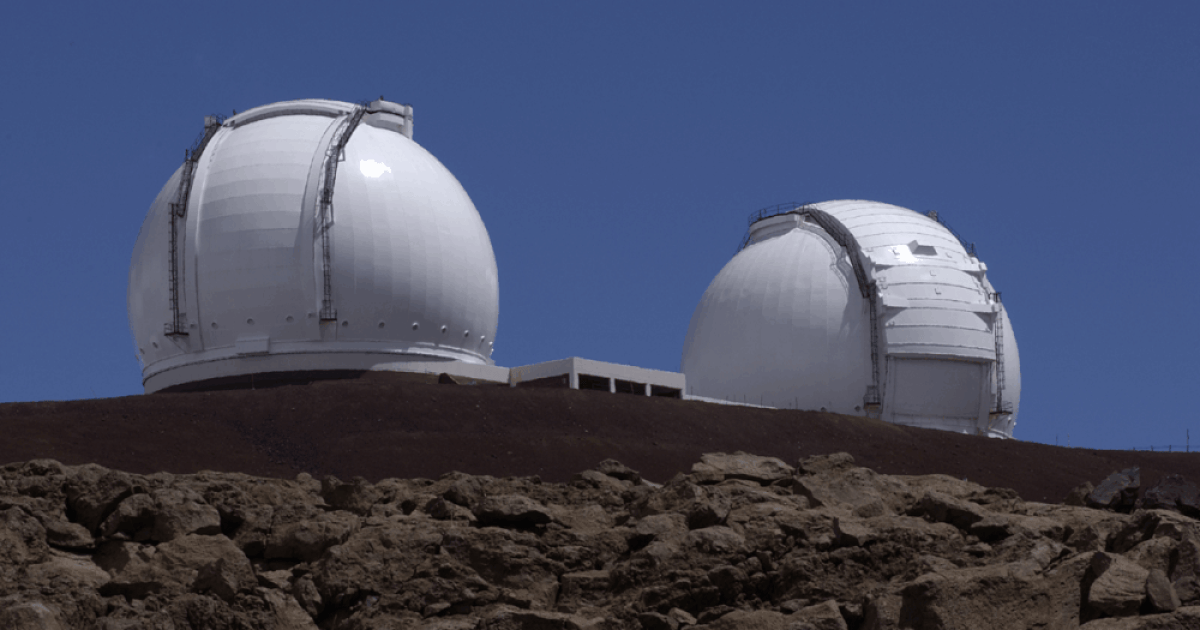
Today in the history of astronomy, the incomplete Keck telescope still achieves a successful image. | Published: November 24, 2026 The twin domes of the Keck telescopes mark one of many observatories on Maunakea in Hawaii. Credit: T. Wynne / JPL, Public domain, via Wikimedia Commons In 1985, the W.M. Keck Foundation donated $70 million for the University of California and Caltech to construct a new observatory on Maunakea in Hawaii. The twin telescopes of the Keck Observatory would be larger than any previous telescope, and the first to use a segmented-mirror design. The goal was a facility that could see farther out into the universe, and with more detail, to study exoplanets, black holes, star and planet formation, and more. On Nov. 24, 1990, with only nine of the 36 segments of its mirror in place, Keck I turned skyward and achieved first light. The telescope’s image of NGC 1232 was an auspicious beginning of a long career for the Keck Observatory, furthered when Keck I was completed in 1992, and when Keck II was constructed and saw first light in October 1996. The twin telescopes would become the most scientifically productive optical and infrared telescopes in the world. Elisa Neckar is senior production editor of Astronomy magazine, and the editor of the Today in the History of Astronomy feature on Astronomy.com.
Nov. 24, 1990: Keck I sees first light
Full Article
Original Source
Read the full article at Astronomy →KhanList aggregates and links to publicly available news content. We do not host full articles from third-party sources. Always verify important information with original sources.