
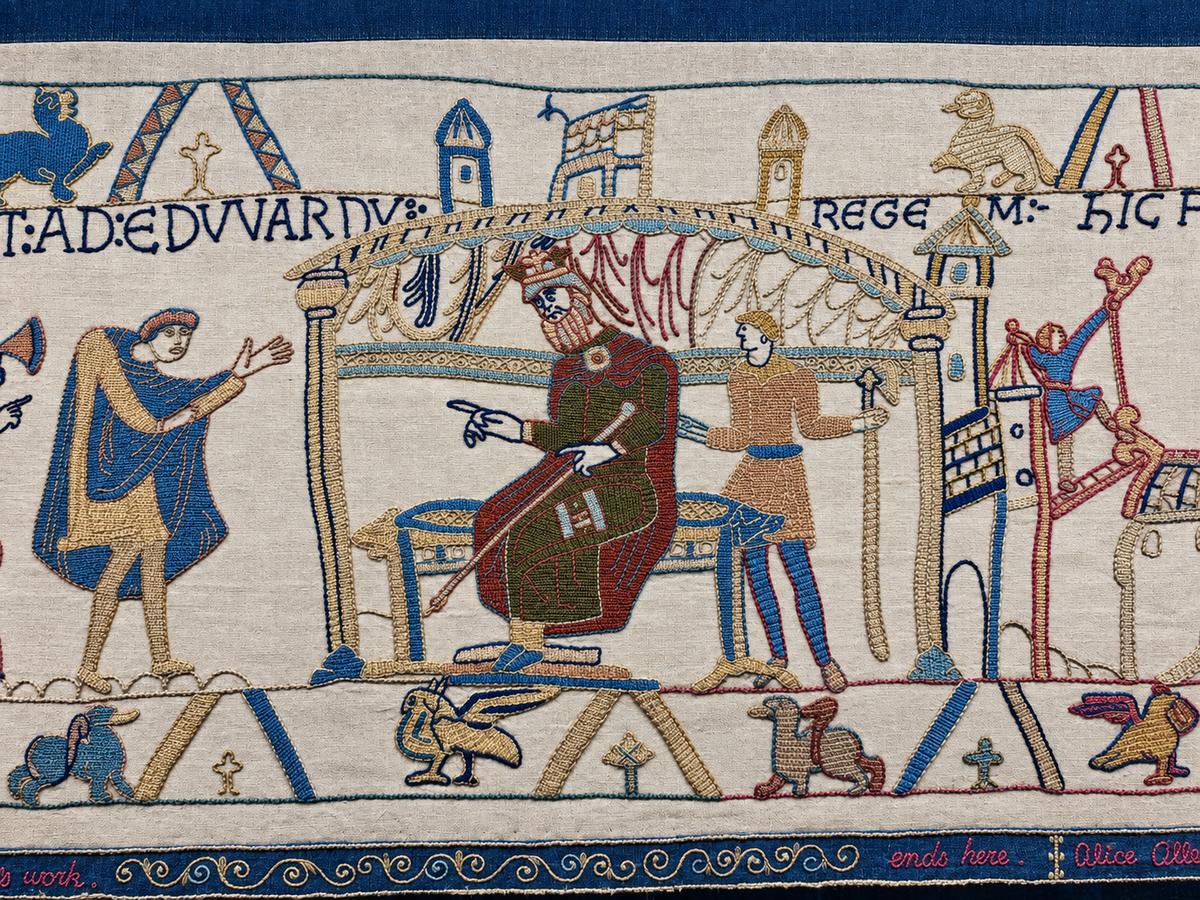
While the British Museum queues for Bayeux, Reading offers space to breathe: a full-scale Victorian version, Norman ruins, plus grand rooms and a surprisingly serious restaurant at The Roseate Reading.There are, admittedly, more obvious places in which to go looking for William the Conqueror. Bayeux would be one. The British Museum, currently showing the original embroidery on its historic loan from France, would be another, assuming one is prepared to participate in what one visitor recently described as “Glastonbury for the over-60s”. Or, there is Reading. Three or four minutes on foot from The Roseate Reading, inside the gloriously municipal Reading Museum, is Britain’s Victorian Bayeux Tapestry: roughly 70 metres of the surviving story, recreated at full scale. No scrum around Harold’s eye; no stranger’s shoulder advancing inexorably into your field of vision just as William lands at Pevensey. Admission, magnificently, is free.The Roseate ReadingPRESS HANDOUTBefore taking my daughter, Lyra, I described the Bayeux Tapestry as an eleventh-century graphic novel: kings, battles, ships, horses, feasts, omens and propaganda, frame-by-frame. Her verdict was less reverential. It looked, she said, like a badly drawn comic crossed with an old lady’s knitting club.This is not entirely unfair. The longer one stands before it, though, the stranger and more accomplished it becomes. Reading’s version is not, strictly speaking, identical to the original. It may preserve details since faded from its medieval ancestor; elsewhere the Victorians introduced their own morality (more on that later). But as a chance to get extremely close to one of Europe’s most consequential pieces of visual storytelling, without being hurried along, Reading has been hiding a cultural cheat code in plain sight.The Norman shortcutThe copy exists because Elizabeth Wardle, an accomplished embroiderer from Leek, decided England should have a Bayeux Tapestry of its own. After seeing the original in 1885, she recruited 35 women from across Britain to recreate all 70 metres of it, using her own study and hand-coloured photographs from what is now the V&A.Her husband, Thomas, a silk dyer and friend of William Morris, supplied the yarns; each embroiderer stitched her name beneath her section. Stand close and one charming truth emerges: some were considerably better at it than others.Finished in just over a year, it toured Britain, Germany and America before reaching Reading in 1895, where former mayor, Arthur Hill bought it for the town.This was more historically apposite than it sounds. William the Conqueror’s youngest son, Henry I, founded Reading Abbey in 1121, then was buried there in 1136. On our cool, windy walk from the hotel’s red carpet towards the museum, we passed straight through its ruins, enormous enough to make Reading suddenly feel less like somewhere reached by a fast train from Paddington and instead a place sitting rather squarely on top of English history. The route has pleasing logic: out of the former Shire Hall, through the abbey of the Conqueror’s son, then into a Victorian recreation of the story which put the family in charge.Britain's Bayeux TapestryDouglas BlydeThe tapestry rewards slowness. I particularly liked the banquets: convivial, happy, a rare interval in which nobody appears to be invading, betraying or dismembering anyone, before the omens, mobilisation and assorted medieval decapitation resume. There is Victorian censorship too. One naked fellow in the border acquires pants in Reading. For years the women of Leek were blamed for the prudery, unfairly; male staff at the South Kensington Museum had already added the underwear to the photographs they copied. The embroiderers were merely being accurate. Though, seeing the figure concerned, I did wonder whether the pants would actually fit.After a guided tour finished, people flocked in, forgive the pun, and queued at the beginning. Yet the embroidery is displayed in two long sections, so starting halfway produced an entirely different experience. At one point I stood virtually alone before the famous image of Harold apparently taking an arrow through the eye. The original ending is lost. On a separate wall Reading offers an imagined final panel, with William enthroned: an answer to a medieval cliffhanger. And the Victorian copy is now nearly 140 years old itself, with its own journeys, repairs, scholarship and conjecture. It has acquired a history of its own.Britain's Bayeux TapestryDouglas BlydeShire Hall after darkThe Roseate has civic history baked into it. Its Grade II-listed main building was constructed between 1904 and 1911 as Berkshire’s Shire Hall in emphatic Queen Anne mode: red brick, Portland stone, Doric columns and a groin-vaulted entrance hall. Berkshire County Council stayed until 1981. The building has strong bones. Purbeck marble, vaulted ceilings, and the original lift shaft survive, although into that shaft someone has suspended an Italian chandelier containing 86,000 beads, approximately the correct number for a former county administration depending on your attitude to local government. The old council chamber survives too, now the Eden room. Reading Crown Court sits next door. One former manager joked that boring through the wall would effectively put him in court, a hazard which may concentrate the mind when settling a hotel bill.Roseate Executive Suite PRESS HANDOUTThe former Berkshire Shire Hall has loosened up considerably since 1911. Alain Bonnefoit’s reclining nude now watches over the bed, prompting Lyra to stand on the mattress for a closer inspection. Civic administration did not, I suspect, originally involve quite so much buttock.The hotel belongs to Bird Group, whose interests follow an unusually broad flight path, from luxury hotels to ice skating. Not all bedrooms occupy the old Shire Hall either. The “House” sits across the car park in a former serviced-apartment block, creating an online schism between those who prefer history and those who prefer newer rooms and air conditioning. One TripAdvisor pilgrim compared moving from old to new to walking through first class before sitting in business.More curious is how little the hotel commercially exploits its location. The abbey ruins and Reading Museum are almost under its nose, yet Reading itself feels oddly faint once inside. There is surely an opportunity here for packages, guided walks, museum tie-ins and a stronger sense of place: reasons not merely to sleep in Reading, but to spend in it.Crab, caviar, melon, nashi pear, chervil juice, The Reading RoomPRESS HANDOUTReading, unexpectedly, eats wellIts restaurant provided the other surprise. The Reading Room sits at the more upholstered end of the town’s ambitions, overseen by executive chef, Rajesh Maharjan. On our visit, however, head chef Pridep Thapa seemed almost as present at our table as in his kitchen: precise, detailed, warm, returning to explain starter and main before pastry chef, Vishnu Santhosh appeared for the pre-dessert and pudding. We sat at the chef’s table among books on ingredients, fashion, art, Burgundy, and even books on books. The first indication that dinner might be rather better than expected arrived as an amuse-bouche of local beetroot prepared four ways. Warm, gentle, restrained, the beetroot had spent hours baking in herb-encrusted salt before being reworked into several textures, including something aerated, with chutney beneath. We were told some guests ask for an encore. Fair enough.Thapa’s explanation of the scallop was telling. The kitchen checks the following day’s bookings before ordering, so Orkney scallops arrive in shell specifically for that service rather than being held in stock. Ours was perfectly cooked, with pearl vegetables, golden caviar and Champagne foam. South Coast crab came with more caviar, melon, nashi pear and chervil juice, the melon a particularly good touch. “The Forest”, a chestnut mushroom velouté with truffle foam and artichoke crisp, was satisfyingly old school. Best of all was Dorset spring lamb with pressed potato, grilled cauliflower and tomato-and-fenugreek sauce, the meat marinated overnight with Indian spices while the potato terrine remained resolutely French. It could easily have become muddled and did not. Santhosh followed with an excellent strawberry and lemon pre-dessert, finished with olive oil and dried olive, then Jivara chocolate, hazelnut, salted caramel and brown-butter ice cream. No one appeared to be economising on ingredients.Chef’s Table, The Reading RoomPRESS HANDOUTI already had form with Reading. Earlier this year, we steered a cruiser for Thames Lido on one of those days when England decides it is Alicante. The kitchen’s refrigerated walk-in chose precisely that moment to die. This would have been a respectable excuse for surrender. Instead, the kitchen somehow pulled off a valiant service. Perhaps I should have known not to underestimate the town.The British Museum has the eleventh-century masterpiece until July 2027, although photography is restricted to keep visitors moving. Reading has a 140-year-old Victorian version you can examine at your own pace, a Norman abbey founded by the Conqueror’s son on the way there, a handsome former Shire Hall to sleep in afterwards, and a restaurant considerably more serious than I expected.For once, Reading may be the insider’s choice.
Normans, Nudes and No Queues: Reading’s Other Bayeux
Full Article
Original Source
Read the full article at Standard →KhanList aggregates and links to publicly available news content. We do not host full articles from third-party sources. Always verify important information with original sources.