
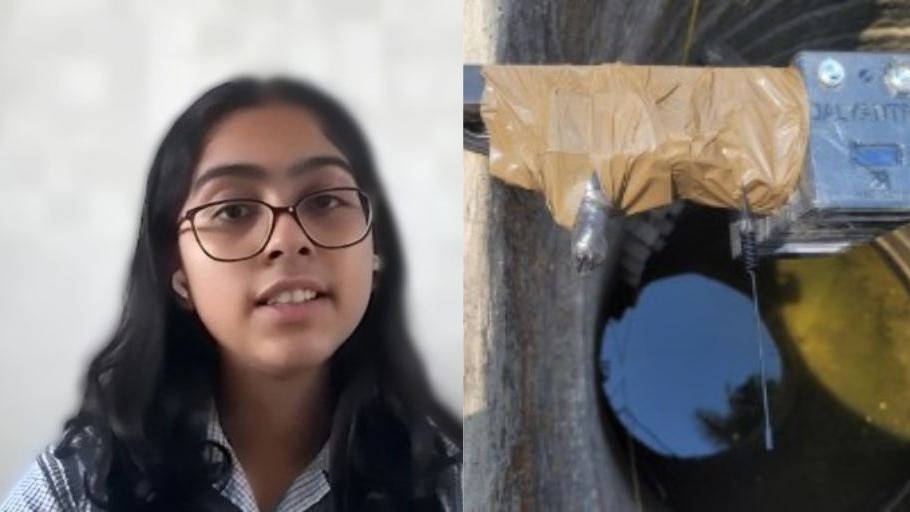
Kaavya Majumder, a Mumbai Class 11 student, has deployed JalYantra, a battery-free groundwater monitoring system, across villages in Maharashtra, helping communities track water levels, pumping activity and groundwater recovery without internet connectivity.No Wi-Fi, no batteries: Mumbai teen builds sensor to track groundwater in rural India (Image: jalyantra.tech)New Delhi,Nov 26, 2026 16:25 ISTGroundwater is a lifeline for millions of people in rural India, but monitoring its availability remains a challenge in areas that depend on wells. A Class 11 student from Mumbai is trying to change that. Kaavya Majumder, a student at Dhirubhai Ambani International School, has developed JalYantra, a groundwater monitoring system that operates without Wi-Fi, batteries or solar panels. What started as a school project is now being deployed in villages across Maharashtra.Groundwater levels fluctuate with rainfall, seasonal changes and water extraction. Yet, people who depend on wells often lack reliable ways to track these variations, sometimes discovering a drop in water levels only when their pumps stop drawing water. Kaavya set out to bridge this information gap by developing a system that could continuously monitor groundwater levels and present the findings in an easy-to-understand format, as reported by EdexLive.JalYantra is an Internet of Things (IoT)-based monitoring system that uses sensors installed in wells to record groundwater depth and pumping activity. The collected information is made available through a mobile-friendly dashboard, allowing users to observe changes over time and understand how quickly a well recovers after water is extracted.The project also includes a portable, handheld version that can be used to survey multiple wells without installing permanent sensors at every location. NINE SENSORS, EIGHT VILLAGES AND A GROWING BODY OF DATATaking a technology project beyond the classroom is rarely easy, especially when it is intended for rural communities. Poor internet connectivity, high infrastructure costs and the challenges of maintaining equipment can often prevent promising solutions from reaching the people who need them most.Kaavya developed JalYantra with these ground realities in mind. Designed to function without Wi-Fi, batteries or solar panels, the system offers a practical alternative for areas where conventional groundwater monitoring technologies may be difficult to install and maintain. According to information on the project's website, JalYantra has established a network of nine active sensors across eight village communities. The installations span Nagpur, Mumbai, Buldhana, Washim, Gondia, Ratnagiri, Raigad and Palghar.So far, the system has recorded more than 250,000 groundwater-depth readings, building a growing database of local water patterns.These readings are important because a single measurement offers only a snapshot of groundwater availability. Continuous monitoring, on the other hand, can reveal seasonal variations, declining water levels and how quickly groundwater replenishes after extraction. This information can help communities better understand their local water resources and make more informed decisions about their use.WHY COMMUNITY PARTICIPATION MATTERSFor Kaavya, developing the technology is only one part of the challenge. Ensuring that it reaches the right people and generates useful information requires working closely with communities.She has partnered with Krushi Vikas Va Gramin Prashikshan Sanstha, a Maharashtra-based organisation involved in sustainable agriculture, rural development and soil and water conservation. The organisation has supported JalYantra's field deployments, particularly across the Vidarbha region.The partnership also helps bridge the gap between technological innovation and its practical use. By working with local communities, the project aims to ensure that groundwater readings are not just collected but understood and used to inform decisions about water management.Rather than positioning JalYantra as an instant solution to water shortages, the project focuses on providing reliable information that can support better-informed conversations and decisions about groundwater use.FROM MAHARASHTRA TO AN INTERNATIONAL WATER SUMMITKaavya's work has also received international recognition. She is presenting JalYantra at InnoHub during the International Water Association (IWA) Digital Water Summit 2026 in Istanbul, being held from November 24 to 26.The summit offers her an opportunity to showcase the project to an international audience, exchange ideas with experts and learn from others working on water management and digital monitoring solutions.Looking ahead, the focus is on improving the system's reliability, expanding its reach and making groundwater data easier for local communities to interpret and use.For a Class 11 student, taking a school project into villages across Maharashtra is a significant achievement. But the larger significance of Kaavya's work lies in the problem she has chosen to address.JalYantra may not solve India's groundwater crisis on its own, but it is helping communities move from guesswork to data when it comes to understanding their water resources. By making groundwater levels easier to monitor and interpret, the project is attempting to turn information into a tool for better water management.- Ends
No Wi-Fi, no batteries: Mumbai teen builds sensor to track groundwater in rural India
Full Article
Original Source
Read the full article at Indiatoday →KhanList aggregates and links to publicly available news content. We do not host full articles from third-party sources. Always verify important information with original sources.