
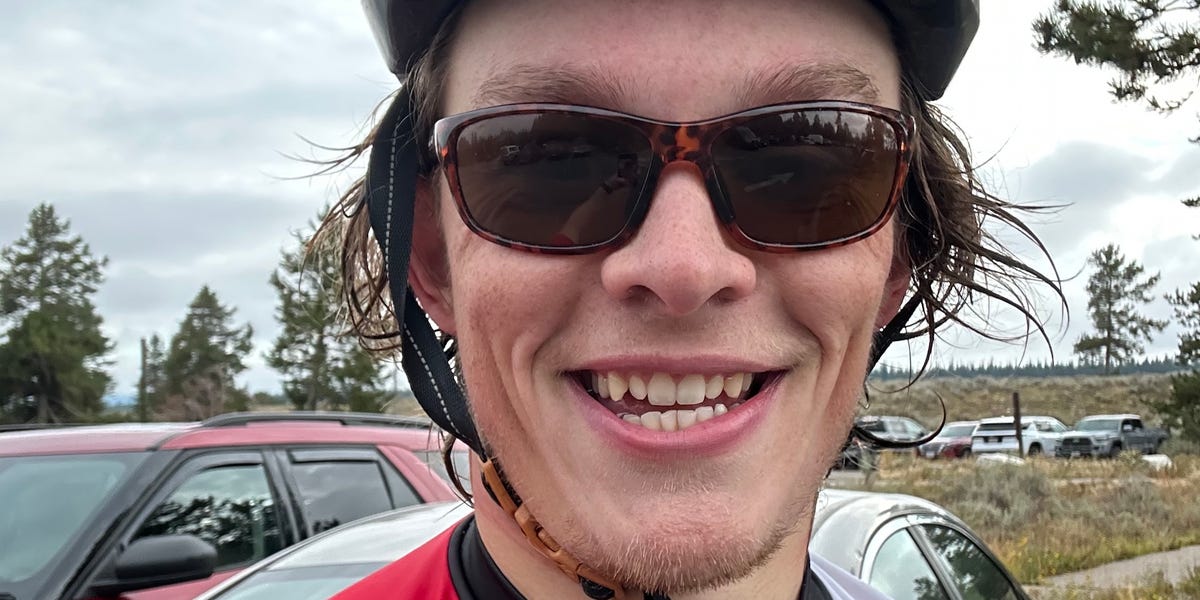
Late last year, a friend in Seattle suggested we train for an Ironman 70.3 from opposite coasts. He did the runs, swims, and bike rides along the Pacific Ocean, and I followed suit along the Chesapeake Bay. We weren’t sure whether we’d meet in the middle for an organized event in Nebraska, or save on travel costs with an unofficial “Do-It-Yourself” approach in our backyards.About halfway through training, he dropped out because of a knee injury. I soldiered on. After 16 weeks of prep, I felt ready, so I set out on my own—no aid stations or medals waiting at the finish line—and accomplished the trek to Annapolis, Maryland, and back in the middle of a snowstorm, with 84 laps in the community pool counting as my 1.2-mile swim.Later on, I moved to Jackson, Wyoming, where my runs, swims, and bike rides would take place in the shadow of the Tetons. I decided to increase my training workload to try for a full-distance Ironman, also DIY, in Grand Teton National Park. I doubled everything from the 70.3 training block except for the weekend long runs. The schedule as written would have quickly had me running marathons the day after punishing bike rides that took half a day and marked my longest-ever distances in the saddle.Evan Robinson-JohnsonEvan Robinson-Johnson in Grand Teton National ParkIt wasn’t easy. Trail runs and lake swims easily eclipsed the distances I’d done for my high school cross country and swim teams, respectively. And the time was hard to schedule around my 9-to-5. I found a few encouraging partners to swim, ride, and bike with, but I did the majority of the sessions on my own.The joy of training in pristine wilderness, as spring turned to summer, turned out to be solid motivation. After missing only a handful of workouts over 16 weeks, I felt ready.I had done another solo half-Ironman to get a feel for the course, my gear, and my fitness level. The week before my target DIY attempt on August 8, I raced a short gravel triathlon with some friends in Steamboat Springs, Colorado, placing second in the first-timers category.An ill-fated first attemptThe week of my taper, I relaxed with virtually no workouts. On the day of my attempt, unfortunately, a thick smoke from a West Coast wildfire filled the valley. The swim felt fine, and the bike ride was issue-free, but I could feel my lungs working overtime. By the time I started the run, I couldn’t fathom the marathon ahead of me. Temperatures crested at 80°F, and I was dipping my face and hands in every available stream.Seven miles in, I started walking and, from there, it was all over. Doing an Ironman without any of the pressure of an organized event means it’s much easier to quit at any point. And the moment I FaceTimed my parents to fill them in, I knew I could just as easily come back and try again the following weekend. No pricey entrance fee or travel to make up. This is my backyard.So I waited for the smoke to clear, made sure to do a more reasonable taper, and tried again the following weekend, with some of the nerves already shaken out.Sure, these are luxuries I wouldn’t have had if I’d done a “real” Ironman. But it’s certainly in line with the ethos of these mountains: Sometimes it’s not your summit day. Buoyed by a friend’s words of encouragement (“You have the fitness; you just need a better day”), I packed up the car again and set off for Jenny Lake.More sugar, and a trail-side saviorThis time, I had my nutrition more dialed: instead of 20-gram protein bars, I packed apple slices and an egg sandwich. The smoke was gone and overcast skies kept temperatures cool. Halfway through the bike ride, a light rain helped chill me even more.One hundred miles in, disaster struck. My bike’s rear wheel went flat. Rookie road cyclist that I am, I had failed to heed the advice of a more experienced friend to invest in a patch kit. But the trail gods were smiling on me. I pulled right into the Jackson Lake Lodge, where, to my great luck, a pair of bikepackers on their way down the Continental Divide were happy to share some basic supplies.Evan Robinson-JohnsonIn 30 minutes, I was back on the way to Jenny Lake, and made it into the parking lot—just as the tire went flat again. I nervously glanced at the odometer: 112.05 miles. Phew!I felt I owed it to my trail fairy Don to complete the challenge at this point. In a break from official Ironman rules, I allowed myself headphones and music, figuring they were replacing some of the hype of fellow competitors and spectators on a real course.After 26.2 medium-speed miles, I clicked stop on my watch and collapsed into the cool waters of Jenny Lake as the pink hues of sunset framed the mountains that had been my guide.“I will forever be a changed man,” I thought to myself. I slept in late the next day, and returned to work on Monday, proud but mostly unchanged. What followed might surprise you.What really mattersAs the days became shorter and the water colder, a next goal failed to materialize. I fell off my tri-sport routine and started to tick off a few longer hikes instead. I don’t know if I’ll ever do an actual, sanctioned Ironman.I admire the YouTubers who inspired me to keep up with my training. I understand the appeal of qualifying for the championships in Hawaii. For me, I was simply curious if my body could string together the distances. It was enough that my friend in Seattle called me a beast.Oddly, I didn’t feel stronger, or more disciplined, or more motivated than when I had started. It was great to have a distraction from work and the chance to push myself in another realm. But, absent others doing the exact same things at the same time, the distances felt arbitrary.One blessing of living so close to a national park is there are countless adventures and challenges nearby. A few years ago, I tried my hand at the Teton Triathlon. Also known as The Picnic, this unsanctioned endeavor starts with a 20-mile bike ride to Jenny Lake, which you swim across before climbing Grand Teton, the tallest mountain in the range (its summit is 13,775 feet, about 7,000 feet above the Jackson valley), before descending and doing it all in reverse, swimming back across the lake (about 1.2 miles) and biking back to town. It took me 22 hours, and I’d do it again in a heartbeat.There’s nowhere else in the country you can do anything quite like it. And, to me, the point is to test yourself, rather than beat a field of neoprene-clad athletes. The joy of completing even an unsanctioned Ironman in Grand Teton National Park paled in comparison to the deep satisfaction I felt after completing The Picnic.A few friends told me it was more impressive to do the Ironman without competitors and fans urging me on. I understand how the public nature of competition helps some people push through hard training days and the race itself. I don’t know that it would have made a difference for me.When I ran the Chicago Marathon a few years ago, the mandatory fundraising gave that race meaning. I wasn’t bummed that I didn’t qualify for Boston because I’d still hit my dollar goal.A few weeks after this summer’s Ironman, I accompanied a man running a 50K route in every state in 50 days to raise $1 million for charity. He said that, after a few years of ultramarathons, he wanted to give his time and effort a greater purpose, and doing it for the Make-A-Wish Foundation did that.That single slow, conversational 50K holds as much meaning for me as all the work I did for my own Ironman. Maybe because it’s a fraction less selfish. Or maybe because it was shared.That experience, and that man, have stayed with me. I think both of us are chasing something similar in our non-running lives.Find Your Next Running Playlist
No Medal, No Aid Stations, No Crowd: What a Solo Ironman Through a National Park Taught Me
Full Article
Original Source
Read the full article at Runnersworld →KhanList aggregates and links to publicly available news content. We do not host full articles from third-party sources. Always verify important information with original sources.