
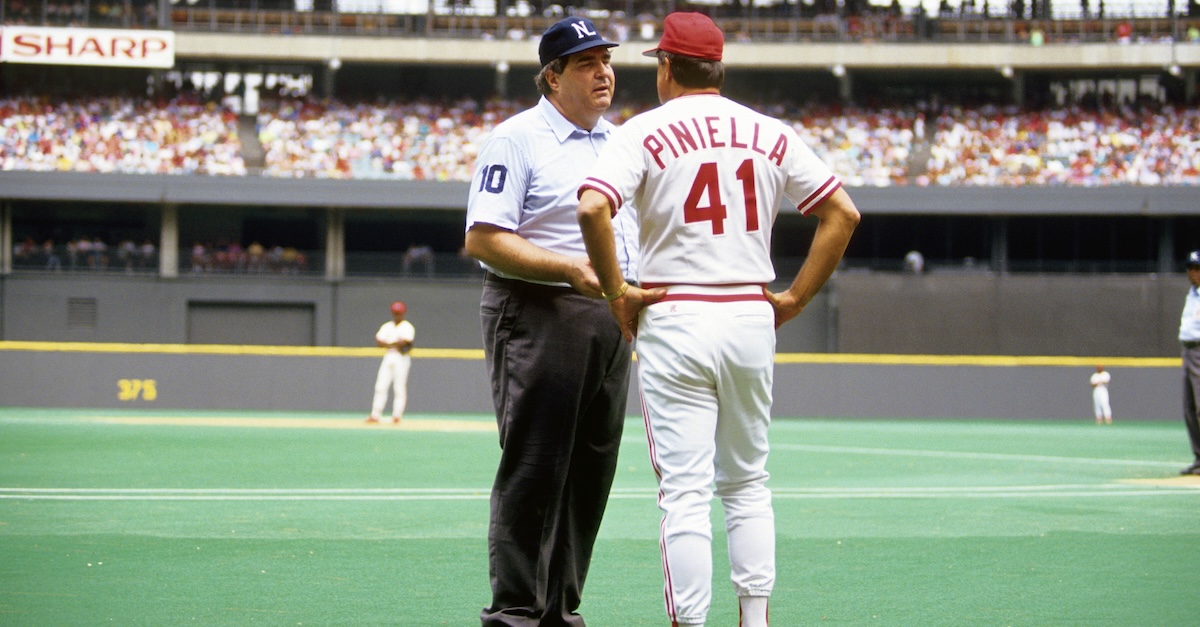
RVR Photos-USA TODAY Sports This post is part of a series covering the 2027 Contemporary Baseball Era Committee Managers/Umpires/Executives ballot, which includes candidates in those categories who made their greatest impact from 1980 to the present. You’ll find an introduction to the ballot here. The eight candidates will be voted on in San Diego on December 6, and anyone receiving at least 75% of the vote from the 16 committee members will be inducted in Cooperstown on July 25, 2027 along with any candidates elected by the BBWAA. 2027 Contemporary Baseball Candidate: Manager Lou Piniella Manager G W-L W-L% G>.500 Playoffs Pennants WS Lou Piniella 3548 1835-1713 .517 122 7 1 1 AVG HOF Mgr* 3636 1943-1673 .537 270 7 5 2.5 Source: Baseball-Reference * Average based on the careers of 22 enshrined AL/NL managers from the 20th and 21st centuries Lou Piniella spent even more years managing in the majors (23, between 1986 and 2010) than he did playing the outfield (18, between 1964 and ’84). To both roles, “Sweet Lou” brought a flair for the dramatic and a fiery intensity — his dust-kicking, hat-stomping, base-throwing tirades became the stuff of legend — as well as tremendous baseball acumen. Like fellow 2019 Today’s Game and 2024 Contemporary Baseball candidate Davey Johnson, he won championships in both phases of his career, but his failure even to reach the World Series a second time as a manager cast a long shadow on every successive stop. Unlike Johnson, he came close to election on both of those ballots, missing by just one vote each time. However, that doesn’t mean it will be easy for him to get to 75% this time. A native of Tampa, Florida, Piniella was signed by Cleveland as an amateur free agent in 1962. Before getting a foothold in the majors, he passed through the hands of the Washington Senators, the Baltimore Orioles (for whom he played four games in 1964), Cleveland (again, with a brief 1968 cameo) and the Seattle Pilots. He spent spring training with the expansion Pilots, where he caught the attention of Jim Bouton, who memorialized the rookie’s hot temper (and baseball’s wonderful terminology for such a case) in Ball Four by writing, “Lou Piniella has the red ass.” More, from one of Bouton’s diary entries less than a week later: “Piniella is a case. He hits the hell out of the ball. He hit a three-run homer today and he’s got a .400 average, but they’re easing him out. He complains a lot about the coaches and ignores them when he feels like it, and to top it off he’s sensitive as hell to things like Joe Schultz not saying good morning to him. None of this is supposed to count when you judge a ballplayer’s talents. But it does.” The Pilots ended up trading Piniella to the American League’s other expansion team, the Kansas City Royals, on April 1. Piniella pulled himself together, winning AL Rookie of the Year honors with the Royals in 1969. A high-average contact hitter who didn’t have a ton of patience or power (as his .291/.333/.409 line suggests), he was particularly potent as a lefty-masher. He made the AL All-Star team in 1972, and after being traded to the Yankees in December ’73, he would contribute to four pennant-winning teams, including their ’77 and ’78 championships. His reputation preceded his arrival in the Bronx. “Yes, I had a bad temper,” Piniella said in 1974, his first spring as a Yankee. “I guess I was trying to succeed too much. I probably was trying to exceed my capabilities and was expecting perfection all the time. When I couldn’t reach it, I’d get mad at myself… Last year, they had a wire mesh screen around the water cooler at the new park in Kansas City so I couldn’t kick that one.” You Aren't a FanGraphs MemberIt looks like you aren't yet a FanGraphs Member (or aren't logged in). We aren't mad, just disappointed. We get it. You want to read this article. But before we let you get back to it, we'd like to point out a few of the good reasons why you should become a Member. 1. Ad Free viewing! We won't bug you with this ad, or any other. 2. Unlimited articles! Non-Members only get to read 10 free articles a month. Members never get cut off. 3. Dark mode and Classic mode! 4. Custom player page dashboards! Choose the player cards you want, in the order you want them. 5. One-click data exports! Export our projections and leaderboards for your personal projects. 6. Remove the photos on the home page! (Honestly, this doesn't sound so great to us, but some people wanted it, and we like to give our Members what they want.) 7. Even more Steamer projections! We have handedness, percentile, and context neutral projections available for Members only. 8. Get FanGraphs Walk-Off, a customized year end review! Find out exactly how you used FanGraphs this year, and how that compares to other Members. Don't be a victim of FOMO. 9. A weekly mailbag column, exclusively for Members. 10. Help support FanGraphs and our entire staff! Our Members provide us with critical resources to improve the site and deliver new features! We hope you'll consider a Membership today, for yourself or as a gift! And we realize this has been an awfully long sales pitch, so we've also removed all the other ads in this article. We didn't want to overdo it. In case you didn't read all that, here's the short version. Membership includes:✓Ad-free browsing✓Unlimited FanGraphs & RotoGraphs articles✓Historical & platoon projections✓Leaderboard & player-page stat heatmaps✓One-click data exports✓Customizable player-page dashboards✓Dark & Classic site modes✓Weekly Members-only mailbag✓FanGraphs Walk-Off, your year in review✓Optional homepage photo removal✓Gift articles to non-Members✓Full postseason coverage A left shoulder ailment limited Piniella’s playing time late in his career, so he became the Yankees’ hitting coach under manager Yogi Berra in 1984 while still a reserve outfielder. By mid-June, he decided to retire as a player so as to take over first base coaching duties as well. In 1986, he became the team’s manager, that during an era when owner George Steinbrenner was eating managers for breakfast and lunch. Billy Martin, in his fourth of five stints managing the team, had gone 91–54 in guiding the Yankees to second place in relief of Berra in 1985, but he was fired yet again, this time after an infamous late-September brawl with pitcher Ed Whitson. With 25-year-old Don Mattingly hitting a sizzling .352/.394/.573 in the follow-up to his MVP-winning campaign, Piniella’s Yankees won 90 games in 1986 but finished second, 5.5 games behind the Red Sox. After New York slipped to fourth despite winning 89 games in 1987, general manager Woody Woodward resigned. Steinbrenner rehired Martin for the final time and “promoted” Piniella to general manager. The job was not a fit. “After 25 years in uniform, I wasn’t used to the office aspects of it, the confinement,” he told The New York Times. “I enjoy the baseball part of it very much. When I talked to other general managers about talent, I enjoyed that aspect.” Piniella resigned as GM on May 29, 1988, downplaying rumors of clashes with Martin over personnel, though within the organization there was awareness of the friction. Less than a month later, with the team in a slide, Martin ran out of rope via a series of alcohol-related incidents, including one that left him with 40 stitches following an altercation in a topless bar in Texas. Steinbrenner fired him for the fifth and final time, and Piniella returned to the dugout. After the Yankees went just 45–48 under him en route to an 85–76 finish, Steinbrenner fired Piniella with two years remaining on his contract, the first of which he spent in the Yankees’ TV booth. In November 1989, Piniella escaped from New York to become the manager of the Reds. Replacing Pete Rose, who had just landed on the permanently ineligible list for gambling, he inherited a team driven by stars Barry Larkin and Eric Davis as well as the “Nasty Boys” bullpen of Norm Charlton, Rob Dibble, and Randy Myers. His first year in Cincinnati was the most successful one of his managerial career: The Reds went 91–71 and won the NL West (the Senior Circuit’s screwed-up geography somehow had both Cincinnati and Atlanta in the West and St. Louis and Chicago in the East) and the World Series, the last by sweeping the heavily favored A’s, the defending champions. The Reds collapsed to just 74 wins in 1991, and despite rebounding to 90 wins in ’92, Piniella resigned at season’s end, just weeks after brawling with Dibble. His departure owed less to the fight than to owner Marge Schott’s lack of support when he was sued for defamation by umpire Gary Darling. Following the reversal of a home run call in a 1991 game, Piniella had publicly proclaimed that Darling was biased; Schott refused to pay for a lawyer, forcing Piniella to do so out of his own pocket. The suit was eventually settled out of court, and Piniella issued a statement of apology, retracting his comments and praising Darling and umpires in general. “But I got no backing,” he said of Schott, who by the time of his comments had been suspended for a year due to racially insensitive remarks. “It got in my craw. That was the big thing.” Piniella wasn’t out of a job for long. In November 1992, he reunited with Woodward in Seattle, where the Mariners had finished with a winning record just once in 16 years. With young Ken Griffey Jr., Randy Johnson, Edgar Martinez, and later Alex Rodriguez, he oversaw the most successful stretch in franchise history. The Mariners went 82–80 under Piniella in ’93, the first of seven times in 10 seasons (through 2002) that they’d post a winning record. They made the playoffs four times on his watch but have done so just twice since then. During the strike-abbreviated 1995 season, Piniella’s team overcame a sub-.500 first half (34-35) and a 12.5-game deficit to finish the 144-game schedule tied with the Angels atop the AL West at 78-66. They won the one-game tiebreaker, then beat the Yankees in a thrilling five-game Division Series that ended with Martinez bringing Griffey home as the winning run via The Double. The excitement of the moment helped generate the groundswell of support that secured the Mariners a new taxpayer-funded stadium within a week of the series’ end. Piniella won the first of his three Manager of the Year awards that year. He took the Mariners back to the playoffs in 1997, 2000 (after Johnson and Griffey had been traded in advance of their free agency), and ’01 (after Rodriguez had departed in free agency). Fueled by the arrival of Ichiro Suzuki, the 2001 Mariners tied the major league record with 116 wins, and Piniella garnered his second Manager of the Year award. Yet his Seattle teams never advanced past the ALCS, falling at the hands of the Yankees in both 2000 and ’01. Often, they were limited by horrible bullpens, and Piniella made matters worse; the 1997–99 units all finished with ERAs of 5.44 or above and totaled an AL-low 0.7 WAR over that span, squandering the last years of the Johnson/Griffey/Rodriguez nucleus. After winning 93 games in 2002, Piniella, who still had one more year under contract, decided he wanted to go home to Tampa to help care for his ailing mother. The Mariners obliged by trading him and infielder Antonio Perez to the Devil Rays in exchange for outfielder Randy Winn, who was coming off his lone All-Star season. Though Piniella guided the expansion team to its first 70-win season in 2004, the Devil Rays weren’t able to progress further, and he became frustrated by the team’s minimal payrolls. After agreeing to a buyout with one year remaining on his deal, he became the manager of the Cubs in October 2006. He succeeded Dusty Baker in Chicago, while in Tampa Bay, Joe Maddon succeeded him; both are on this ballot alongside Piniella. With a cast led by Derrek Lee, Aramis Ramirez, Alfonso Soriano, and Carlos Zambrano (a man with an infamous temper of his own), Piniella’s Cubs won back-to-back NL Central titles in 2007 and ’08. He won his third Manager of the Year award in the latter year after leading the Cubs to a league-high 97 wins, but in both of those seasons, his squads were swept out of the Division Series. The Cubs declined to 83 wins in 2009, and in August of the following year, with the health of his mother again in mind, he stepped down for the final time. Because he managed for 21 full seasons plus two partial ones, Piniella ranks high in managerial counting stats. He’s 16th in games managed overall, and fifth behind ballot-mates Bruce Bochy and Baker, the still-active Terry Francona, and Gene Mauch among skippers outside the Hall. Piniella is 17th in wins, trailing only that quartet (Baker, Bochy, Francona, and Mauch, in that order) among those not enshrined. He’s tied for 17th with seven playoff appearances, a total aided by a career spent mostly in the Wild Card era; even so, 11 contemporaries have as many or more such appearances. Due in part to his time in Tampa Bay, he’s a modest 122 games above .500, 46th all-time (including only AL/NL and bygone 19th-century major leagues). Even if you wave off his time there (200–285, .412), he’d rank just 29th. It’s worth noting that a low winning percentage isn’t itself disqualifying for the Hall of Fame; many a great manger has found himself stuck in a noncompetitive situation for years at a time but offset that with their success. Connie Mack (.486) and Bucky Harris (.493) are in Cooperstown despite sub-.500 records, Wilbert Robinson is right at .500, and Casey Stengel finished at .508. But Stengel won 10 pennants and seven World Series, all with the Yankees after years piloting mediocre National League teams. Mack won nine pennants and five World Series between tear downs of the team he owned, and Harris won three pennants and two World Series. Robinson’s total of two pennants without a championship is something of an outlier in this context, but he was a larger-than-life personality for a team that was often severely outmanned. Bochy, who’s 14 games below .500 (2252-2266, a .498 winning percentage), nonetheless won five pennants and four World Series. The positives for Piniella’s case boil down to his longevity, a championship in Cincinnati, a memorable run that legitimized major league baseball in Seattle, and one hell of a highlight reel for his tantrums. His playing career, with 12.5 bWAR, doesn’t add much of a bonus if one wants to think along those lines; if we start playing that game, he loses ground to managerial giants like John McGraw, Stengel, contemporary Joe Torre, and Baker (37.0 bWAR), to name just a few. Piniella’s positives are offset by his lack of postseason success beyond 1990 — his teams won just three series in his final 18 full seasons — and a comparatively unexceptional winning percentage. Even if you exclude his lost-cause Devil Rays stint, his .533 would rank 34th among managers with at least 1,500 games, one point ahead of Maddon including the latter’s two seasons of 90-plus losses after taking over in Tampa Bay. Ultimately, Piniella’s case as a Hall of Fame manager rests more on longevity than sustained success, either in the regular season or postseason. As I wrote when he stepped down in 2010, “In a world where [Whitey] Herzog and [Dick] Williams — two innovators who won multiple pennants and made the playoffs more frequently without benefit of the Wild Card — needed a quarter of a century to gain election via the Veterans Committee, I just don’t see how Piniella has got enough to get into Cooperstown.” Despite my own affinity for him, that feeling is even stronger now that the more-decorated and longer-lasting Baker and Bochy are alongside him on this ballot. I don’t have a vote, and I have more homework to do before I’d settle on my top three candidates, but I don’t see how I could conclude Piniella is more worthy of induction than not only that pair but also Maddon (who won two pennants and a championship), and fellow candidates Sandy Alderson (who as GM built three pennant-winners and one championship team in Oakland), and Brian Sabean (who as GM built four pennant winners and three championship teams in San Francisco after helping to lay the foundation for the Yankees’ success under Torre). That said, Era Committee members have generally supported Piniella. He received seven votes on the 2017 Today’s Game ballot from which John Schuerholz and Bud Selig were elected, then 11 two years later. Since then, each of the other candidates who had fallen one vote short on at least one Veterans or Era Committee ballot has been elected: Elected to the Hall of Fame Since 2017 After Previously Falling One Vote Short Candidate 1 Vote Short Elected Marvin Miller 2011 Expansion 2020 Modern Baseball Ted Simmons 2018 Modern Baseball 2020 Modern Baseball Gil Hodges 1993 Veterans* 2022 Golden Days Tony Oliva 2015 Golden Era 2022 Golden Days Dick Allen 2015 Golden Era, 2022 Golden Days 2025 Classic Baseball * = Unofficial, as vote totals were not publicly announced. Hodges’ near-miss gets an asterisk, because Veterans Committee vote totals weren’t officially announced in that era. The well-weathered story from biographer Danny Peary is that Veterans Committee chairman Ted Williams would not allow the hospitalized Roy Campanella to cast a vote by telephone, leaving his former Brooklyn Dodgers teammate with 11 out of 15 votes (73.3%). Heading into the 2024 Era Committee election, it didn’t appear that any candidate was a slam dunk, but in the end, Jim Leyland — who won three pennants and one championship — received 15 votes, with Piniella a distant second with 11. Unless the as-yet-named committee is particularly sympathetic towards Piniella, however, I don’t expect Sweet Lou to come even that close.
2027 Contemporary Baseball Era Committee Candidate: Lou Piniella
Full Article
Original Source
Read the full article at Blogs →KhanList aggregates and links to publicly available news content. We do not host full articles from third-party sources. Always verify important information with original sources.