
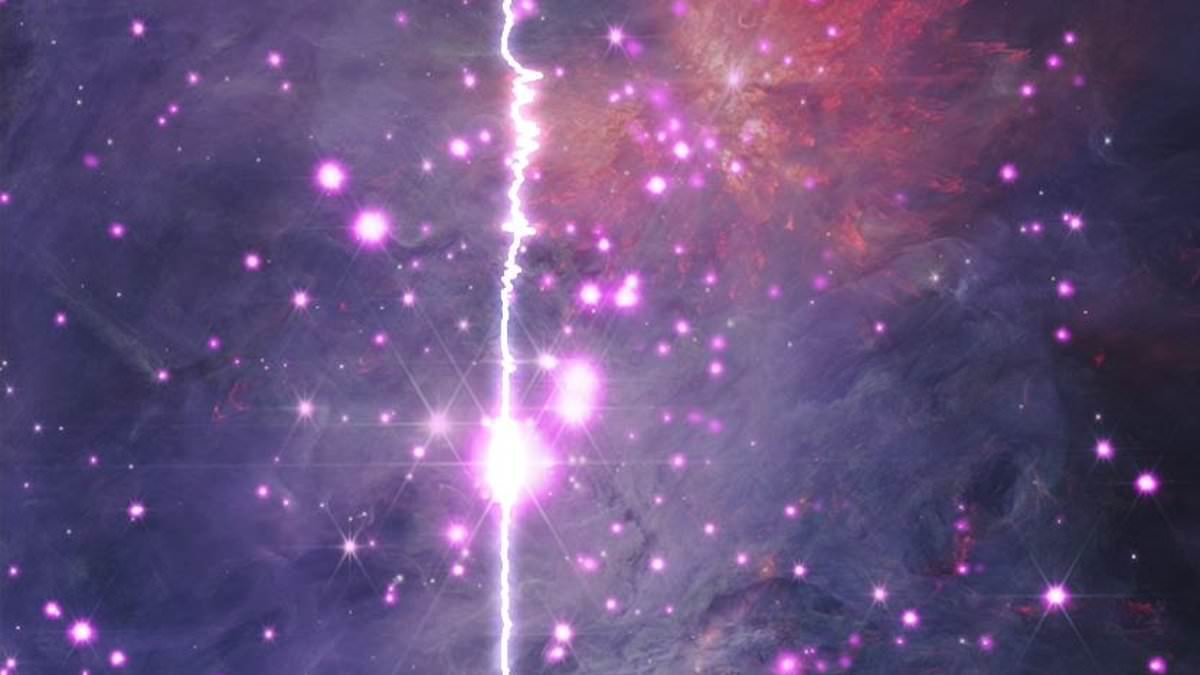
Nasa has revealed the eerie sounds made by baby stars as they burst into life.Using the Chandra X-ray Observatory, the space agency has collected snapshots of newborn stars across the Milky Way and out in far-away galaxies.Researchers used a technique called 'sonification' to transform the raw data from the telescopes into sounds that the human ear can recognise.But these stellar babies aren't cooing or gurgling; and the results range from beautiful string arrangements to haunting low-frequency drones.In these videos, you can hear the twinkling sounds of energetic new stars igniting in clouds of gas within the Orion Nebula.Meanwhile, in the distant 'Cosmic Cliffs' of the Carina Nebula, short stabbing string sounds pick out the individual baby stars peeking through the dust.Nasa says that each sonification starts with real data captured by space telescopes, and transforms this using a process tailored to the specific data.It explained: 'Each sonification is created to best portray the scientific data in a way that makes the most sense for the specific data, keeping it accurately represented and telling the story, while also providing a new way of meaning-making through sound.' Researchers used a technique called 'sonification' to transform the raw data from star-forming regions from telescopes into sounds that the human ear can recogniseEach of the four new sonifications shows a specific region that is associated with high rates of new star formation.While stars like our sun are already billions of years old, new generations of stars are constantly forming from clouds of collapsing dust.These 'stellar nurseries' are places in the universe where the conditions are just right for hundreds or even thousands of stars to get started in a relatively small region.One of the closest and busiest of these regions is the Orion Nebula, which can be seen with amateur telescopes just below the 'belt' in the Orion constellation.Located 1,267 light-years from Earth, this nebula is usually shrouded by clouds of dust, but the Chandra X-ray Observatory can see more than a thousand stars that are very energetic and active in their infancy.In the sonification, these stars are rendered as twinkling sounds, while the diffuse X-ray radiation can be heard as pure tones.Infrared data from the James Webb Space Telescope (JWST) also reveals the vast regions of dust and gas used to build these new stars, which are converted to 'lower musical tones, distorted string instruments, and a digital harp'. The Orion Nebula (pictured), one the of busiest star-forming regions close to Earth, contains more than a thousand stars that are very energetic and active in their infancyAt the very other end of the scale, Nasa has also captured data from the galaxy Messier 82, located about 12 million light-years from Earth.Messier 82 is a 'starburst galaxy', so-called because stars form there at a rate tens or even hundreds of times higher than in the Milky Way.Even at this staggering distance, astronomers can still pick up the powerful plumes of hot gas that are the by-product of young giant stars that explode quickly after formation.In the video, you can hear these as tones combining data from the visible, infrared and X-ray wavelengths.Nasa has also mapped star-producing clouds of gas and dust within our own galaxy.One of these is the Carina Nebula, also known as the 'Cosmic Cliffs' due to the impressive dust structures spotted by JWST. The farthest object you can listen to is the galaxy Messier 82 (pictured), located about 12 million light-years from Earth. These video 'sonifications' reveal the sound of the violent jets formed by massive new stars exploding The Chandra X-ray Observatory's study of this area can pick out the individual baby stars normally hidden by the gas and dust, turning these into short string sounds in the sonification.The diffuse X-ray glow spreading through the region is assigned to longer string notes, while the dusty nebula studied by JWST is converted into a sustained drone.But one of the strangest compositions produced by a stellar nursery comes from the Rho Ophiuchi, a striking star-forming cloud filled with gas and suns of all different sizes and ages.The X-ray data reveal infant stars that violently flare in bursts of energy, rendered in high-pitched glassy tones, while infrared radiation captured by JWST reveals the clouds' regions of dust and gas.Strikingly, there is a noticeable gap in the middle of the piece due to the incredibly dark clouds of dust that emit very little light in any spectrum.Nasa says: 'By studying places in the universe where stars are currently being born, and young stars are present, astronomers can better understand the lifecycle of all stars, including our own Sun.'
No cooing and gurgling over here! Nasa reveals the eerie sounds made by baby STARS
Full Article
Original Source
Read the full article at Dailymail →KhanList aggregates and links to publicly available news content. We do not host full articles from third-party sources. Always verify important information with original sources.