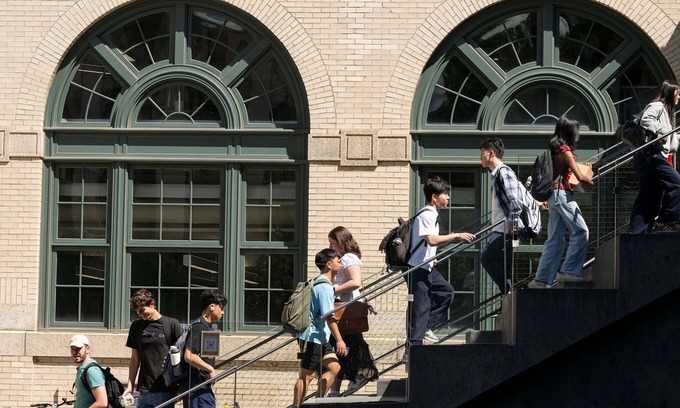
International students in the U.S. are facing new uncertainty as sweeping visa regulations introduce additional administrative requirements, higher costs, and stricter rules that could complicate plans to change academic programs or pursue doctoral studies. Kim Ngoc, a second-year undergraduate student in the U.S., originally planned to transition directly into a master's program after graduation. Instead, she now spends her free time monitoring policy updates, gathering documents, and preparing contingency plans."The policy was introduced very quickly and is much less flexible than before, so I feel quite stressed," Ngoc said. "I have to be much more careful with everything related to my visa and immigration paperwork." Students at the campus of Carnegie Mellon University in the U.S. Photo from the university's Facebook page Under new regulations issued by the U.S. Department of Homeland Security (DHS), students holding non-immigrant F-1 (academic) and J-1 (exchange) visas will be limited to a maximum four-year period of authorized stay. Anyone needing to remain longer must apply directly to U.S. Citizenship and Immigration Services (USCIS) for an extension and will face stricter limits on changing their field of study.The announcement has sparked widespread concern among international students and parents, with many seeking guidance on online forums."If I leave the U.S. and come back, for example to attend a conference, what happens to my status?" asked Max Lu, a doctoral student at the Harvard Graduate School of Education, on an online message board.Education experts warn that the new framework will significantly increase paperwork, expenses, and processing times for students. Previously, extending an authorized stay was a routine administrative procedure managed directly by a university’s international student office, according to U.S.-based education consultant Nguyen Ngoc Khuong. Under the new system, students must independently file an Extension of Stay (EOS) application for federal review.Students advancing to a higher degree level will now have to navigate two systems simultaneously: updating their records in the Student and Exchange Visitor Information System (SEVIS) to secure a new Form I-20, and filing a formal EOS application with USCIS.A similar dual process will apply to graduates requesting Optional Practical Training (OPT), which allows eligible international students to work in the U.S. for one to three years post-graduation. Applicants must now file for an EOS alongside their Employment Authorization Document (EAD) application.Financial and timeline pressuresTo avoid gaps in legal status, education consultant Nhung Do of VnTalent advises students to submit their applications two to three months before graduation.Filing fees currently range between $420 and $470. Students may also be required to pay an additional $85 biometrics fee if USCIS requires fingerprinting, according to immigration law firm Grape Law.Khuong noted that because the policy has no precedent, immigration lawyers and USCIS personnel alike are finding it difficult to predict approval timelines or potential processing bottlenecks.However, students currently enrolled in U.S. institutions are expected to face limited immediate disruption because the four-year counter starts on the policy's effective date of Sept. 15. For example, a student currently in their second year of a bachelor’s program would not need to file for an extension until 2030, well after their expected graduation.Dang Huu Phuoc, an adviser at education consultancy Edu4Life, noted that current students may continue studying until the program end date listed on their Form I-20 or the expiration date on their EAD, whichever is later, provided their overall stay does not exceed four years from the effective date.Impact on doctoral candidates and extended degreesThe policy will most severely impact students whose plans deviate from standard four-year tracks. This includes candidates switching degree levels (such as moving from a master's program to a community college), students extending language study, doctoral candidates, and undergraduates in multi-year or cooperative programs.According to the U.S. National Center for Science and Engineering Statistics’ 2024 Survey of Earned Doctorates, the median time required to complete a research doctorate in the U.S. ranges from five to seven years. Analyses by the Organization for Economic Co-operation and Development indicate that dissertation research, publication requirements, funding limitations, and personal circumstances frequently extend PhD timelines further.In a public comment submitted to DHS, Vanderbilt University's provost warned that fixed visa limits could disrupt the education of nearly all 528 international doctoral students at the university, where the average PhD takes more than 5.75 years to complete."A fixed period of stay would add expense, delay, and uncertainty for nearly every international Ph.D. student and J-1 research scholar and professor at Vanderbilt University," the provost wrote, as cited by NPR.Phuoc added that doctoral students face added risk if their academic adviser relocates, if they transfer universities, or if their lab loses funding or closes.Undergraduate degrees often take longer than expected as well. Data from the Education Data Initiative shows that only 39.5% of bachelor's students graduate within four years, while 64.6% complete their degrees within six years. The national average time to earn a bachelor's degree stands at 5.1 years.Expert recommendationsDespite the tighter regulations, Khuong emphasizes that international students can still obtain extensions if they provide clear, legitimate academic justifications. Students in integrated or cooperative education (co-op) programs that alternate classroom learning with work experience are generally well-positioned to justify extensions."Students planning to study in the U.S. should take their coursework seriously and avoid failing classes or running into academic trouble, as it will be much harder to convince immigration authorities to approve an extension," Khuong said.Nhung advises incoming and current students to finalize their majors early, secure internships as soon as possible, and begin building professional networks early in their academic careers. Students planning to pursue further degrees should consult their campus international student advisors well in advance to prevent processing delays.Phuoc further recommends that students regularly check their official electronic I-94 arrival/departure records to track their legal duration of stay and prepare extension paperwork well before expiration dates.In response to the changes, major institutions, including Carnegie Mellon University, the University of California, Riverside, and Bentley University, have already published guidelines and are scheduling campus-wide information sessions to assist international students ahead of the upcoming academic term.
New US visa rules create fresh hurdles for international students pursuing higher study or careers
Full Article
Original Source
Read the full article at E →KhanList aggregates and links to publicly available news content. We do not host full articles from third-party sources. Always verify important information with original sources.