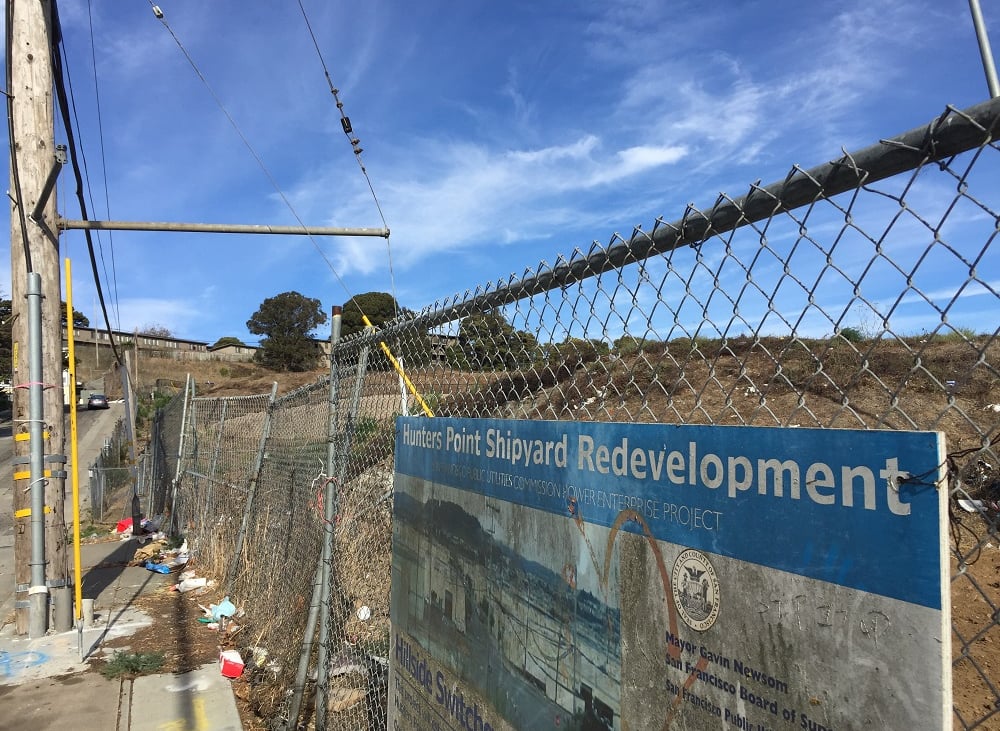
The judge said the claims fall under the purview of the Price-Anderson Act, a federal law that helps shield private players in the nuclear energy industry from liability claims.SAN FRANCISCO (CN) — A federal judge ruled Tuesday that U.S. Naval contractor Tetra Tech is immune from claims brought by current and former property owners who purchased homes on the site of radioactivity cleanup fraud at Hunters Point Naval Shipyard near San Francisco.U.S. District Judge James Donato granted summary judgment to Tetra Tech under the Price-Anderson Act. The act helps shield private players in the nuclear energy industry from liability claims and deems certain lawsuits arising from nuclear waste injuries to be covered by federal law.Specifically, the act prohibits plaintiffs from seeking recovery for exposure to radioactive materials where they did not suffer “bodily injury, sickness, disease, or death, or loss of or damage to property, or loss of use of property.”“Tetra Tech is entitled to judgment as a matter of law that plaintiffs cannot recover against them pursuant to the Price-Anderson Act,” Donato wrote in his nine-page ruling.In a statement to Courthouse News, plaintiffs’ attorney Bradley Bowles of Bowles & Verna condemned the ruling.“We adamantly disagree with the ruling and are evaluating all available legal options,” he said.Anne Marie Murphy of Cotchett, Pitre & McCarthy, also an attorney for the plaintiffs, called the ruling “hugely disappointing,” noting the case has been litigated for eight years, and they had been waiting on a ruling for summary judgment for months.“It is so tragic,” Murphy said in a phone interview. “There are hundreds of families out there that have been very badly harmed by the fraudulent cleanup, largely lower-income and retirement populations, and they are not seeing justice for this result.”A representative for Tetra Tech did not immediately respond to a request for comment.The case stems from accusations that Navy contractor Tetra Tech EC, a wholly owned subsidiary of Tetra Tech Inc., ordered workers to destroy soil samples that “had some of the highest radioactive readings” and replace them with samples from other areas of the site while avoiding “radioactive hot spots.”The former Navy shipyard in the city’s Bayview neighborhood was home to radiation experiments from 1946 to 1969 and a place where ships returning from hydrogen bomb tests were decontaminated, both potential sources of radioactive waste.Plaintiffs filed their proposed class action in August 2018, naming Tetra Tech and its affiliates as defendants, along with developers Lennar Corporation, Five Point Holdings and their affiliated companies.The homes lost up to hundreds of thousands of dollars in value, according to the homebuyers’ lawsuit, after two former Tetra Tech supervisors’ plea agreements were unsealed in May 2018. The Tetra Tech workers admitted to fudging soil samples to hide potential radioactivity on part of a 400-acre site where more than 10,000 homes are slated to be built.In August 2020, the Lennar Corporation and Five Point Holdings defendants announced they had reached a $6.3 million class settlement agreement with the plaintiffs, resolving claims that developers failed to warn homebuyers about revelations surrounding the $1 billion cleanup of the Hunters Point shipyard. Donato granted final approval to the settlement in March 2022, dismissing the parties from the case and leaving the Tetra Tech defendants to continue litigation.In 2024, Donato denied the plaintiffs’ class certification against Tetra Tech.In Tuesday’s order, the Barack Obama appointee ruled the plaintiffs’ claims fell under the PAA because the case was a “public liability action” that asserts “legal liability arising out of or resulting from a nuclear incident” against Tetra Tech.The judge pointed out the plaintiffs did not meaningfully disagree that their claims constitute a “nuclear incident” within the purview of the PAA, nor did they object to the position that the PAA applied to all of their claims in the case.“The upshot of this candor is that all of plaintiffs’ claims against Tetra Tech must be treated as a public liability action arising under the PAA,” he said.Donato additionally noted the plaintiffs “fully acknowledge” having disclaimed physical injury to themselves or to their properties.“Consequently, on this undisputed record, plaintiffs cannot recover under the PAA because they have not suffered any injury that falls under the scope of 42 U.S.C. § 2014(q), i.e., ‘bodily injury, sickness, disease, or death, or loss of or damage to property, or loss of use of property,’” Donato said.Despite ruling in favor of Tetra Tech, the judge said he shared plaintiffs’ frustration that Tetra Tech had only recently raised the PAA as a defense, wasting time and money across years of litigation.“Why Tetra Tech was asleep at the switch for so long is not explained in its papers. This is not a reason to deny summary judgment, as will be discussed later, but it calls into question the advocacy presented by Tetra Tech and its attorneys,” Donato said.Subscribe to our free newslettersOur weekly newsletter Closing Arguments offers the latest about ongoing trials, major litigation and rulings in courthouses around the U.S. and the world, while the monthly Under the Lights dishes the legal dirt from Hollywood, sports, Big Tech and the arts.Additional Reads
Judge sinks homeowners’ case over Navy shipyard cleanup fraud
Full Article
Original Source
Read the full article at Courthousenews →KhanList aggregates and links to publicly available news content. We do not host full articles from third-party sources. Always verify important information with original sources.