
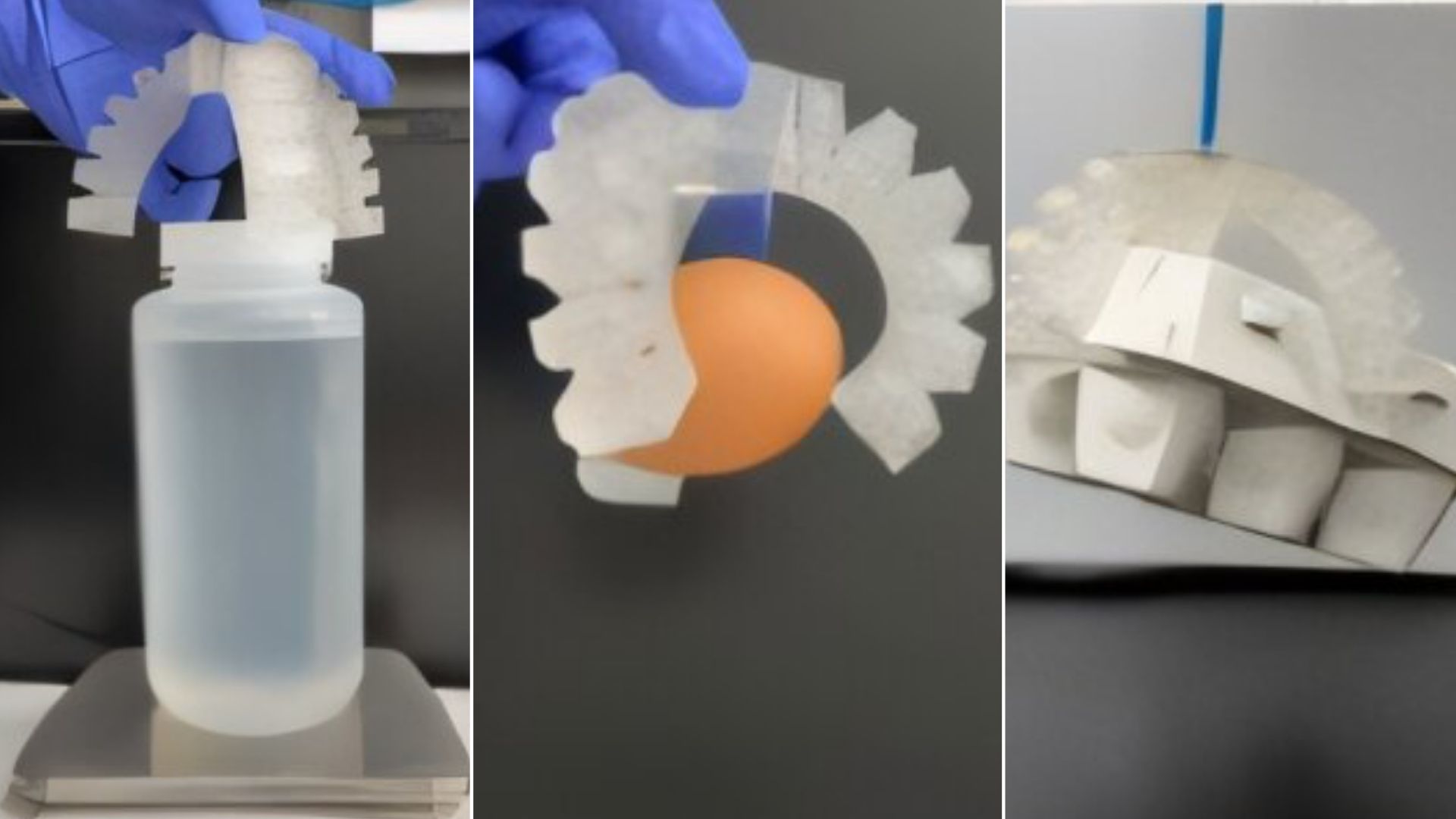
Robots can automate factories and speed down racetracks, but these machines are still imperfect in many ways. For instance, the simple human act of gripping an object with just the right amount of force remains one of automation’s toughest challenges. But experts are slowly solving this. Now, Korean researchers have developed a soft, 3D-printed robotic hand so delicate it can cradle a raw egg without cracking the shell, yet strong enough to hoist a full one-liter water bottle without losing its grip. The Korea Advanced Institute of Science and Technology (KAIST) used AI to discover an optimal material recipe that makes 3D-printed products as stretchable as rubber without clogging printers. Interestingly, this optimal chemical recipe for a 3D-printable material stretches to over six times its original length without tearing. “This research is significant as it shows that combining researchers’ experimental data with artificial intelligence can efficiently identify optimal material combinations that were previously difficult to find,” explained Professor Seungchul Lee. “We expect it to be used to more rapidly develop 3D-printing materials with the performance needed across a range of fields, including soft robots, wearable devices, and custom medical devices,” Lee added. AI-based material design framework proposed in this study and its application to soft robotics. Credit: KAIST Overcoming printing challenge Digital Light Processing (DLP) 3D printing operates by projecting light patterns onto a vat of liquid resin, instantly curing it into solid layers to form complex shapes. However, creating stretchable objects with DLP created a engineering impasse: the polymer chains required to give a material high elasticity and durability make the liquid resin thick and viscous, preventing it from flowing smoothly into thin layers during the printing cycle. On the other hand, diluting the resin with solvents or low-molecular-weight additives thins the liquid for easy printing, but it disrupts the polymer network, leaving the final product brittle and prone to tearing. Instead of relying on years of manual trial and error, a collaborative Korean research team (KAIST, KIST, and SEOULTECH) used machine learning to discover an ideal 3D-printing material. The AI was trained on a dataset of chemical formulations, including hard-to-print, high-viscosity failures. The model mapped out how minor chemical adjustments influenced flow rates and light-curing speeds. This allowed the AI to identify a balanced recipe that flows smoothly during the printing process while curing into a highly durable resin that stretches to over six times its original length without tearing. Soft actuator demonstration To test their creation, the team printed soft pneumatic actuators — small hollow structures that flex when filled with air. When pressurized, the material expanded like a balloon, curling into the natural shape of a human finger. Combining these actuators into a soft robotic hand produced remarkable results. The hand effortlessly adapted its grip to hold computer mice, egg cartons, slick glass bottles, and fragile eggs, demonstrating a level of adaptable soft-touch control that rigid robotics struggle to replicate. Apart from flexible robotic grippers, this AI-driven approach promises to accelerate production across multiple biomedical and industrial fields. This AI-driven framework eliminates years of manual testing by rapidly predicting optimal material formulations for specific manufacturing needs. As a result, it accelerates the creation of custom anatomical medical implants, tear-resistant wearable sensors for human joints, and gentle robotic tools designed to work safely alongside humans. The development proves that sometimes the best way to tackle a rigid engineering challenge is to soften it up. The findings were presented in the journal Nature Communications. Get the latest in engineering, tech, space & science - delivered daily to your inbox.Mrigakshi is a science journalist who enjoys writing about space exploration, biology, and technological innovations. Her work has been featured in well-known publications including Nature India, Supercluster, The Weather Channel and Astronomy magazine. If you have pitches in mind, please do not hesitate to email her.
New soft robotic hand gently grips fragile eggs while lifting heavy water bottles
Full Article
Original Source
Read the full article at Interestingengineering →KhanList aggregates and links to publicly available news content. We do not host full articles from third-party sources. Always verify important information with original sources.