
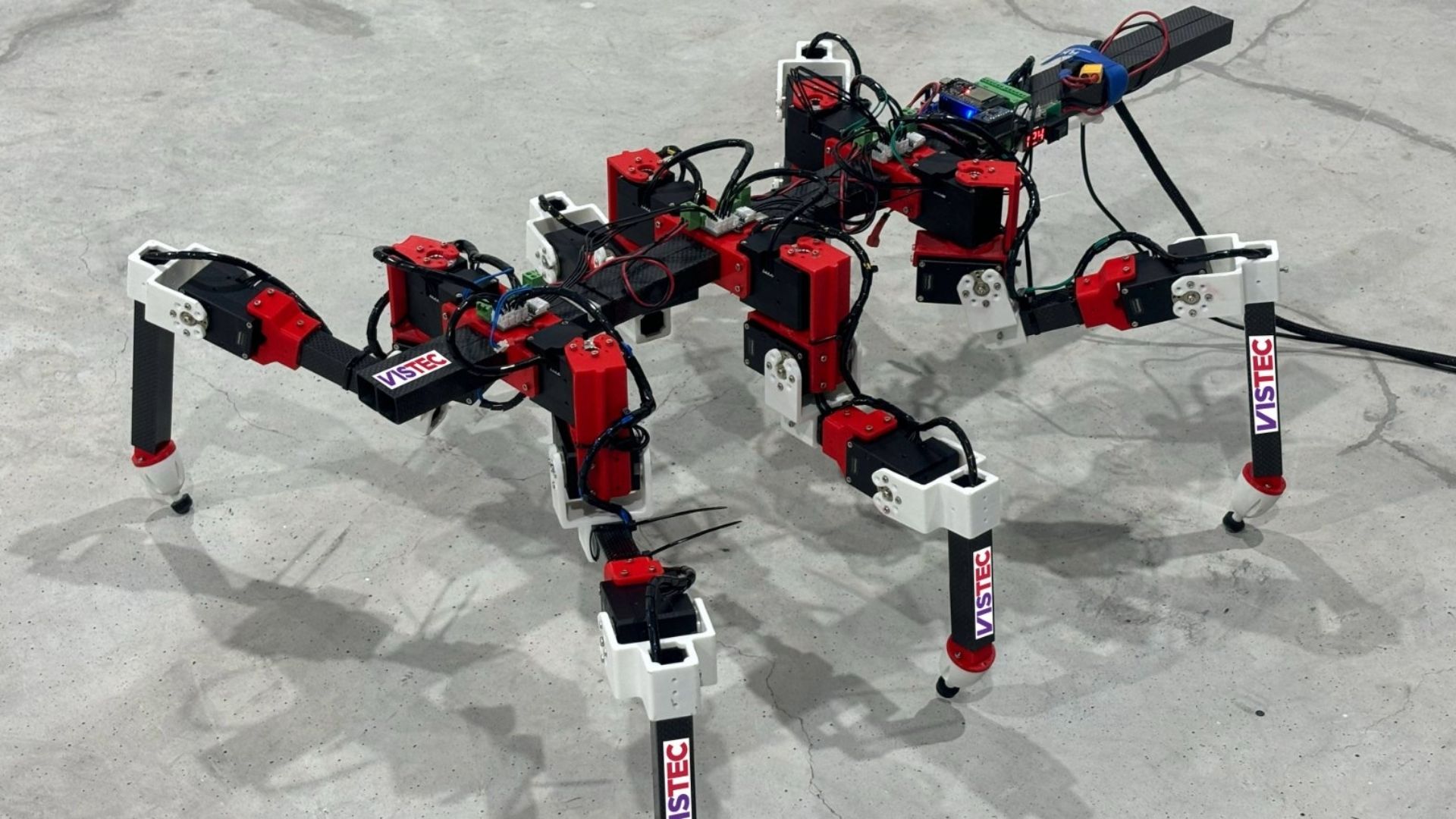
Researchers have developed a six-legged robot that can learn to walk by mimicking a stick insect’s movement patterns. The AI-powered system enables the robot to adapt its walking strategy across different surfaces and challenging environments. Researchers from Tohoku University in Japan and VISTEC in Thailand say the approach could help robots move more effectively through unpredictable terrain. The technology could eventually support robotic systems designed to operate in disaster zones and other environments where conventional wheeled robots may struggle to navigate. Robot learns insect gait Researchers have developed a new AI-based method that allows a six-legged robot to learn walking strategies from a stick insect. Instead of manually programming how each leg should move, the system studies biological movement data and uses it to learn the underlying coordination patterns needed for stable locomotion. The approach uses adversarial inverse reinforcement learning (AIRL) to learn walking strategies from stick insects. Researchers trained the system on flat-ground walking data from Medauroidea extradentata, capturing movements across 18 leg joints. Instead of copying each motion, the AI learned the underlying coordination principles. This could overcome the limits of conventional robot gait systems, which rely on fixed patterns, tuned parameters, and predefined rewards that may struggle on unfamiliar terrain. The six-legged robot RedMirror of VISTEC walks using a control law learned from only a few steps of stick insect data The new system combines AIRL with proximal policy optimization (PPO), a reinforcement-learning method. During training, one neural network compares the robot’s movements with the insect demonstrations, while another learns a reward structure that encourages behavior similar to the biological example. According to a statement by researchers, the robot’s controller uses information such as body orientation, joint angles, and whether each leg is touching the ground. It then produces commands for the robot’s 18 joints. This allows the system to learn coordinated leg movements without researchers having to explicitly program a particular gait. Robots learn adaptability The researchers found that the learned controller could produce stable walking that resembled the coordination seen in stick insects. More importantly, the system was able to adapt when conditions changed. Although it was trained using only flat-ground walking data, the robot continued to walk on uneven terrain. Its body experienced greater movement as the ground changed, but it remained stable, and its forward speed fell only slightly. The system also changed the timing and coordination of its legs, producing a more wave-like walking pattern suited to uneven surfaces. The robot also demonstrated an ability to cope with the loss of a leg. Researchers disabled one of its six legs to simulate damage. Instead of simply continuing with the original walking pattern, the controller reorganized how the remaining legs worked together and redistributed the load to maintain stability. This showed that the AI could respond to a physical change that was not present in its original training data. Another key result was the ability to transfer the learned reward structure to a different robot model with different physical properties. Directly transferring the original walking policy failed because the second robot had different body proportions, joint configurations, and motor characteristics. However, transferring the AIRL-derived reward allowed a new policy to learn coordinated movement on the different robot. The combined AIRL and forward-velocity rewards reached a useful walking strategy in 70,000 training steps, compared with 200,000 steps when using velocity-based reward shaping alone.The researchers also carried out a preliminary test on a physical RedMirror robot. The robot showed walking and body-coordination patterns that were qualitatively similar to those seen in simulation. The results suggest that biological movement data could provide a practical way to build more adaptable robot locomotion systems, particularly for machines expected to operate across changing terrain or after mechanical damage.Get the latest in engineering, tech, space & science - delivered daily to your inbox.Jijo is an automotive and business journalist based in India. Armed with a BA in History (Honors) from St. Stephen's College, Delhi University, and a PG diploma in Journalism from the Indian Institute of Mass Communication, Delhi, he has worked for news agencies, national newspapers, and automotive magazines. In his spare time, he likes to go off-roading, engage in political discourse, travel, and teach languages.
New six-legged robot mimics stick insect to master walking across uneven terrain
Full Article
Original Source
Read the full article at Interestingengineering →KhanList aggregates and links to publicly available news content. We do not host full articles from third-party sources. Always verify important information with original sources.