
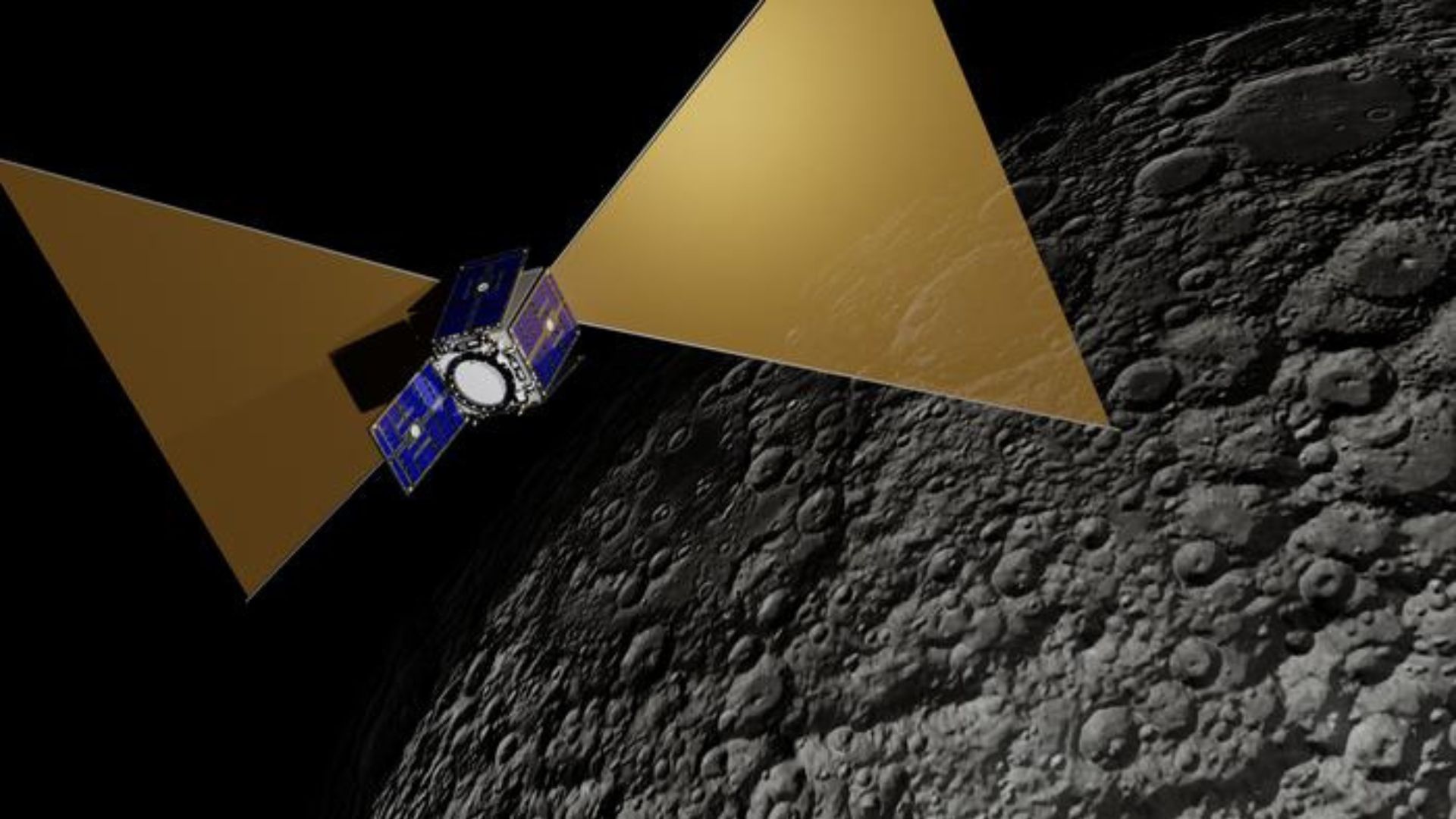
A new suitcase-sized satellite has been designed to investigate the cosmic dark ages, which is the 150-million-year period between the Big Bang and the birth of the first stars. Dubbed CosmoCube, it will also explore the role of dark matter in early universe formation. Led by researchers at the University of Cambridge, the mission aims to detect the faint 21-centimeter radio line emitted by early hydrogen atoms operating at low frequencies (10–50 MHz), a signal never before directly observed. Moon as a shield Earth’s ionosphere and radio interference (FM radio, telecommunications) block these low-frequency signals. For astronomers trying to listen for the faint, 13.5-billion-year-old signals of the early universe, Earth’s radio noise is like a heavy metal concert playing right outside a recording studio door. As a result, the team designed CosmoCube to hide behind the Moon. The UK-backed satellite will embark on a two-year mission around the Moon. Every two hours, CosmoCube will loop around the lunar far side. For 40 brief minutes, the Moon will block every piece of human chatter from Earth. “There’s no other place where you can get the sort of shielding you need to detect such a faint signal, while at the same time looking at the whole of space,” said Professor Eloy de Lera Acedo from Cambridge’s Cavendish Laboratory. “The far side of the Moon is really the only option: it solves multiple problems at once, opening a clear window to the very early universe.” Over a two-year mission, CosmoCube will gather 1,000 hours of data to map the universe’s transition from an empty, dark void into the complex cosmos seen today. Supported by funding from the UK Space Agency, researchers aim to launch the satellite within the next five years. Calibrating for precision CosmoCube will use a newly unfolded, lightweight antenna during its far-side orbits. To ensure accuracy, an internal “Dicke switched” calibrator will continually toggle between the sky and reference sources to filter out satellite electronic noise. Once transmitted back to Earth, scientists will use Bayesian statistical methods alongside sky-response computer simulations to remove Galactic foreground emissions and instrument distortions. The satellite will also use cutting-edge RF-System-on-Chip (RFSoC) technology to power its miniature radiometer. Apart from mapping the pre-star universe, CosmoCube will also investigate how mysterious dark matter functioned in the early cosmos. Scientists hope to reveal its role as the gravitational force that pulled hydrogen together to form the very first stars and galaxies. “This emission from hydrogen after the Big Bang, but before the first stars, will hopefully allow us to understand the role of dark matter in the early universe, how it worked to pull together hydrogen into the first stars and galaxies,” said de Lera Acedo. The pristine radio-quiet zone on the far side of the Moon may soon become a crowded place like Earth’s orbit. As nations like the US and India plan increasingly ambitious lunar orbital and surface missions, human presence and satellite communications risk introducing new radio interference. This impending surge in lunar traffic makes time-sensitive missions like CosmoCube crucial to capturing the universe’s earliest faint signals before the quietest sanctuary in the solar system becomes noisy.Get the latest in engineering, tech, space & science - delivered daily to your inbox.Mrigakshi is a science journalist who enjoys writing about space exploration, biology, and technological innovations. Her work has been featured in well-known publications including Nature India, Supercluster, The Weather Channel and Astronomy magazine. If you have pitches in mind, please do not hesitate to email her.
New satellite to search for 13.5-billion-year-old signal from the far side of Moon
Full Article
Original Source
Read the full article at Interestingengineering →KhanList aggregates and links to publicly available news content. We do not host full articles from third-party sources. Always verify important information with original sources.