
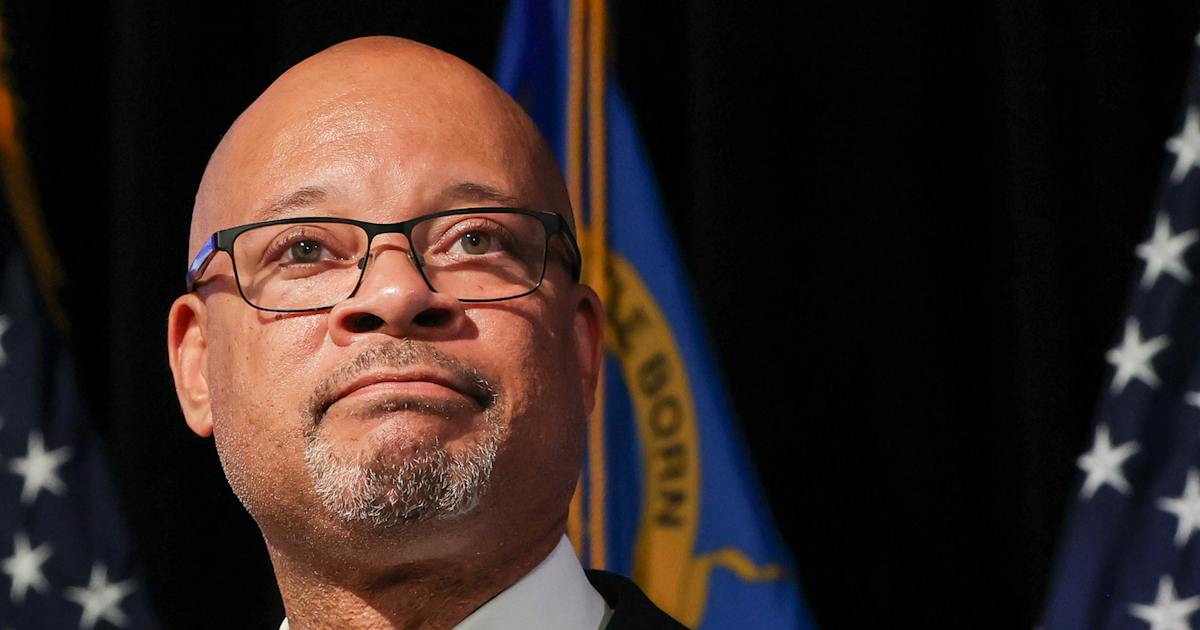
Nevada’s incoming Democratic governor wants to negate the Electoral College.Aaron Ford said Wednesday that he thinks the state should join the National Popular Vote Interstate Compact, an agreement where member states give their electoral votes in every presidential election to whoever wins the national popular vote.“I didn’t initially support it frankly because I hadn’t done enough research on it, but I have researched it and, looking at the Electoral College, understanding the, frankly, racist underpinnings of it in the first place leads me to believe that we need to get rid of it,” Ford told Nevada TV station KOLO regarding the compact. “Not only for that reason, but because we’ve seen several times now the person who wins the popular vote not win because of the Electoral College.”After last week’s midterm elections, Democrats have taken over control of state legislatures and governorships not just in Nevada but also Pennsylvania, Michigan, Arizona, and Wisconsin, which haven’t agreed to the compact. If all five states agree to join the compact, their electoral votes combined with the states that have already agreed to it would be enough to effectively nullify the Electoral College.Ford’s comments give the idea more weight, especially considering that he’s one of the country’s five Black governors who won their elections last week. But the idea faces constitutional hurdles. In Article 2, Section 1, Clauses 2 and 3, the Constitution says that states can appoint electors “in such Manner as the Legislature thereof may direct.” But in Article 1, Section 10, Clause 3, it also prohibits interstate compacts without the consent of Congress.The current Supreme Court has six conservative justices who are more than likely to take a narrow interpretation and shoot down the compact, and require Congress and the president’s consent on any deal. That means even if enough states agree to the compact now, it could be years before it takes effect, if ever. Still, for now, Democratic-led states could set up that legal challenge.Former Nvidia CEO Jensen Huang has responded to Republican Representative John Moolenaar’s request for a closed-door meeting, and he is reportedly in talks to coordinate a date.Moolenaar told NBC News’s Brennan Leach that he expects Huang to appear before Congress while the GOP is still in the majority.“I would hope he would want to come in and have that discussion with us,” Moolenaar told NBC News.Huang resigned as Nvidia’s CEO, president, and board member Thursday morning, after The New York Times caught Huang in another scandalous affair with one of his direct reports: Kimberly Powell, the company’s vice president of healthcare. Huang was already facing fire for a different affair he had with a Chinese businesswoman, former Megaspeed executive Alice Huang (no relation of Jensen’s), who U.S. intelligence agencies identified as a spy and a state asset.Nvidia emerged in recent years as the largest semiconductor company in the world, and a precious American asset in the burgeoning AI tech wave. In January 2025, Nvidia was announced as one of the “key” technology partners in the Trump administration’s $500 billion public-private initiative to jumpstart AI-focused data center development, dubbed the Stargate Project. Months later, Donald Trump allowed the company to export previously banned chips to China, loosening trade restrictions on tech that Washington feared could be used against U.S. national security interests. Trump reportedly knew about Huang’s affair—and his spying partner—for months. State Secretary Marco Rubio informed Trump about the alarming relationship moments before Huang joined the presidential trip to Beijing at the president’s request. It was at least the second time that Trump had been informed of Huang’s ties to the Chinese government, inside sources told The New York Times.But Trump did not act on the information.Instead, Trump has denied any knowledge of the illicit affair. On Tuesday, Trump refuted the Times’ report, telling a reporter in the White House press room that he “didn’t hear about” the scandal in May. Trump added that he spoke with the Nvidia leader earlier that day, when Huang claimed he had “absolutely no idea that the person in question was a spy.”“And I really believe him,” Trump added.But not everyone is convinced by the Trump administration’s blind eye. Connecticut Representative Jim Himes, who is expected to become chair of the House Intelligence Committee in the new year, expressed alarm that the FBI had not opened an investigation into the apparently suspicious relationship, despite the internal circulation of a memo detailing the Megaspeed executive’s myriad links to the Chinese government.“I would hope that the FBI would launch a major counterintelligence investigation. I haven’t heard that they did,” Himes told Politico, noting that Director of National Intelligence Jay Clayton and CIA Director John Ratcliffe, apparently “didn’t know” whether the FBI had opened an investigation, either.Vice President JD Vance secretly met with one of his top donors days before the Trump administration invaded Venezuela and cut a deal that would make his company millions from selling the country’s stolen crude oil.A week before the U.S. military invaded Venezuela and kidnapped its leader, Nicolás Maduro, Vance travelled to Bozeman, Montana, where he secretly met with John Addison, a U.S. gasoline trader at Vitol, the world’s largest energy and commodity trading company, Reuters reported Wednesday.In 2022, Addison poured $300,000 into Vance’s successful bid for one of Ohio’s U.S. Senate seats. He and his wife later gave a combined $7 million to groups supporting Donald Trump’s presidential campaign in 2024.At the meeting, the two men spoke about Venezuela, and the vice president expressed a particular interest in how fast Venezuelan crude oil could be sold in the case that the U.S. gained control of the country’s energy supplies, a person who was given an account of the meeting from Addison told Reuters. Addison assured Vance that Vitol was more than able to get the job done.Addison’s private Embraer jet and Vance’s government plane sat together on the tarmac at Bozeman Yellowstone International Airport on December 27, according to flight records reviewed by Reuters.This meeting was previously unreported, but gives insight to the backroom deals to enrich allies of the Trump administration. Both Addison and Vance denied the meeting took place.On January 5, just two days after the operation to kidnap Maduro, Addison got a call from Energy Secretary Chris Wright, who asked whether Vitol would be interested in selling Venezuelan crude oil.Addison wasn’t a natural choice to receive a call from Wright. He wasn’t a regional CEO, or an expert in Latin American gasoline, but rather, a senior trader involved in sales of U.S. oil. But Vance had told Wright that he was the right person for the job, Addison told Reuters.The Department of Energy, however, claims that Vance and Wright never discussed the sales of Venezuelan oil, and Vitol was chosen solely because of the firm’s scale.By January 9, Vitol and Trafigura, its direct competitor, had obtained special licenses to sell Venezuelan crude oil. Since then, the companies have raked in hundreds of millions of dollars in profit from selling stolen supplies.Typically, large U.S. government contracts are awarded through a competitive bidding process—a standard that has seemingly gone out the window during Trump 2.0.Representative Robert Garcia, ranking Democrat on the House Oversight Committee, and its incoming chair, sent a letter to the heads of Vitol and Tafigura demanding answers about how exactly they received these licenses, and voicing concern that the companies may have been given advanced notice about U.S. military action in Venezuela. Both Vitol and Trafigura declined to answer Garcia’s letter, but the companies told Reuters that they did not receive any advanced knowledge.Last month, right-wing conspiracy theorist and YouTuber Nick Shirley followed an old woman around Lam’s Seafood, a Vietnamese grocery store in Seattle. He observed her buying spring rolls and tuna, which he incorrectly called spam and sushi. Shirley claims in a video voiceover that the items were “magically $120.”“How come you sold this spam and sushi for $120?” he says to the cashier, who gives him a confused look. He eventually demands to speak to the manager and asks any worker in sight why they’re “letting people commit food stamp fraud.” “You all are committing fraud, this entire block is committing fraud,” he says in the video, which can still be seen on TikTok. Lam’s denied Shirley’s allegations more than a month ago, with its operations manager saying that Lam’s had never participated in any EBT fraud. They pointed out that because Shirley does not speak Vietnamese, he missed the woman clearly asking for an entire case of tuna—which she was correctly charged. A month later, Shirley fully retracted his story. “I have an important correction to make,” Shirley said in a video posted Wednesday. “I stated [the woman at Lam’s] purchased one can of spam and one order of sushi for $120. That was incorrect, as Lam’s has later now clarified that the lady was attempting to purchase a case of spam, which is why the transaction was $120. I have not uncovered any evidence that Lam’s itself engaged in EBT fraud or that Lam’s colluded with the woman in the video who was attempting to use her EBT card.” So Shirley harassed an old Vietnamese woman just trying to buy tuna for nothing. Many online noted that the GOP operative’s apology and retraction sounded like they had been written by a lawyer.“Did he get a cease and desist letter? This sounds very lawyered,” The New York Times’s Ken Bensinger wrote. Shirley has made a career out of harassing minority-owned businesses and baselessly accusing them of financial crimes. In April, more than a dozen federal agents showed up at the Mini Childcare Center in Minneapolis. It was one of the many daycares that Shirley harassed while attempting to prove that Somali Americans were running an elaborate fraud scheme. None of the daycares that Shirley targeted have been found to have committed fraud. Donald Trump no longer seems concerned about brokering a deal with Iran after the midterms.In a layered Truth Social post Thursday, the president declared that “we don’t need a deal with Iran.”“Those days have long since passed,” Trump continued. “We’ve got their money, Hundreds of Billions of Dollars, and we’ve got their Strait!”Hours earlier, Trump declared victory against Iran during a Veteran’s Day speech at Arlington National Cemetery in Virginia, even though he acknowledged the war is not yet over.“Under this administration, and it was about time, somebody fought back,” Trump said. “All of us fought back. We fought back. And we seriously fought back. And we won. Just a question of when we want to end it.”“We want to make sure we have a total victory, not a 93 percent victory,” he added. “It’s going to be total. It’ll take them 25 years to rebuild back what we have destroyed, and hopefully we won’t have to destroy any more of that country.”Trump on Iran War: We won. We want to make sure we have a total victory, not a 93% victory. https://t.co/d4DTeWZZls— Clash Report (@clashreport) November 11, 2026 For weeks, Trump teased a full-scale bombardment of Iran after the midterm elections. That has not yet happened. Instead, the Pentagon launched Task Force Iron Gate to choke off the country’s trade routes and limit its advanced weapons shipments, according to Reuters.But Iran has not backed down. Instead, Iranian security chief Mohsen Rezaei escalated the country’s threats on Wednesday, pledging that Tehran would also attack European military bases if they were used by American forces for renewed warfaring purposes.“If American aircraft take off from an American military base, even one located in a European country or some other distant region, to bomb Iran, we will strike those bases as well,” Rezaei told Lebanese broadcaster Al Mayadeen TV.In another portion of the interview, Rezaei vaguely warned that Iran might also attack more distant U.S. military installations, as well as “certain islands that they assume are beyond the reach of our missiles.”
New Nevada Governor Calls to Join Pact to Overthrow Electoral College
Full Article
Original Source
Read the full article at Newrepublic →KhanList aggregates and links to publicly available news content. We do not host full articles from third-party sources. Always verify important information with original sources.