
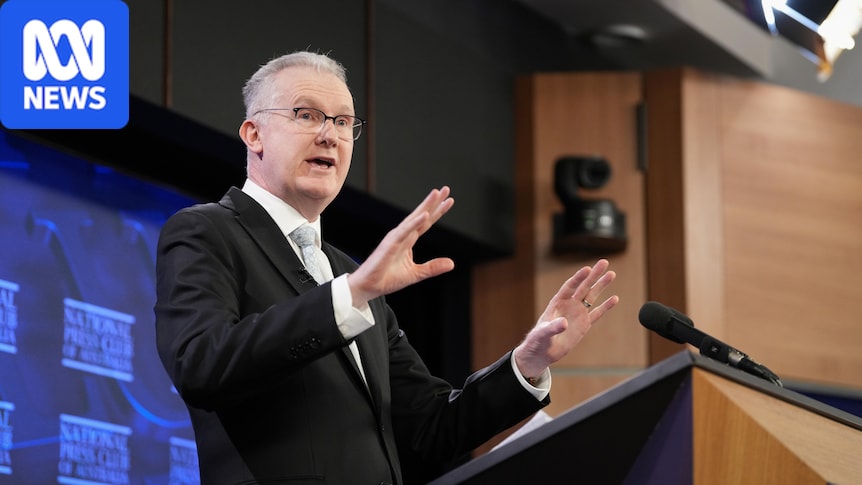
Home Affairs Minister Tony Burke says Australia's counterterrorism agencies are moving "from the meeting room to the chat room" as the government opens its first dedicated hub for tackling online extremism in Sydney today.The Counter Terrorism Online Centre (CTOC), a $76m Commonwealth venture announced in the May budget, will bring the Australian Federal Police (AFP) and the Australian Security Intelligence Organisation (ASIO) together to identify at-risk youth online and prevent them from crossing the line into terrorism."Where extremists are in a meeting room, we've wanted to have ways that our agencies can find out what's happening and disrupt," Mr Burke told the ABC."Effectively, we now extend that capability from the meeting room to the chat room."Intelligence agencies view the centre as vital to clamping down on a new wave of terrorism defined by mixed ideologies, younger offenders and dramatically faster radicalisation.It launches amid a sharp spike in youth extremism, with children now representing 40 per cent of Australia's overall counterterrorism caseload this year alone.Just yesterday, the AFP said a 17-year-old boy in New South Wales was charged with collecting and making documents likely to facilitate a terrorist act and possessing items connected with the preparation of a terrorist act.Intelligence officials hope CTOC will allow investigators to intercept similar cases earlier, stepping in before online curiosity escalates into real-world offending.Gaming platforms used to radicalise young peopleMr Burke warned that extremists were increasingly targeting young people inside gaming ecosystems such as Discord and Roblox, rather than just mainstream social media."We've got people wanting to foster extremism who will go on, impersonate themselves as someone younger than who they are, and effectively go on missions with people, play games with people, build a relationship of trust and a relationship where they have defended each other, and then start taking people down a path of radicalisation," he said.He revealed ASIO had recently uncovered an Australian-based Discord server with more than 1,000 members that appeared harmless from the outside, but was harbouring nationalist, racist and incel ideology.When one Australian user escalated to talking about firearms and bashings, intelligence officers identified him and intervened early, steering him away from violent extremism before an attack could occur.New government legislation first step to tackling radicalisationMr Burke acknowledged the government's under-16 social media ban and proposed Digital Duty of Care legislation were not enough on their own to stop youth radicalisation.He told the ABC the most severe grooming occurred in gaming chat rooms."'It's often on these areas like Discord, where someone's been on a gaming platform and they go down a very dark rabbit hole," he said."Those sorts of bans, while they're helpful, on their own they're not enough. We need the dedicated online centre to deal with counterterrorism that we're announcing today."Over the next two years, the new centre will combine human investigators with new artificial intelligence capabilities to improve threat detection and run full digital operations.Asked where the government drew the line between early prevention and authoritarian surveillance when intelligence agencies monitored teenagers before a crime was committed, Mr Burke insisted free speech would not be policed."If we're talking about whether someone has a conversation you don't like, then there's no role for my agencies," he said."[If] we talk about someone getting involved with violent extremism, then my agencies have to be there."Pressed whether further changes to federal terrorism laws were in the pipeline to help agencies tackle online extremism, Mr Burke left the door open to ongoing updates while stressing that laws alone would not solve the crisis."There's always new drafts because the behaviour and the threat that we're dealing with is always, always changing," he said.Krissy Barrett says law enforcement is increasingly dealing with a "grievance generation".AFP Commissioner Krissy Barrett said law enforcement was increasingly dealing with a "grievance generation" who felt angry and powerless, and sought control by consuming violent extremist material, joining sadistic online groups or committing acts of violence."Individuals, particularly youth, can be radicalised extremely quickly, and in the past investigators have witnessed kids being self-radicalised within the same time it takes to watch a test cricket match," she said in a statement.The new hub will sit alongside existing counterterrorism teams, focusing specifically on tracking extremist networks online — a capability ASIO director-general Mike Burgess says is now essential."Online operations are often the only way we can identify and engage with these individuals to understand their intent, capability, identity and targets," he said in the same statement.
New $76m hub helps agencies enter 'chat room' to disrupt youth extremism
Full Article
Original Source
Read the full article at Abc →KhanList aggregates and links to publicly available news content. We do not host full articles from third-party sources. Always verify important information with original sources.