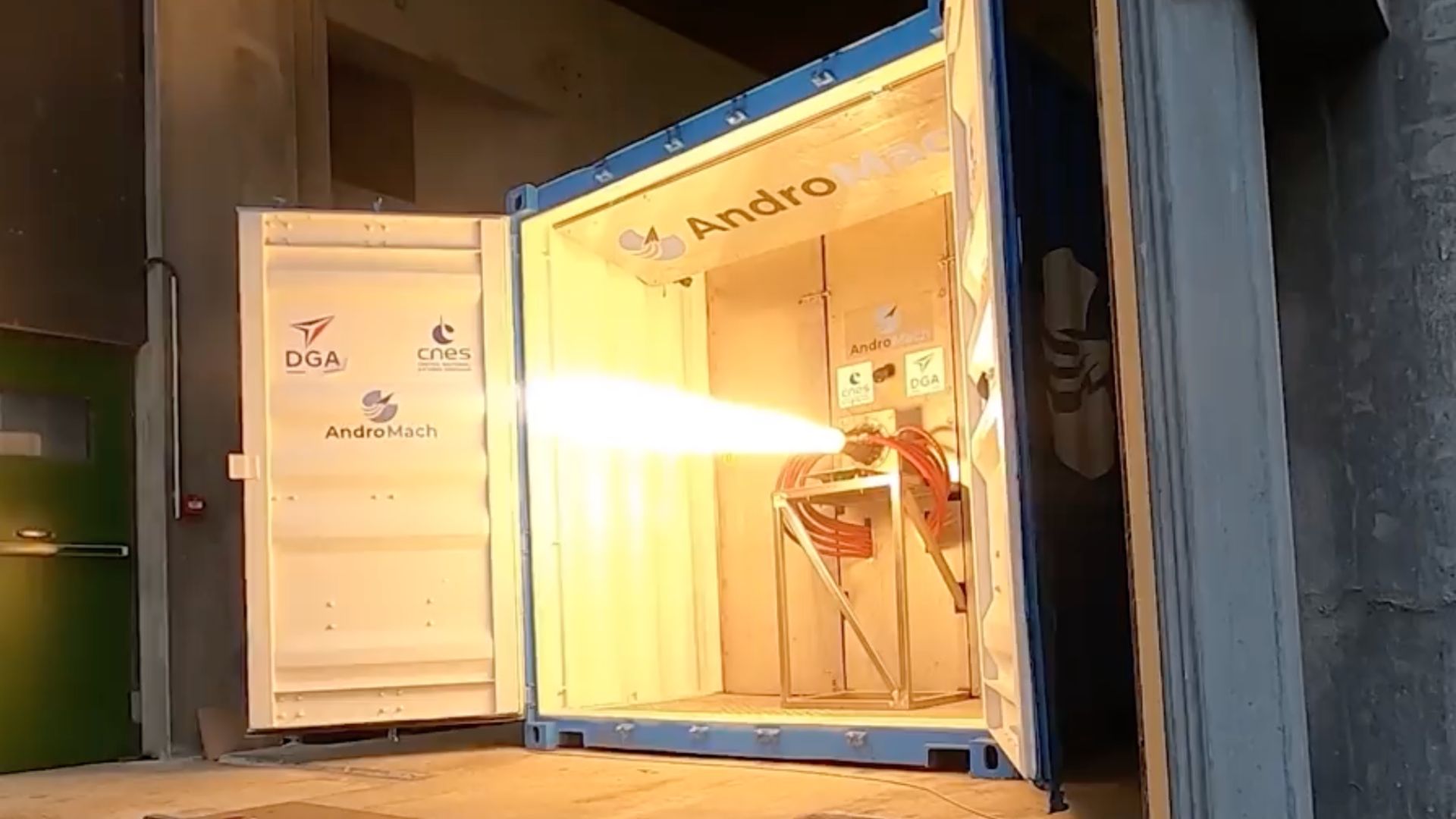
A French aerospace startup has reached a key milestone in its hypersonic drone program after completing a series of successful rocket engine tests. The French defense procurement agency, Direction Générale de l’Armement (DGA), announced that AndroMach completed a campaign of 21 engine ignitions at a government test facility, with the engine remaining reusable after the trials. The tests were conducted at the DGA Essais de Missiles (DGAEM) center in Gironde, southwestern France. The campaign marks an important step before the company can move toward flight testing of its Envol suborbital hypersonic drone. Engine passes repeated ignition tests During the campaign, the Envol rocket engine was fired about 20 times as planned and completed 21 successful ignitions. On July 24, the DGA said the engine ran for a total of seven minutes and proved it could be reused after several firings, rather than being thrown away after just one use. Reusable rocket engines help lower testing costs since developers do not have to replace parts after every test. Starting the engine multiple times is also important to make sure it works reliably before moving on to flight tests. The campaign mainly looked at how the engine works during ignition, which is one of the toughest parts of rocket operation because the propulsion system faces extreme heat and pressure. The tests were with support from France’s national space agency, Centre National d’Études Spatiales (CNES), which contributed expertise in propulsion testing and spaceflight systems. Government facility supported the campaign The engine tests happened at DGAEM, a government site that focuses on checking missile and rocket propulsion systems before they move on to the next stages of development. According to the DGA, the agency provided more than just access to the test site. Engineers, technical specialists, and test personnel assisted throughout the campaign by preparing the facility, overseeing the engine firings, and ensuring each test was conducted safely. Testing rocket engines means working with powerful fuels and being ready for possible failures. Special government facilities are built to run these tests safely and gather detailed data to help with future development. The campaign also helped determine the engine’s preferred operating conditions for future missions. Hypersonic drone designed for several missions The tested engine is being developed for Envol, a suborbital hypersonic drone. A suborbital vehicle travels to the edge of space before returning to Earth without entering orbit. Hypersonic flight refers to speeds above Mach 5, or more than 3,800 mph (6,100 km/h). Once operational, the vehicle is expected to support microgravity experiments, allowing researchers to study how materials, fluids and biological samples behave during short periods of near weightlessness. The DGA also said the platform could serve as an airborne technology demonstrator by testing new systems under real flight conditions. In addition, it is intended to act as a high-performance target vehicle capable of flying complex trajectories for evaluating civilian and military detection, tracking and missile defense systems. While the successful engine campaign clears an important technical hurdle, the DGA did not announce when AndroMach plans to begin flight testing. The timeline for Envol’s first launch remains undisclosed. Recommended ArticlesGet the latest in engineering, tech, space & science - delivered daily to your inbox.A versatile writer, Sujita has worked with Mashable Middle East and News Daily 24. When she isn't writing, you can find her glued to the latest web series and movies.
New hypersonic drone engine passes 21 ignition tests to prove reusable design
Full Article
Original Source
Read the full article at Interestingengineering →KhanList aggregates and links to publicly available news content. We do not host full articles from third-party sources. Always verify important information with original sources.