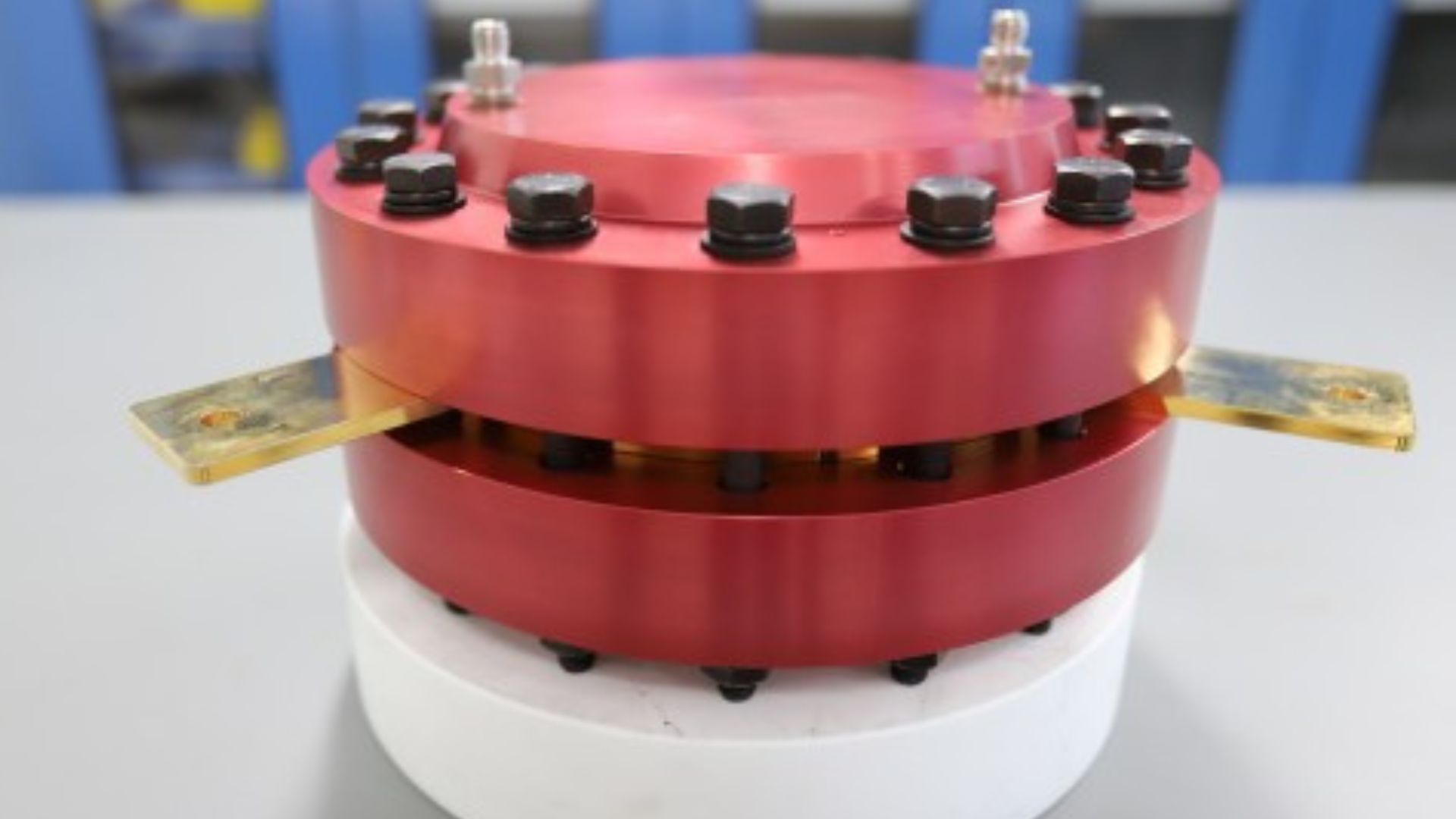
A joint research team from the Korea Institute of Machinery and Materials (KIMM), in collaboration with Chung-Ang University, has created a new chemical adsorption heat pump that turns low-temperature waste heat directly into cooling power. Data centers and industrial plants burn through huge amounts of electricity just trying to keep equipment cool. Meanwhile, the low-temperature thermal exhaust dumped into the surrounding environment goes completely unused. It’s a massive waste of energy. South Korean researchers aim to fix this problem using the new heat pump system. KIMM engineered the heat pump to harness lukewarm exhaust from factories and data centers. On the other hand, Chung-Ang University created a noise- and vibration-free electrochemical compressor. Manufacturer Samjung Tech Co., Ltd. then successfully produced a 10 kW-class prototype to demonstrate the groundbreaking system. Noise- and vibration-free Conventional adsorption cooling technology requires scorching heat sources above 70°C to operate. Also, standard air conditioners depend on noisy, energy-draining mechanical compressors. In particular, the new system can drive cooling using waste heat as low as 40°C (104°F). It combines chemical adsorption with a silent electrochemical compressor, thereby replacing heavy, grid-straining machinery with an almost silent, highly efficient cooling solution. Notably, a world-leading Specific Cooling Power (SCP) of 346.5 W/kg was achieved by completely redesigning the heat pump’s core adsorption bed. This structural optimization increases thermal efficiency, allowing the system to extract much more cooling capacity per unit mass. Ultimately, it delivers more than double the performance benchmark of existing international technologies, paving the way for far more compact and powerful waste-heat cooling units. The system uses natural ammonia as its working refrigerant, completely overcoming synthetic compounds like HCFCs and HFCs that contribute to global warming and ozone depletion. With zero ozone depletion and near-zero global warming potential, ammonia easily complies with today’s strict global environmental standards. Moreover, this makes the heat pump a green technology, slashing greenhouse gas emissions from both energy production and chemical refrigerants. Prototype testing Facilities discharge huge amounts of 40°C thermal runoff every day. Previously, this heat was considered too cold to capture for practical work. Now, that discarded thermal waste becomes the primary power source for air conditioning. A 10 kW-class prototype is currently undergoing demonstration testing. Furthermore, the collaboration advanced a large-area ammonia compressor, which could bring this whisper-quiet technology closer to commercial use in noise-sensitive environments like hospitals, schools, and homes. The compressor is built in a multi-layer stack configuration. To scale up capacity, operators simply add more cells to the stack, and no need to redesign heavy mechanical housings. “The most significant achievement of this research is the successful demonstration of cooling low-temperature waste heat at just 40°C from factories and data centers. We are currently conducting demonstration tests with a 10 kW-class prototype. Building on these tests, we plan to pursue further research to advance the technology for field demonstration,” said Dr. Young Kim, Principal Researcher at KIMM.As the team advances toward commercial deployment, the technology promises to slash power bills for data centers and factories and cut industrial carbon footprints worldwide.Recommended ArticlesGet the latest in engineering, tech, space & science - delivered daily to your inbox.Mrigakshi is a science journalist who enjoys writing about space exploration, biology, and technological innovations. Her work has been featured in well-known publications including Nature India, Supercluster, The Weather Channel and Astronomy magazine. If you have pitches in mind, please do not hesitate to email her.
New chemical adsorption 10 kW prototype heat pump uses industrial waste heat to provide cooling
Full Article
Original Source
Read the full article at Interestingengineering →KhanList aggregates and links to publicly available news content. We do not host full articles from third-party sources. Always verify important information with original sources.