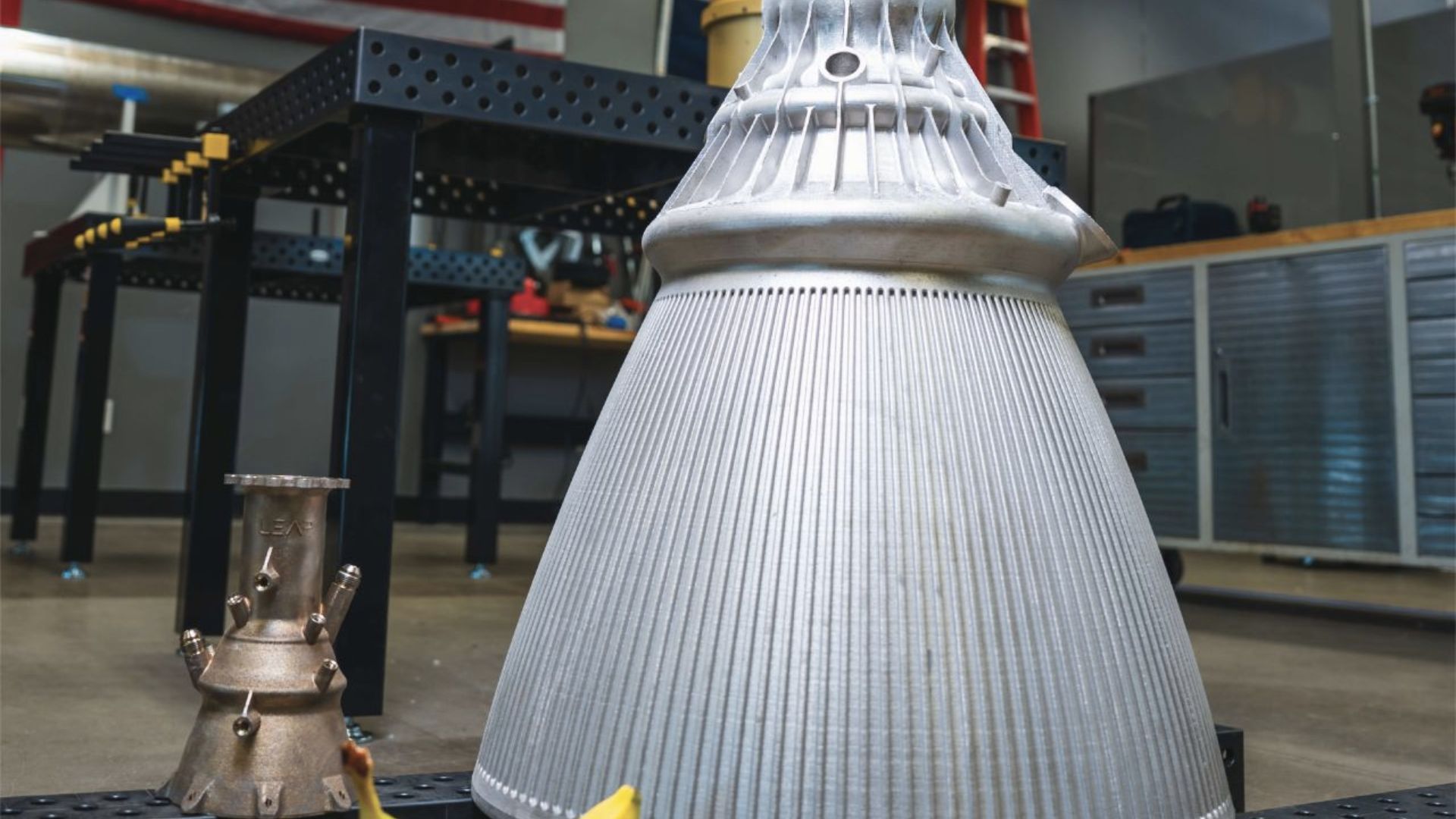
Leap Space has taken a significant step toward the future of affordable and efficient space transportation by revealing its Serrano rocket engine. The latest innovation is a propulsion system manufactured using advanced metal 3D printing technology. Designed to power the company’s upcoming Bighorn launch vehicle, the engine represents an important milestone in the growing adoption of additive manufacturing within the aerospace sector. Serrano engine is engineered to deliver high performance The Serrano engine has been engineered to deliver high performance while simplifying production. Unlike conventionally manufactured rocket engines, which often require hundreds of individually machined and assembled components, the 3D-printed approach allows engineers to consolidate multiple parts into a single structure. This not only reduces manufacturing complexity but also shortens production timelines and improves overall reliability.Rocket engines are among the most complex engineering systems ever built. Traditional manufacturing involves extensive machining, welding, and assembly, making the process expensive and time-consuming. By leveraging metal additive manufacturing, Leap Space has been able to create intricate internal cooling channels and optimized geometries that would be difficult or even impossible to produce using conventional techniques. Efficient engine capable of withstanding extreme temperatures The result is a lighter, more efficient engine capable of withstanding the extreme temperatures and pressures generated during launch. The technology also enables faster design iterations, allowing engineers to refine engine performance more rapidly than with traditional manufacturing methods.The Serrano engine will serve as the propulsion system for Leap Space’s Bighorn launch vehicle, which is being developed to meet the increasing demand for small satellite launches. As the commercial space industry expands, launch providers are seeking vehicles that are not only reliable but also cost-effective and quick to manufacture.By integrating a 3D-printed engine into the Bighorn rocket, Leap Space aims to reduce production costs while maintaining high performance. Faster manufacturing could also allow the company to scale production more efficiently as launch demand grows.Leap Space’s announcement reflects a broader trend across the aerospace industry. Leading launch companies are increasingly adopting additive manufacturing for critical propulsion components because it reduces part counts, lowers material waste, and enables innovative designs that improve engine efficiency.Over the past few years, 3D printing has evolved from being primarily a prototyping tool to becoming a production technology capable of manufacturing flight-ready rocket hardware. Companies worldwide are now using metal additive manufacturing for combustion chambers, injectors, turbopump components, and complete rocket engines. The unveiling of the Serrano engine signals Leap Space’s ambition to become a competitive player in the commercial launch market. If the engine performs as expected during testing and future flight campaigns, it could demonstrate how additive manufacturing is transforming rocket propulsion by making advanced engines faster and cheaper to produce.As satellite constellations continue to grow and demand for dedicated launch services increases, innovations such as the Serrano engine may play a key role in shaping the next generation of launch vehicles. By combining modern engineering with advanced manufacturing techniques, Leap Space is contributing to a future where space access becomes more efficient, scalable, and economically viable.Recommended ArticlesGet the latest in engineering, tech, space & science - delivered daily to your inbox.Prabhat, an alumnus of the Indian Institute of Mass Communication, is a tech and defense journalist. While he enjoys writing on modern weapons and emerging tech, he has also reported on global politics and business. He has been previously associated with well-known media houses, including the International Business Times (Singapore Edition) and ANI.
New 3D-printed rocket engine can enable faster test-and-learn cycles, rapid production
Full Article
Original Source
Read the full article at Interestingengineering →KhanList aggregates and links to publicly available news content. We do not host full articles from third-party sources. Always verify important information with original sources.