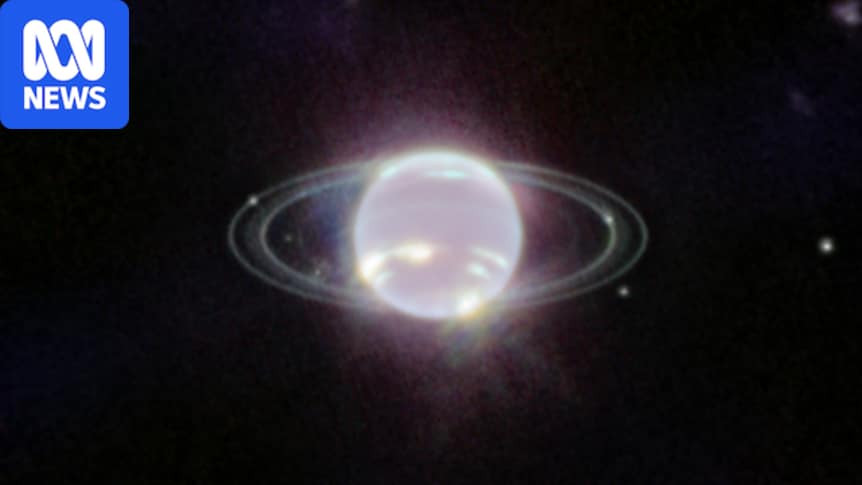
Neptune has a very strange moon system.The farthest planet from the Sun in our Solar System has 16 known moons, named after figures from Greek mythology, and five rings.Its largest moon, Triton, is the seventh largest moon in our Solar System.Named after the Greek god of the sea, Triton makes up more than 99 per cent of the mass of Neptune's satellites. And, unlike any other moon of its size in the Solar System, Triton orbits in retrograde: the opposite direction to Neptune's orbit.The other 15 moons are tiny.None of the other giant planets in our Solar System, Jupiter, Saturn and Uranus, have a moon system this unbalanced.A new study, published in the journal Science Advances, has helped to explain why this might be the case.Pointing the James Webb Space Telescope at NeptuneTriton's odd retrograde orbit has led researchers in the past to theorise that the moon originally came from the Kuiper Belt, a ring of asteroids beyond Neptune.As Triton wandered in towards Neptune it was "captured" by the planet's gravity.In the process, the cosmic gate-crasher may have destroyed Neptune's original moon system, if it had one, according to Ryleigh Davis, a planetary scientist at the University of California San Diego, and lead author on the paper."We don't actually know whether Neptune ever had such a system, and the small inner moons and rings are one of the best places to look for clues," Dr Davis said."The problem is that these moons are tiny, faint, and so close to Neptune that the planet's light overwhelms them."Neptune is named after the Roman god of the sea, and its biggest moon, Triton, is named after Neptune's Greek equivalent, while the smaller moons are lesser Greek sea gods. (Supplied: NASA/ Space Telescope Science Institute)To look for hints of Neptune's original moon system, the researchers used the James Webb Space Telescope (JWST).They analysed light signals coming from three of Neptune's inner moons, Larissa, Galatea, and Proteus, as well as its inner rings, to see what minerals they contained.Dr Davis said the JWST was sensitive enough to look closely at these moons for the first time.Moon minerals hint at a destructive originThe researchers found signals from a type of clay, called a phyllosilicate, on two of the moons (Larissa and Galatea), as well as in the rings."That was not on our list of things we expected to find," Dr Davis said.That's because these clay minerals can't form in cold environments: they need liquid water."We spent a lot of time convincing ourselves it was real before we let ourselves get excited," Dr Davis said.The only place around Neptune that can get warm enough for liquid water is the centre of a large object."The moons we're looking at, Larissa and Galatea, are far too small and cold for that chemistry to have ever occurred in place," Dr Davis said."So the clay had to come from somewhere else: the deep interior of a much larger ancient world."The most natural explanation is that Neptune once had a system of large moons, similar to what Uranus has today, that were shattered when Triton was captured billions of years ago."Neptune's closest neighbour, Uranus, has 28 known moons, five of which are large like Triton.Neptune's brightness makes it difficult to study its inner moons and rings. (Supplied: NASA/ Space Telescope Science Institute)The researchers believe Neptune's remaining rings and moons are mostly the innards of those ancient moons.Helen Maynard-Casely, a planetary scientist at the Australian Nuclear Science and Technology Organisation, who wasn't involved in the research, said the findings supported a generally accepted theory for Triton's origin."Triton turned up and caused havoc," Dr Maynard-Casely said."This gives another piece to the story of how Neptune's moons came to be how they are."Mysterious mineral spottedThe team also found signals from a mineral they couldn't identify on all three of the moons and the rings.Dr Maynard-Casely said this was exciting, because it could potentially be a previously unknown material."This just highlights, again, how much we don't know," Dr Maynard-Casely said.Dr Davis said that figuring out the identity of this material could help researchers learn more about Neptune's original moons, like how large they were."I am hopeful we may eventually get a dedicated Neptune mission," Dr Davis said.The only space probe that has visited Neptune so far was Voyager 2, in 1989. No space agencies have concrete plans to return.Dr Maynard-Casely said a probe would yield better information."Every planetary scientist worth their sodium chloride wants a Uranus-Neptune mission."
Neptune's moon system is bizarre. JWST data helps explain why
Full Article
Original Source
Read the full article at Abc →KhanList aggregates and links to publicly available news content. We do not host full articles from third-party sources. Always verify important information with original sources.