
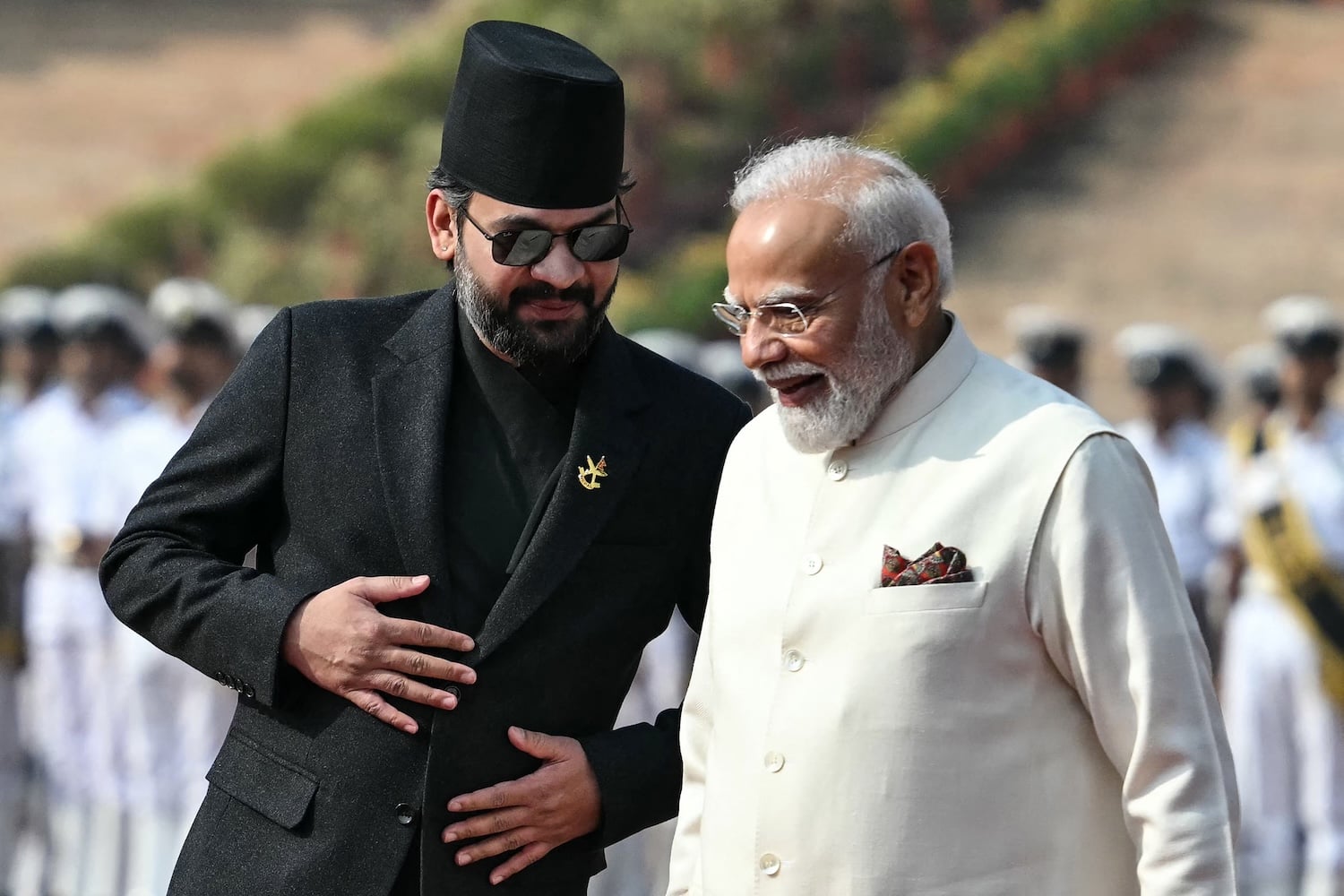
Welcome to Foreign Policy’s South Asia Brief. The highlights this week: Nepali Prime Minister Balendra Shah makes a notable visit to India, former Prime Minister Sheikh Hasina announces a return date to Bangladesh, and senior Pakistani opposition leaders are detained. Balendra Shah Visits India Nepali Prime Minister Balendra Shah’s two-day visit to New Delhi concluded on Monday. Standing alongside Shah, Indian Prime Minister Narendra Modi announced a $1.6 billion assistance package for Kathmandu, most of it earmarked for reconstruction after August’s catastrophic floods. The two sides also pledged cooperation on satellite communications and urban development, and India announced that it will open a new Indian Institute of Technology campus in Nepal. Shah affirmed the strength of the Nepal-India partnership, saying that he hoped it would “be one where trust stands as tall as the Himalayas.” Shah, 36, is a highly unconventional leader, known for his love of rapping, dark sunglasses, and video games. After taking office in March, he took a defiant approach to diplomacy, refusing to meet with visiting foreign dignitaries unless they were of similar rank. His unwillingness to meet Indian Foreign Secretary Vikram Misri prompted New Delhi to call off Misri’s scheduled visit in May. That Shah made India his first trip abroad as prime minister speaks to the importance of the relationship. It is also a reminder of India’s regional influence at a moment when some commentators argue that India is on the back foot relative to China. China has grown increasingly present in Nepal in recent years. In late 2024, the previous Nepali government, led by K.P. Sharma Oli, inked a framework deal with Beijing on the Belt and Road Initiative (BRI). Progress has been slow, and Nepal remains one of the only South Asian countries today with no BRI projects on its soil. However, Nepal, like other smaller South Asian states, relies heavily on Indian development and humanitarian assistance. This gives New Delhi leverage, even as most regional capitals scale up ties with China. The Maldives offers an instructive parallel. One of President Mohamed Muizzu’s first foreign-policy moves after taking office in November 2023 was to expel India’s relatively small military presence. Shortly thereafter, he signed new defense deals with China and signaled a desire to deepen ties further. Yet months later, he visited New Delhi, where Modi announced a new financial assistance package at a critical moment of economic distress. In 2024 and 2025, Muizzu repeatedly called India his country’s closest ally. India is not taking its neighbors for granted, and Shah’s visit showed it. The assistance package was generous, among the largest provided to Nepal since the floods. Modi’s announcement that India will create new innovation hubs and start-up incubators in Nepal will help boost the country’s shaky economy—but it is also likely meant to preempt Beijing from doing the same. None of this means the relationship is in great shape. India and Nepal face several entrenched challenges entirely unrelated to China, including territorial disputes and public perception problems. Many young Nepalis see India as a bully, a view reinforced by India’s unofficial blockade of Nepal more than a decade ago. Shah’s visit nevertheless shows that the two capitals can get substantive things done despite their disagreements, and both walked away with wins. For India, it’s a useful pushback against China. (Shah could, after all, have gone to Beijing first.) For Nepal, it secured badly needed reconstruction aid and pledges of additional economic support, which are hard to come by in a constrained global donor environment. What We’re Following Hasina announces return date. Former Bangladeshi Prime Minister Sheikh Hasina, who has resided in India since being ousted by mass protests in 2024, says she will return home on Dec. 16, her spokesperson told Reuters on Tuesday. The date is symbolic, marking the anniversary of Bangladesh’s 1971 victory over Pakistan. Getting back will not be simple. Hasina was stripped of her passport after her ouster, and Bangladeshi officials have refused to issue a new one. A Bangladeshi court also sentenced her last year to death in absentia for her role in the violent crackdown on protests. Still, Hasina says she wants to return to challenge the legitimacy of the charges and rally her party, which was banned last year. Dhaka repeated its standard response: Hasina is a fugitive and cannot return unless India extradites her—something New Delhi, which was close to Hasina during her time in power, is unlikely to do. Hasina, through her spokesperson, also asked the government to arrange her trip back on Bangladesh’s national carrier, Biman Bangladesh Airlines. Bangladesh’s state minister for foreign affairs called the request “delusional.” If Hasina does return, she will almost certainly be arrested. That would inflame both supporters and opponents, likely sparking violent protests. But if she chooses not to, or tries but is blocked, her base could react violently as well. With major economic, energy, and public health challenges already on its plate, the government can’t afford fresh instability. Pakistani minister visits India. Pakistan’s climate change minister, Musadik Malik, also traveled to New Delhi this past week, representing Pakistan at an arts and culture forum organized by the Shanghai Cooperation Organisation (SCO). It was the first visit by a Pakistani minister since 2023. On one level, the visit went as expected. Malik held no bilateral meetings with Indian counterparts, and both governments emphasized that he came in his SCO capacity. With India-Pakistan ties ice cold since last year’s brief but intense conflict, any official bilateral engagement would have been stunning. What stood out was Malik’s performance. He won admirers in Pakistan, and some in India, with a speech (delivered in Urdu) that emphasized the countries’ shared heritage and praised India’s rich cultural history. He also responded calmly to Indian journalists who peppered him aggressively with questions about Pakistan-sponsored terrorism. Malik’s trip won’t thaw a frozen bilateral relationship, but it underscored the potential for people-to-people engagement. Sri Lankan oil spill. Authorities in Sri Lanka moved quickly to respond to an oil leak at Colombo’s main port on Nov. 21, which the Marine Environment Protection Authority said occurred when a pipeline connected to a fuel storage tank ruptured unexpectedly. The spill polluted nearly two miles of coastline, including the city’s main drainage canal, a fisheries harbor, and an area where local fishers dock their boats. Fortunately, the port authority stopped most of the leak within an hour. It is unclear how much oil escaped, but the tank reportedly held about 1,000 metric tons of marine gas oil. This is the second such incident at the port in under a year. In December 2025, a pipeline sprang a leak while crude oil was being unloaded from a nearby tanker. Under the Radar For more than a week, one of Pakistan’s most prominent opposition leaders has been detained, with no details released about his condition or location. All that is known is that on Nov. 17, Taimur Jhagra and two other senior leaders of the Pakistan Tehreek-e-Insaf (PTI) party were taken into custody in Peshawar. The three were already facing legal trouble: The government links them to attacks on a state radio facility in May 2023, though their lawyers say there is no evidence tying them to violence. Jhagra served as finance and health minister in Khyber Pakhtunkhwa province when Imran Khan was prime minister. He oversaw a series of notable health reforms, including the introduction of a universal health insurance program. Many Pakistanis—and not just PTI supporters—view him as thoughtful, clean, and committed to public service. His arrest, the information blackout that followed, and the lack of a widespread public outcry illustrate the extent of state repression in Pakistan today. FP’s Most Read This Week Huang’s Return Is the Biggest National Security Scandal in U.S. History by James Palmer The Middle East Is Finally on Its Own by Stephen M. Walt Shenzhen Was No Yalta Conference by James Palmer Regional Voices Human rights activist Glenfrey De Mel, writing in the Daily Mirror, praises Sri Lanka’s new anti-terrorism legislation: The proposed Anti-Terrorism Act “represents a critical juncture in the nation’s pursuit of a framework that effectively addresses extremist threats while upholding the fundamental pillars of human rights and the rule of law.” Student Taiba Akhter Mim warns in the Daily Star of the dangers of Bangladeshi children spending too much time on their devices: “Short, supervised viewing of age-appropriate material is unlikely to ruin a child. What should concern us is endless autoplay. … Before pressing play, we should ask what the video gives a child besides a reason to keep watching.” Writer Akbar N. Shad explains in the Express Tribune why Pakistani society holds back from protests: “Pakistan’s political and institutional landscape has, at times, made dissent a difficult undertaking. Concerns about pressure, restrictions and the personal cost of challenging authority can discourage ordinary citizens from raising their voices.”
Nepal’s New Leader Reaffirms Ties With India
Full Article
Original Source
Read the full article at Foreignpolicy →KhanList aggregates and links to publicly available news content. We do not host full articles from third-party sources. Always verify important information with original sources.