
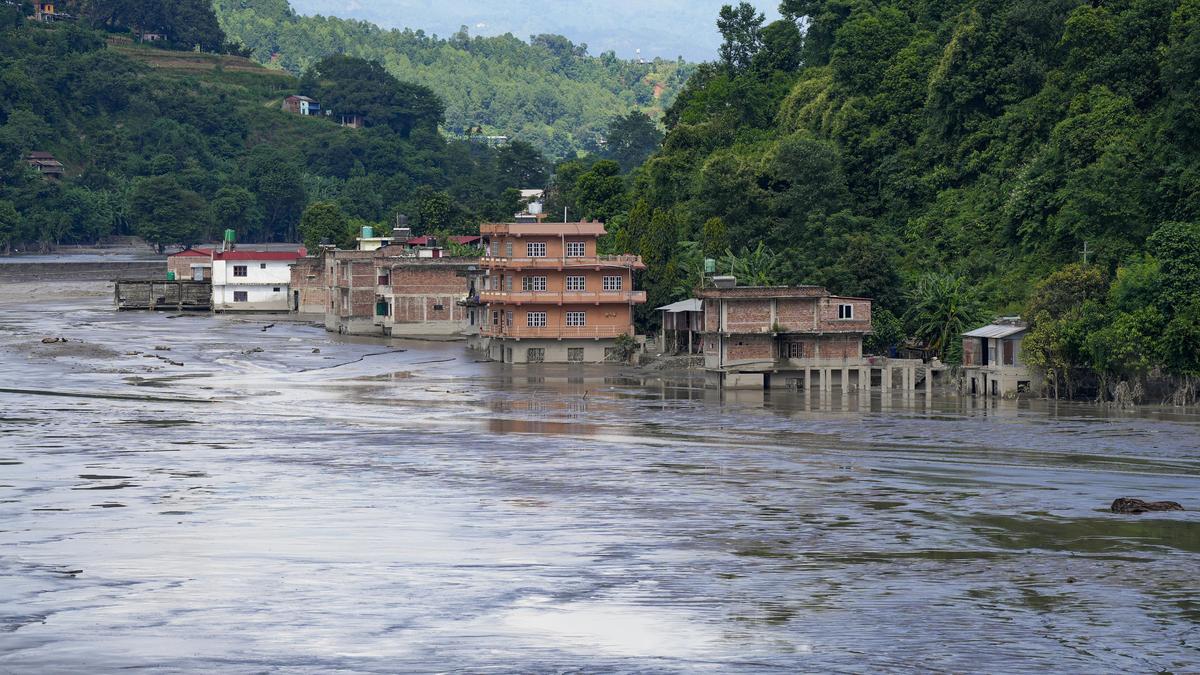
Nuwakot: Floodwaters inundate a residential area after flash floods, at Belkotgadhi in Nuwakot, Nepal, Sunday, Aug. 30, 2026 | Photo Credit: Nand Kumar Singh The dire human and economic cost of the catastrophic flash floods in Nepal on August 26, serves as a stark reminder to countries of the urgent need to strengthen their disaster resilience and preparedness.Nepal, which bore the brunt of the latest glacial collapse, was already identified as being increasingly vulnerable to glacial lake outburst floods (GLOFs). As per the UN Development Program, the country had experienced 26 GLOF events since the 1970s. Data show that the world has lost over 9,500 gigatonnes of its glacier mass since 1975.Several mountain ranges in the Himalayan region such as Central Himalaya (which includes Nepal and India’s Uttarakhand) have recorded over 20% decline in glacier area in three decades.But it is not just glacier-related events. With natural disasters becoming frequent, it is imperative for governments to assess and be better prepared for disasters. Just this month, Indonesia witnessed a 7.7 magnitude earthquake, China battled typhoons, and several European countries combated wildfires. Massive death tolls aside, they displace millions of people. In 2024, over 45 million people were displaced internally due to natural disasters.Further, as shown in the chart below, the economic cost of the damage spans several billion. For several low income and lower-middle income countries, the cost of such disasters takes a hit on their growing economies. For instance, Nepal’s finance minister told Reuters that the country would require about $4 billion to $5 billion to rebuild, nearly a tenth of their economy.Climate change impacts countries disproportionately. An assessment of vulnerability (exposure, sensitivity and ability to adapt) and readiness (ability to leverage investments to adaptation actions) of countries shows that several low- and lower-middle-income countries remain highly vulnerable and less ready to deal with such disasters.The data for charts were sourced from Our World in Data, EM-DAT, International Centre for Integrated Mountain Development (ICIMOD)’s “Changing Dynamics of Glaciers in the Hindu Kush Himalayan Region 1990-2020”, Notre Dame Global Adaptation Initiative scores (2024) and Copernicus Climate Change Service (C3S) Published - August 31, 2026 10:30 am IST
Nepal disaster, a grim reminder to rethink preparedness | Data
Full Article
Original Source
Read the full article at Thehindu →KhanList aggregates and links to publicly available news content. We do not host full articles from third-party sources. Always verify important information with original sources.