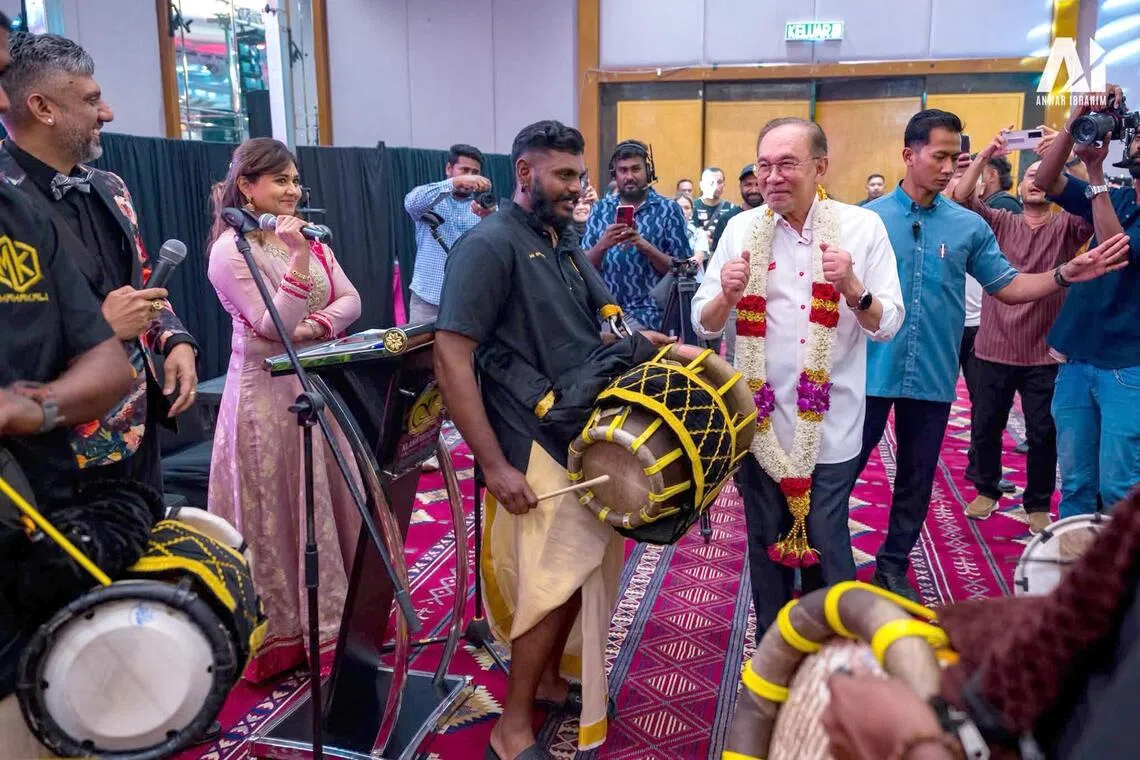
PORT DICKSON, Negeri Sembilan — Indian voters could play a decisive role in determining whether Prime Minister Anwar Ibrahim’s Pakatan Harapan (PH) retains control of the state government of Negeri Sembilan, which goes to the polls on Aug 1.Indians make up more than 20 per cent of the electorate in 11 of the state’s wards, of which nine are governed by the ruling coalition.PH had internally estimated that it secured more than 80 per cent of the Indian vote in the 2023 Negeri Sembilan state election, winning 17 out of 36 seats overall. But this support now appears to be hanging in the balance.So much so that Anwar sought the Indian community’s forgiveness for his previous use of the term “kuil haram” (illegal temple) over controversies linked to Hindu temples in Kuala Lumpur and Selangor located on disputed land.“When I realised that it was wrong for me to say ‘kuil haram’, I apologised...Since I have been the prime minister, there was not a single old temple that I have demolished,” he was quoted as saying by the local media at an Indian community event in Seremban on July 29.The stakes are high for PH, whose share of seats fell at the July 11 Johor state election.BN won an estimated 60 per cent of the Indian vote in Johor, a bloc that had largely backed PH for the past two decades, according to Ibrahim Suffian, programme director of the Merdeka Center in a commentary for the S. Rajaratnam School of International Studies (RSIS).The temple issue is a major concern for the Indian community, said Malaysian Indian People’s Party (MIPP) deputy president S. Subramaniam, who argued that it is inappropriate to describe longstanding temples built before Malaysia’s independence in 1957 as “illegal.”MIPP, a component party of the opposition Perikatan Nasional (PN) coalition, is contesting the Lukut state seat in Port Dickson, where Indians make up about 27 per cent of the electorate.Sharan, a Foodpanda rider who asked to be identified only by his first name, has decided to vote for Barisan Nasional (BN) instead of PH, as a result of his disappointment with Anwar’s remarks about Hindu temples.“I am impressed with Anwar’s economic achievements. But I wanted to vote for Barisan Nasional because Anwar did not take a firm stand against racism,” said the 28-year-old Indian Malaysian, who will be voting in Port Dickson.BN and PN teaming upPH faces increased competition for the Indian vote given that BN - its partner in the federal government - has formed an electoral pact with PN in the Negeri Sembilan state poll.MIPP has gained support from a new ally, the Malaysian Indian Congress (MIC), a decades-old Indian-based party under BN.At an Indian community event in Port Dickson on July 26, BN chairman and Deputy Prime Minister Zahid Hamidi promised that, if BN formed the state government, two state executive council members would come from the Indian community.Indian supporters wave Barisan Nasional flags during a meeting with BN chief Zahid Hamidi on July 25 during a political rally in Port Dickson, Negeri Sembilan. ST PHOTO: HAZLIN HASSANThe promise drew loud cheers from the crowd of about 1,000. Among those in attendance was company manager Jeevan, who declined to share his full name.The 32-year-old said he believed BN was the better choice. “PH promised a lot but they never did anything, especially for Indians on issues like scholarships and temple demolitions,” he told ST.Incumbency advantageBut it is not all bleak for PH, which enjoys the advantage of incumbency. First-time voter Kishen Abdullah, 19, said PH’s state executive councillor Arul Kumar Jambunathan, one of two Indian councillors in the PH state government, had served the people of Nilai well. The urban constituency in Seremban, the capital of Negeri Sembilan, has an Indian electorate of 20.8 per cent.“He has built a flood retention pond and expanded the roads. Things are better than before,” the Indian Muslim shopkeeper told ST.In an interview with ST on July 24, Arul said his proudest achievements since taking office in 2018 include building a Tamil primary school and resolving land disputes in the state involving 30 Hindu temples.“We have never demolished Hindu temples in Negeri Sembilan. Any dispute must be referred to the state executive council meeting,” he told ST, while acknowledging that the temple issue had affected PH’s popularity.Political analyst Tricia Yeoh said PH continued to be weighed down by perceptions of mismanagement over Hindu temples, despite its strong governance record.“The sentiment of the Indian community towards PH, and in particular Prime Minister Anwar, seems to have shifted dramatically in a negative direction,” Yeoh, a senior visiting fellow at the ISEAS – Yusof Ishak Institute, told ST.Still, she believes that PH could still retain eight of the nine seats with a significant ratio of Indian voters.PH had won these eight seats in 2023 with a majority of more than 6,000 votes each and this would cushion the potential electoral swing from Indian community, she added.The exception is Port Dickson’s Sri Tanjung, which PH won by about 4,000 votes in 2023.Sign up for our weekly Asian Insider Malaysia Edition newsletter to make sense of the big stories in Malaysia.
Negeri Sembilan election: Indian voters could be key to whether Anwar’s PH retains the state
Full Article
Original Source
Read the full article at Straitstimes →KhanList aggregates and links to publicly available news content. We do not host full articles from third-party sources. Always verify important information with original sources.