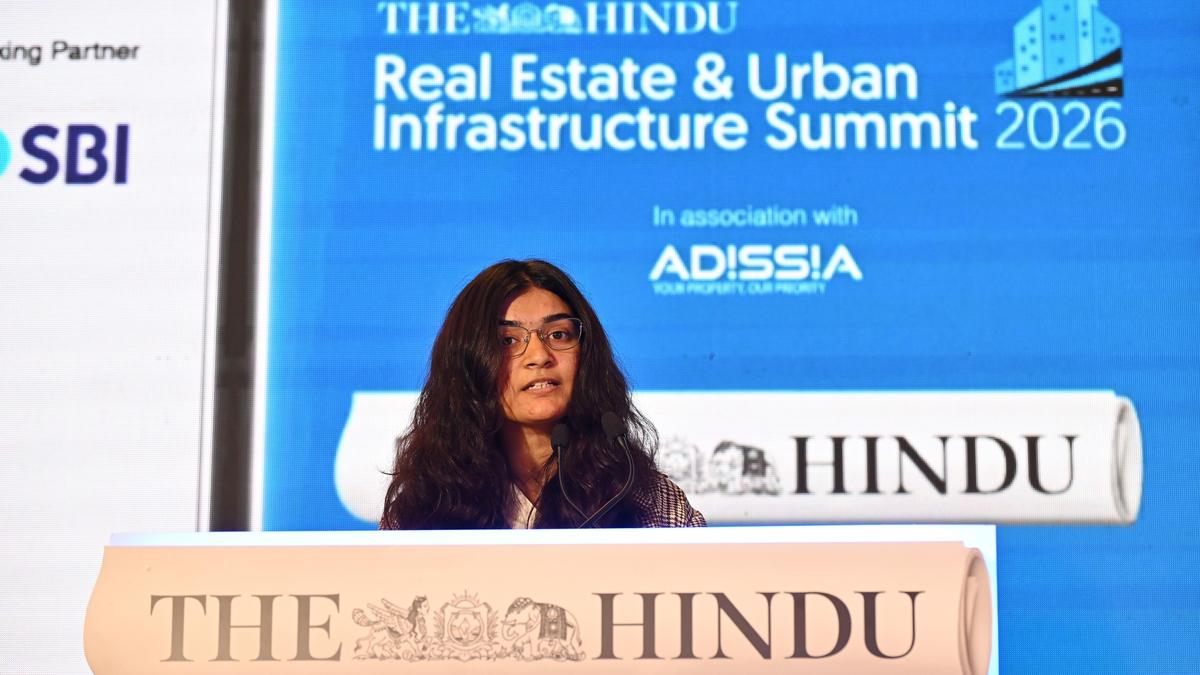
Architecture student Subhapradha presenting a case for skyscrapers integrated with urban farming, biodiversity corridor, carbon sequestration, and cooling landscapes at The Hindu Real Estate and Urban Infrastructure Summit 2026 in Chennai on Thursday. | Photo Credit: VELANKANNI RAJ B. As the concrete jungle in Indian cities such as Chennai has outgrown green cover and increased heat stress, these cities need vertical forest cities, integrating skyscrapers with urban farming, biodiversity corridors, carbon sequestration, and cooling landscapes. According to data compiled for The Hindu Real Estate and Urban Infrastructure Summit 2026 by final-year architecture student Subhapradha, Saveetha College of Architecture and Design, dense, built-up areas in Chennai showed rising surface temperature, creating persistent heat spots, as the city’s vegetation declined from 25% in 2014 to 10% in 2024 and built-up area expanded from 36% in 2014 to 67% in 2024. “We need vertical forest cities in India, integrating skyscrapers with urban farming, biodiversity corridors, carbon sequestration, and cooling landscapes. Chennai already has a built example of vertical greenery at scale with 15,000 sq. ft. of landscaped gardens,” said Ms. Subhapradha.“Future high-rise developments should move beyond treating greenery as an amenity. Instead, architecture and ecology need to be designed as one integrated system, where vegetation, water management, and building performance work together. Rather than replicating international examples, my proposal adapts these principles to suit India’s climate, ecology, and urban conditions,” she said.“Approvals reward built up areas over retained open space. Green space and water body norms exist on paper but lack enforcement in many parts of Chennai. No mandated maintenance budget is followed once a green project is inaugurated,” she said. Another Architecture student Aldrich Bennet makes a presentation at The Hindu Real Estate and Urban Infrastructure Summit 2026 in Chennai on Thursday. | Photo Credit: VELANKANNI RAJ B. In a presentation on “Water positive cities solving urban water crisis through architecture,” B.Arch student Aldrich Bennet said they have started a study on old temple tanks in Chennai. “We explored the concept of water-positive cities and demonstrated how architecture and urban design can help address Chennai’s growing water crisis. It begins by explaining India’s traditional water systems—temple tanks, lakes, eris, and canals, which historically captured monsoon rain, recharged groundwater, controlled floods, and supported community life. We examined how rapid urbanisation, impervious surfaces, and the loss of interconnected water bodies have led to flooding, groundwater depletion, and the disappearance of public water commons, particularly in George Town, Chennai. Using the 300-year-old Krishnappa Tank as a case study, we proposed a water-sensitive urban regeneration strategy that includes rainwater harvesting, greywater treatment and reuse, permeable streets, wetlands, groundwater recharge, and the ecological restoration of the tank. Reviving historic water bodies as multifunctional blue-green public spaces can reduce flooding, improve microclimate, enhance biodiversity, strengthen community life, and provide a scalable model for creating climate-resilient water-positive cities,” he said. Published - July 30, 2026 11:50 pm IST
‘Need vertical forest cities in India, with skyscrapers integrated with urban biodiversity corridors’
Full Article
Original Source
Read the full article at Thehindu →KhanList aggregates and links to publicly available news content. We do not host full articles from third-party sources. Always verify important information with original sources.