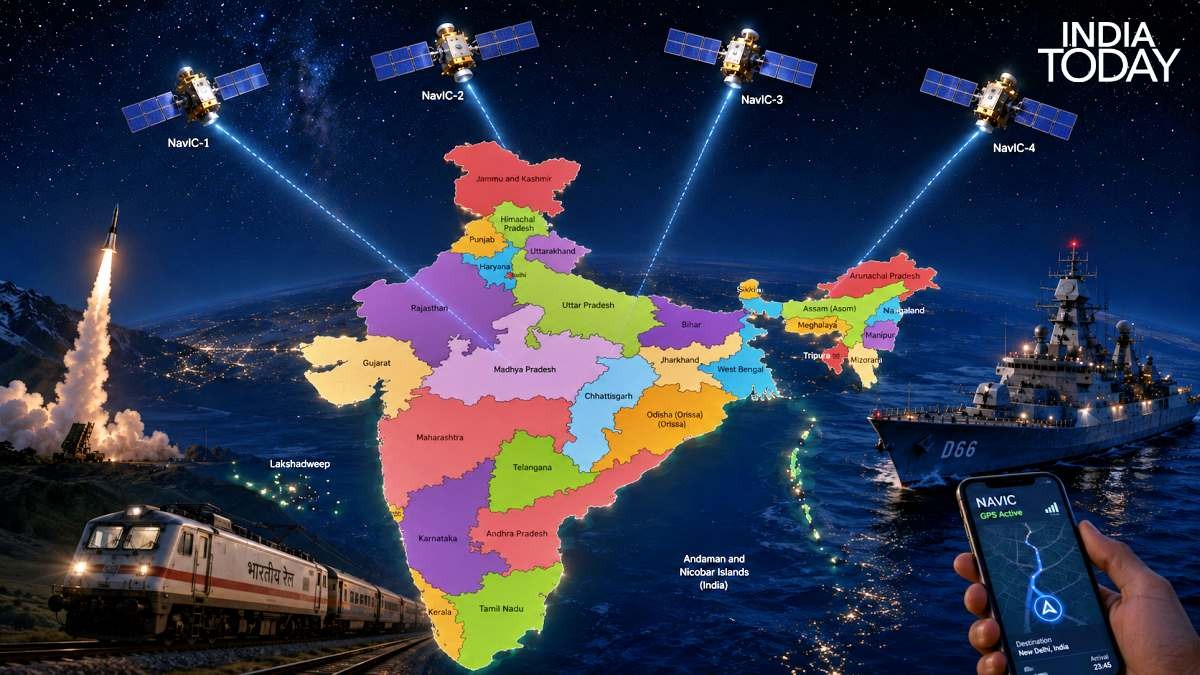
The government has told Parliament that NavIC cannot provide standalone positioning because only three satellites are operational.NavIC provides Positioning, Navigation and Timing (PNT) services across India. (Photo: India Today)The government has finally acknowledged in Parliament that India's indigenous navigation system, NavIC, is currently unable to provide standalone positioning services because too few satellites are operational.In a written reply in the Lok Sabha, Union Minister of State for Space Dr Jitendra Singh said that after the completion of the mission life of IRNSS-1F, only three satellites, IRNSS-1B, IRNSS-1I and NVS-01, are currently providing Positioning, Navigation and Timing (PNT) services.While NavIC's timing service continues to function, at least four operational satellites are needed in orbit to determine a user's position using NavIC alone.The next satellite, NVS-03, is ready for launch, while NVS-04 and NVS-05 are in advanced stages of development. For NavIC, the current shortage means it cannot independently provide positioning across its service area. (Photo: India Today) WHY DOES NAVIC NEED FOUR SATELLITES?Imagine you're lost in a dark city. Someone tells you, "You're exactly 5 km away from India Gate."Does that tell you where you are? No. You could be anywhere on a huge circle with a radius of 5 km around India Gate.Now another person tells you, "You're also exactly 4 km away from Rashtrapati Bhavan."Now your location is narrowed down to two possible places where those two circles meet. A third person says, "You're 3 km away from Kartavya Path."Now only one location fits all three distances, and you've found where you are. India's NVS-03 is ready for launch. (Photo: Isro) GPS and NavIC satellites do something very similar, but in 3D space, so instead of circles they create giant invisible spheres around themselves.Each satellite continuously broadcasts:"This is where I am.""This is the exact time I sent this signal."Your phone measures how long the signal took to arrive. Since radio waves travel at the speed of light, it calculates how far away that satellite is.The more satellites it hears, the more accurately it can pinpoint your location.SO WHY ISN'T THREE SATELLITES ENOUGH?Because there is one hidden problem, your phone doesn't have an atomic clock.Each NavIC satellite carries an incredibly accurate atomic clock that loses only a second in millions of years. Your phone's clock is nowhere near that accurate.Imagine your watch is just one millionth of a second slow.That sounds tiny, but because radio signals travel at 3,00,000 km every second, that tiny error translates into about 300 metres of location error.So when your phone uses only three satellites, it has four things it doesn't know:Where it is north-south (latitude)Where it is east-west (longitude)How high it is (altitude)How much its own clock is wrongBut it only has three measurements, which isn't enough to solve four unknowns.The fourth satellite provides one extra measurement. With four satellites, your phone can correct its clock error and calculate all three coordinates accurately at the same time.That's why Isro says NavIC needs at least four operational satellites for standalone positioning. With only three satellites, NavIC can still provide accurate timing, but it cannot independently calculate a user's location. Each NavIC satellite carries an incredibly accurate atomic clock. (Photo: Getty) WHY THE NAVIC CONSTELLATION MATTERSA navigation system is called a constellation because multiple satellites work together as a coordinated network.Each satellite contributes a unique ranging signal from a different point in space. It is this geometry, not the capability of any individual satellite, that allows a receiver to calculate its position accurately.Although only four satellites are the minimum needed for a position fix, operational navigation systems usually deploy many more.Extra satellites improve accuracy, ensure continuous coverage when some satellites are below the horizon or undergoing maintenance, and provide redundancy in case of failures.For NavIC, the current shortage means it cannot independently provide positioning across its service area.Once NVS-03 joins the constellation, followed by NVS-04 and NVS-05, Isro expects to restore and strengthen India's homegrown navigation capability, reducing dependence on foreign satellite navigation systems for civilian and strategic applications.- EndsPublished By: Sibu Kumar TripathiPublished On: Jul 30, 2026 11:38 IST
NavIC not working: Why the constellation needs 4 satellites to function
Full Article
Original Source
Read the full article at Indiatoday →KhanList aggregates and links to publicly available news content. We do not host full articles from third-party sources. Always verify important information with original sources.