
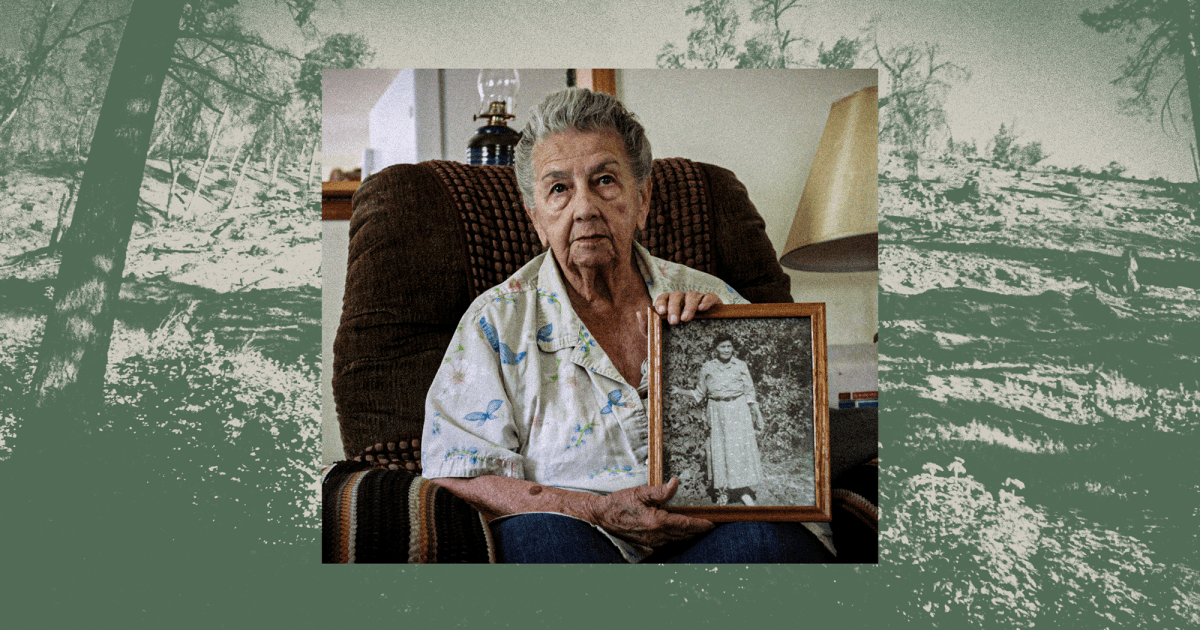
Get your news from a source that’s not owned and controlled by oligarchs. Sign up for the free Mother Jones Daily. As Stephen Young stepped into the woods about an hour drive from Mt. Lassen volcano in northeast California, the forest began communicating to him in an unspoken language learned from his years collecting plants. The tree-shaded March air felt cool against his cheek, and he could sense the moisture of the forest’s understory hanging in the air. He inhaled the rich scent of pine needle duff wafting up from the ground. “I said to myself, there is bracken fern in this area,” he recalls. “I walked maybe 50 yards, and there it was, a whole field of bracken ferns.” Young, 26, is a traditional Maidu basketweaver who collects the roots of the fern and other native plants for material. Over the years, he’s learned to avoid the toxic chemicals sprayed by the US Forest Service in California’s woodlands. He scanned the area, looking for signs that the Forest Service might have sprayed herbicides nearby. Nothing. The site was clean, or at least that was his best guess. “We need the natural environment to practice our religion and spirituality.” Earlier this year, our Mother Jones investigation found that record amounts of glyphosate—the key ingredient in the herbicide Roundup—have been sprayed in California’s forests in recent years. It also exposed how key scientific studies that the Forest Service and others relied upon to say glyphosate was safe were ghost written by manufacturer Monsanto. The Forest Service uses glyphosate and other herbicides in the wake of forest fires or logging operations to kill native plants the agency says compete with replanted saplings for sunlight, water, and soil nutrients. By eliminating the native plants, freshly planted timber trees will grow back faster and in greater density for future logging. The Trump administration announced plans this month to roll back protections for 45 million acres of national forest, including old growth trees, following President Trump’s call last year to increase timber production by 25 percent. https://youtube.com/shorts/sNjafmuqTPc But a growing number of Native American community leaders from across the state—Mt. Lassen in the north to Lake Tahoe and down to Southern California—say the government’s spraying of glyphosate infringes on their cultural and religious practices by poisoning their traditional gathering areas and changing the composition of the forest. They told me that the moment has come to take action, maybe even legal action. And it wouldn’t be the first time. Nearly 25 years ago, a coalition of tribal members from across the state joined with environmental groups to challenge the Forest Service in court after they say community members got sick from ingesting the chemicals. Their efforts back then reduced, and in some areas all but eliminated, the Forest Service’s use of herbicides. “We need the natural environment to practice our religion and spirituality,” Young said. “If we can’t do that then our culture is at risk.” Stephen Young is a traditional Maidu basketweaver who collects the roots of ferns and other native plants for material. Courtesy Stephen Young By removing native plants, the Forest Service is harming the wildlife that depends on it, including mammals, birds and insects, says Jun Bando, executive director of the California Native Plant Society,Courtesy Stephen Young The California Indian Basketweavers’ Association helped lead those legal challenges a quarter century ago. Today, it instructs members to watch out for the warning signs of the government’s herbicide spraying: plants and bushes that are unexpectedly brown and dead in the middle of summer, patches of ground where nothing is growing, and recent logging or replanted timber trees. Young had his herbicide training in mind as he approached the bracken ferns, large fronded plants that resemble ferns you might see for sale at the hardware store. Bracken fern, like other native plants that return after wildfires, will die after being sprayed by glyphosate. But depending on the time of year, it can be hard to tell if brown, dried out fronds have been sprayed or are just changing with the seasons. In 2000, the California Indian Basketweavers’ Association joined a coalition of nonprofits that challenged the Forest Service’s use of herbicides in the Tahoe National Forest after it says members began to get sick, which the native community blamed on the government’s use of herbicides in their gathering areas. “There were elders who started to get sores in their mouths because of the pesticides. We use our mouths to help in basketweaving,” Young says. “And then if you’re cooking in these baskets, and the material has been sprayed, then people can be ingesting it.” The US Forest Service did not respond to a request for comment. Bayer, which manufactures glyphosate, has maintained that the herbicide is safe when used as directed and notes that regulators around the world have approved its use. (Although, notably, the Canadian province of Quebec, one of the largest timber producers in North America, has banned it.) The coalition of nonprofits that included the California Indian Basketweavers’ Association got a federal judge in 2001 to issue an injunction to stop the government’s spraying in the Tahoe National Forest, at least temporarily, because the court ruled the government had not fully assessed the risks of herbicides as required under the National Environmental Policy Act. Following the ruling, and amid widespread public outcry and a series of similar lawsuits in the years that followed, the Forest Service significantly reduced its large-scale spraying in California forests, according to state pesticide records and interviews with foresters, environmentalists, and government officials. But in recent years, following a series of massive wildfires that hit California, the Forest Service began returning to chemical spraying as the cheapest way to regrow dense forests intended for timber sales and harvesting. When replanting trees after a fire or logging operation, the alternative to herbicides is to manually clear areas around the baby pine trees. But a Forest Service study found that hiring people to do that work instead of using herbicides in California’s Eldorado National Forest following the Caldor Fire would cost three times as much. The government chose the cheaper option. “It’s devastating,” says Starla Madrigal, chairperson of the California Indian Basketweavers’ Association, which continues to oppose herbicide use on wildlands. “It stays in the plants. It contaminates the water.” Back in 2001, at the urging of native basketweavers, the California Department of Pesticide Regulation published the results of a multi-year study documenting how long herbicide chemicals linger in plant materials after being sprayed on Forest Service land. It analyzed spray areas in Eldorado, Sierra, and Stanislaus National Forests, and specifically tested plants used by tribal communities for basketweaving, such as bracken fern roots and buckbrush shoots. The report found the chemicals linger in plant material for well over a year, and it advised that “to be certain of avoiding plant materials with detectable herbicide residues, plants should not be gathered within 80 weeks of glyphosate and triclopyr applications.” These are two of the same chemicals the Forest Service is now spraying in the Lake Tahoe area, where plans call for more than 70,000 acres of the Eldorado National Forest to be treated. These chemicals are not staying where they are sprayed, but are instead entering the waterways. Despite the recommendations from state pesticide experts to avoid collecting from these areas for 80 weeks, the Forest Service sprayed glyphosate and triclopyr in the Tahoe area in 2025 but did not notify the public of where it had sprayed until this spring, more than a year later. In an email, an unnamed Forest Service spokesperson wrote that its workers post signs after spraying, but that those signs are typically removed no more than 48 hours after application, well short of the 80 week recommendation for avoiding herbicide residues. In fact, signs can be removed as soon as a day after glyphosate is used, according to the Forest Service’s protocols. (The agency did not respond to my questions about the apparent discrepancy.) A hillside behind the home of Beverly Ogle that was negatively affected by herbicides sprayed by the government.Mother Jones Another herbicide the agency approved for use in the Tahoe area, hexazinone, can linger even longer. The 2001 state report recommended not gathering plant material for 130 weeks after hexazinone is used in order to avoid residues. But the Forest Service stated policy says signs can be removed within days after the chemical is sprayed. A more recent report by California Department of Pesticide Regulation found that these chemicals are not staying where they are sprayed, but are instead entering the waterways. The 2024 study tested rivers, creeks and drainage ditches in the Central Valley—California’s main farmland region—and found glyphosate in 100 percent of the samples. A similar study that tested streams for triclopyr in other parts of California found it was also detected in 100 percent of the waterways. The herbicides can impact the ecosystem for decades, according to the Forest Service’s own 2025 report, which found many native plants will be replaced by invasive species after large-scale herbicide spraying. A study published in the journal Forest Ecology and Management in 2010 found that herbicide use for reforestation resulted in fewer native plants growing back, and instead resulted in “significantly greater” invasive species taking root in the replanted forests.“This is a particularly destructive way to manage the forest,” says Jun Bando, executive director of the California Native Plant Society, who holds a PhD in ecology from University of California, Davis. “There is long-term ecological damage.” By removing native plants, she explains, the Forest Service is harming the wildlife that depends on it, including mammals, birds and insects. It also might be increasing wildfire risk, she says, because many of these invasive species, such as the French broom shrub, are what fire experts refer to as “flashy fuels,” meaning they are more likely to catch fire and kill the replanted trees. This idea is backed up by the 2010 study, which found that the most common invasive grass to take root after herbicide spraying is cheat grass, and that this invasive plant burns nearly ten times more frequently in western ecosystems than the native shrubs that normally repopulate after forest fires. Bando says the only time her organization endorses herbicide use is against these invasive species after all other measures have been tried, and even then only in highly targeted approaches—not anywhere near the scale being deployed by the Forest Service. Assemblymember James Ramos, who was the first Native Californian elected to the state legislature, said protecting the native grasses is important because “basketweaving is truly who we are.” Ramos is the author of the California Indian Freedom Act of 2026, which would give Native people more protections and the right to sue if the state government infringes on their tribal customs or beliefs. The bill passed the assembly and is now up for a vote in the state senate. “We have to stand our ground. We have to make sure our voices are heard,” Ramos said. “There were elders who started to get sores in their mouths because of the pesticides,” says Stephen Young. “We use our mouths to help in basketweaving.”Courtesy Stephen Young “We need the natural environment to practice our religion and spirituality,” Young says. “If we can’t do that then our culture is at risk.”Stephen Young The Native American community is once again starting to organize against the government’s plans to spray herbicides, said Beverly Ogle, a Maidu elder in the Lassen area of California. “I’m afraid to go out in the backcountry and gather plants. Because are we gathering something that’s got poison on it?” “We’re just not going to let it go,” she told me, sitting in her living room in the foothills of Mt. Lassen volcano. “It’s kind of like killing our tribe again. That’s the way I truly feel. It’s gotten to the point where I’m afraid to go out in the back country and gather plants. Because are we gathering something that’s got poison on it?” Ogle, 85, said the herbicide spraying is the government’s latest attack on their native culture and religious practices, a long continuation of an injustice that began more than 150 years ago. In the 1800s, native people were hunted down and killed by authorities, she told me. An English-language newspaper near Mt. Lassen ran this description in 1859 of local efforts to kill native people in eastern Tehama County: “Some men are hired to hunt them, who are recompensed by receiving so much for each scalp, or some other satisfactory evidence that they have been killed.” We survived that, she said, but then the federal government funded a boarding school in nearby Greenville, Calif. where her relatives were sent so that their native language and customs would be replaced by English and American traditions. Today, the Forest Service’s plan is to spray glyphosate and other herbicides across the same areas where the militiamen were paid to murder and scalp Native Americans, and where school-aged children were taken without consent from their parents. It is a continuation of the same genocidal behavior, Ogle said to me, quietly, shaking her head. The Maidu people survived, Ogle said, but their customs, medicines and religious practices are once again being threatened by government officials, this time to grow trees as cheaply as possible. “It’s not a good feeling,” she said. “We’re just not going to let it go,” says Beverly Ogle, as she sat in her living room in the foothills of Mt. Lassen volcano.Mother Jones
Native American Leaders Denounce Record Glyphosate Spraying on National Forests
Full Article
Original Source
Read the full article at Motherjones →KhanList aggregates and links to publicly available news content. We do not host full articles from third-party sources. Always verify important information with original sources.