
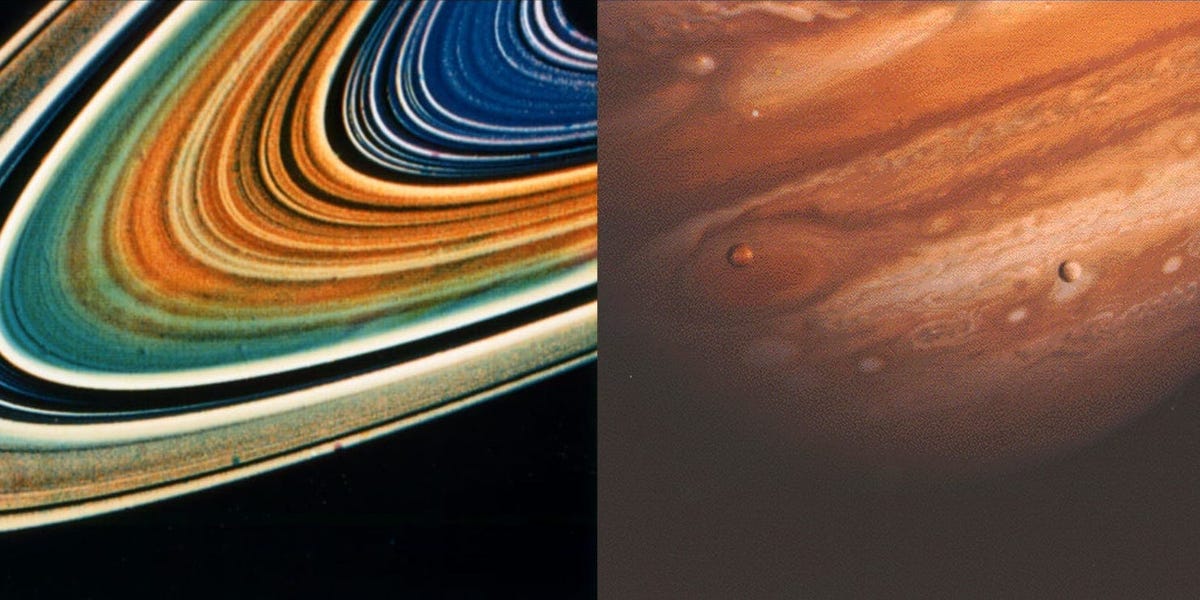
NASA's Voyager probes have traveled through space for nearly 50 years. See the remarkable photos from their journeys. This montage shows examples of striking images of the solar system taken by Voyager 1 and 2 on their missions. NASA/JPL/Insider Voyager 2, a pioneer in outer solar system exploration, left Earth for interstellar space 49 years ago, on August 20, 1977.The twin of Voyager 1, which left Earth only a few weeks after, is the only spacecraft to visit all four of the solar system's outer gas giants — Jupiter, Saturn, Uranus, and Neptune.The Voyager probes were originally sent on a four-year mission to tour the solar system, but they exceeded expectations and are still going nearly half a century later. That makes them NASA's longest-lived mission, costing the agency more than $865 million.The two probes have had their fair share of interstellar road bumps, which have only been exacerbated as the probes age. In 2022, Voyager 1 started sending garbled data from outside the solar system. NASA ultimately figured out that one of its computers had gone dead years earlier.Voyager 2 fell into limbo in 2023, losing contact with NASA after someone sent a wrong command. The agency detected a faint signal from Voyager days later after blasting a "shout" across the cosmos to get the probe to point its antennae back to Earth and resume communication.Come November 2026, Voyager 1 will be 16 billion miles — or one light-day — away from Earth. Voyager 2, meanwhile, will be more than 13.2 billion miles from Earth, traveling through interstellar space — the space between stars — at 34,000 mph relative to the Sun.While both probes are losing about 4 watts of power each year, NASA continues to make efforts to keep them exploring.In August, the agency announced it substituted some devices on Voyager 2 with "lower-power alternatives while ensuring the spacecraft remains warm enough to operate." This, it said, should keep the probe's instruments running for at least another year. NASA plans to make the same change for Voyager 1.To celebrate Voyager 2's 49th birthday, here are 23 photos that show its history and what both probes have seen among the cosmos. Voyager 2 launched from Cape Canaveral Air Force Station in Florida in August 1977. NASA's Voyager 2 spacecraft launches atop its Titan/Centaur-7 launch vehicle in Florida on August 20, 1977, at 10:29 a.m. local time. : Hum Images/Universal Images Group via Getty Images The Voyager mission included two probes — Voyager 1 and Voyager 2 — which NASA launched in 1977 within a few weeks of each other. Voyager 1 launched on September 5, 1977.NASA took advantage of a rare planet alignment to turbocharge the journeys into space. Voyager 1 overtook its twin shortly after launch, thanks to a faster flight path. The Voyager probes carry 11 different scientific instruments to study planetary bodies, magnetic fields, and particles. An annotated image of the Voyager probes. NASA/Hulton Archive/Getty Images This annotated image shows the various parts and instruments of NASA's Voyager space probe. The Voyager probes were designed to visit Jupiter and Saturn. The Voyager probes whizzed through the solar system, taking unprecedented pictures. NASA Voyager 2's mission saw all four gas giants. This is what Voyager 1 saw on its approach to Jupiter. A timelapse taken by Voyager 1 as it approached Jupiter in March 1979. NASA/JPL Voyager 1 and Voyager 2 reached Jupiter in 1979.As they flew by the planet, they took about 50,000 pictures of Jupiter. These blew away scientists, as the quality of the pictures was much better than those taken from Earth, according to NASA.These snaps taught scientists important facts about the planet's atmosphere, magnetic forces, and geology that would have been difficult to decipher otherwise. The probes discovered two new moons orbiting Jupiter: Thebe and Metis. Jupiter and two of its moons taken by Voyager. NASA/JPL Jupiter has over 100 known moons; its main four are Ganymede, Io, Europa, and Callisto. They also spotted a thin ring around Jupiter. A false color image of Jupiter's ring, discovered by Voyager. NASA/JPL The probe captured this picture as it was looking back at the planet, backlit by the Sun. Voyager 1 discovered volcanoes at the surface of Io, one of Jupiter's moons. A picture taken by the Voyager probes. NASA/JPL Io is the most volcanically active body in the solar system. Next stop: Saturn. Three Voyager 2 images, taken through ultraviolet, violet, and green filters, were combined to make this photograph. NASA/JPL In 1980 and 1981, the probes reached Saturn. The flyby gave scientists unprecedented insight into the planet's ring structure, atmosphere, and moons. Voyager snapped Saturn's rings in more detail than ever before. Saturn's rings are shown in false color in a picture taken by a Voyager probe on August 23, 1981. NASA Photos showed secrets that Enceladus, the sixth-biggest of Saturn's nearly 300 moons, had to offer. Encheladus, one of Saturn's moons, seen by Voyager. NASA/JPL Saturn, snapped as the probe flew away, was shown in a new light. Voyager 1 looked back at Saturn on November 16, 1980, to give this unique perspective on its rings. NASA/JPL By 1986, Voyager 2 had made it to Uranus. Voyager 2 captured these images of Uranus in 1986, in true colors (left) and false color (right). NASA/JPL By 1986, Voyager 1 had finished its grand tour of the solar system and flew out toward interstellar space. But Voyager 2 kept on exploring our nearest planets, passing 50,600 miles away from Uranus in January 1986. Voyager 2 discovered two extra rings around Uranus, revealing the planet had at least 11, not 9. Voyager 2 also spotted 10 previously unseen moons around Uranus. Here is a picture of Miranda, one of Uranus' major moons. NASA/JPL Voyager 2 was the first spacecraft to observe Neptune from a close distance. Neptune, seen in false color by Voyager 2 in 1989. NASA/JPL In 1989, 12 years after its launch, Voyager 2 passed within 3,000 miles of Neptune. Voyager 2 was the first spacecraft to pass by Neptune. Neptune, seen by Voyager 2 in 1989. NASA/JPL Voyager 2 took this picture of Triton's rough face. Triton, seen by Voyager 2 in 1989. NASA/JPL It captured Triton, Neptune's largest moon, in unprecedented detail. It also snapped Triton's southern hemisphere. Neptune, seen by Voyager 2 in 1989 NASA/JPL As it flew by, Voyager 2 discovered 4 of Neptune's rings. NASA said Neptune has at least 5 main rings, made mostly of dust and small rocks. NASA/JPL As its parting gift, Voyager 2 took this beautiful picture of light grazing Neptune's south pole. Neptune, as seen by Voyager 2 in 1989. NASA/JPL Since it wouldn't come across another planet on its ongoing journey, NASA switched off its cameras after its flyby of Neptune to conserve energy for other instruments. Voyager 1 had one last trick up its sleeve. The solar system's portrait provided by Voyager 1 in 1990. NASA/JPL As its last photographic hurrah in 1990, Voyager 1 took 60 images of the solar system from 4 billion miles away. It gave us the Earth's furthest selfie, dubbed the "pale blue dot." The pale blue dot. NASA This remains the longest-range selfie: a portrait of the Earth taken by a human-made probe from 4 billion miles away. After this picture, NASA switched off Voyager 1's cameras to save energy. NASA could switch the probes' cameras back on, but it is not a priority for the mission. Beyond the solar system This artist's concept shows the general locations of NASA's two Voyager spacecraft. Voyager 1 (top) has sailed beyond our solar bubble into interstellar space, the space between stars. NASA/JPL-Caltech Though the probes are no longer sending pictures, they continue to send crucial information about space. In 2012, Voyager 1 became the first human-made instrument to cross into interstellar space by crossing the boundary between our solar system and the rest of the universe, called the heliopause. Voyager 2 was second, crossing that threshold in 2018. The probe revealed that there was yet another layer outside our heliosphere.The probes keep sending back measurements from interstellar space, like weird hums likely coming from vibrations in the electrically charged gas between stars. Even after their instruments are switched off, the probes' mission continues. A collage shows the two sides of NASA's golden record, which is onboard the Voyager probes. NASA/Insider Even after all their instruments become quiet, their mission will carry on.As they drift off, they will still be carrying a golden record that carries crucial information about humanity. If intelligent extraterrestrial life exists, they could use that information to reach out to us.This article was originally published on June 6, 2022, and is being updated with the latest developments about Voyager 1 and 2. It was last updated in August 2026. Read next Doctor Marianne Guenot is a science reporter based in the UK who writes about health, AI, nuclear sciences, archeology, solar and planetary sciences, space exploration, and the commercial and political impact of science and tech. As part of her work, she visited the world's first final repository for nuclear waste, probed the economy of the climate crisis, untangled the complex factors playing into how the food chain pushes a health and climate crisis, tracked mysterious uranium cubes from the Manhattan project back to a Germany first prototype nuclear reactor, examined the motivations behind a tech tycoon's disastrous exploration of the deep sea, and deciphered the intricate business case behind NASA's return to the moon.Marianne holds a master's and Ph.D. in biomedicine and a master's degree in science communication. She worked with Business Insider from 2021 to 2024. Before then, she edited news and opinion at The Lancet and Nature Medicine. There, she wrote editorials read by leading policymakers. Selected works include.https://www.businessinsider.com/billionaire-backed-harvard-prof-says-science-should-take-ufos-seriously-2024-4The moon is open for business, and entrepreneurs are racing to make billionsOceanGate's CEO wanted to be the Elon Musk of the deep, say former colleagues. His dream was a disaster waiting to happen.OceanGate's cofounder wants to send 1,000 people to a floating colony on Venus by 2050, and says we shouldn't stop pushing the limits of innovationOver 600 cubes of Nazi uranium made their way to the US after the war. 2 scientists are trying to figure out where they are now.Climate change is already costing us money, but we have a chance to limit the worst of it and prosper. Here's how.Inside a nuclear tomb: The underground store that's humanity's first attempt to dispose of nuclear waste for 100,000 yearsThere's no GPS on the moon. NASA and ESA have to fix that before humans return in 2 years.Iceland scientists want to drill a hole straight into a reservoir of molten magma about a mile underground. It could generate limitless energy.Children as young as 10 and rape victims were sterilized in Utah as late as the 1970s. Time is running out to get justice.Elon Musk said his Neuralink brain chip could help treat morbid obesity. Scientists say it's a long shot – but not an impossibility.Resignation of top Biden scientific advisor is just another example of the toxic workplace culture plaguing academia, activists sayA biotech millionaire claimed his wild routine cut his biological age by 5 years. Scientists aren't sure most of it really works.Long COVID patients say they feel gaslit by doctors that still don't believe them3 women share the terrifying experience of COVID-19 in pregnancy: 'This is not my time to go.'NASA has a plan for mini nuclear reactors on the moon which could one day power a lunar colonyI was highly radioactive for a month after a thyroid treatment — here's what it was like and all the rules I had to followDead bodies are randomly mummifying in Portugal, baffling scientists and sparking a crisis in its graveyards2 workers at a remote Antarctic research station describe life cut off from the world, from extreme cold to chips that never go staleI'm an expert in obesity, a condition that is rampantly misunderstood. Here is why I'm very comfortable with a patient weighing 300 pounds.Woman with a rare brain disease says doctors repeatedly dismissed her condition, blaming it on mental illnessNeanderthals and humans may belong to the same species, say scientists. It could rewrite the history of our evolution.I live next to an Icelandic volcano that's about to blow. I wanted to be closer to nature, but not that close.I visited Helsinki's new stress-busting airport terminal — it had bird song in the bathrooms, a Moomin cafe, and rocking chairs to wait for boarding Tristin Hoffman is a Life Fellow on Business Insider’s Editorial Partnerships team. Her reporting focuses on retail, travel, business, and more through a visual storytelling and lifestyle lens. She has previously reported on Oregon’s economy for The Oregonian and Pennsylvania litigation for Law.com. Her stories have inspired policy changes, shed light on public officials’ misconduct, and gained national awards. She graduated from the University of Oregon, where she studied journalism and law while serving as editor-in-chief of The Daily Emerald. NASA
NASA's Voyager probes have traveled through space for nearly 50 years. See the remarkable photos from their journeys.
Full Article
Original Source
Read the full article at Businessinsider →KhanList aggregates and links to publicly available news content. We do not host full articles from third-party sources. Always verify important information with original sources.