
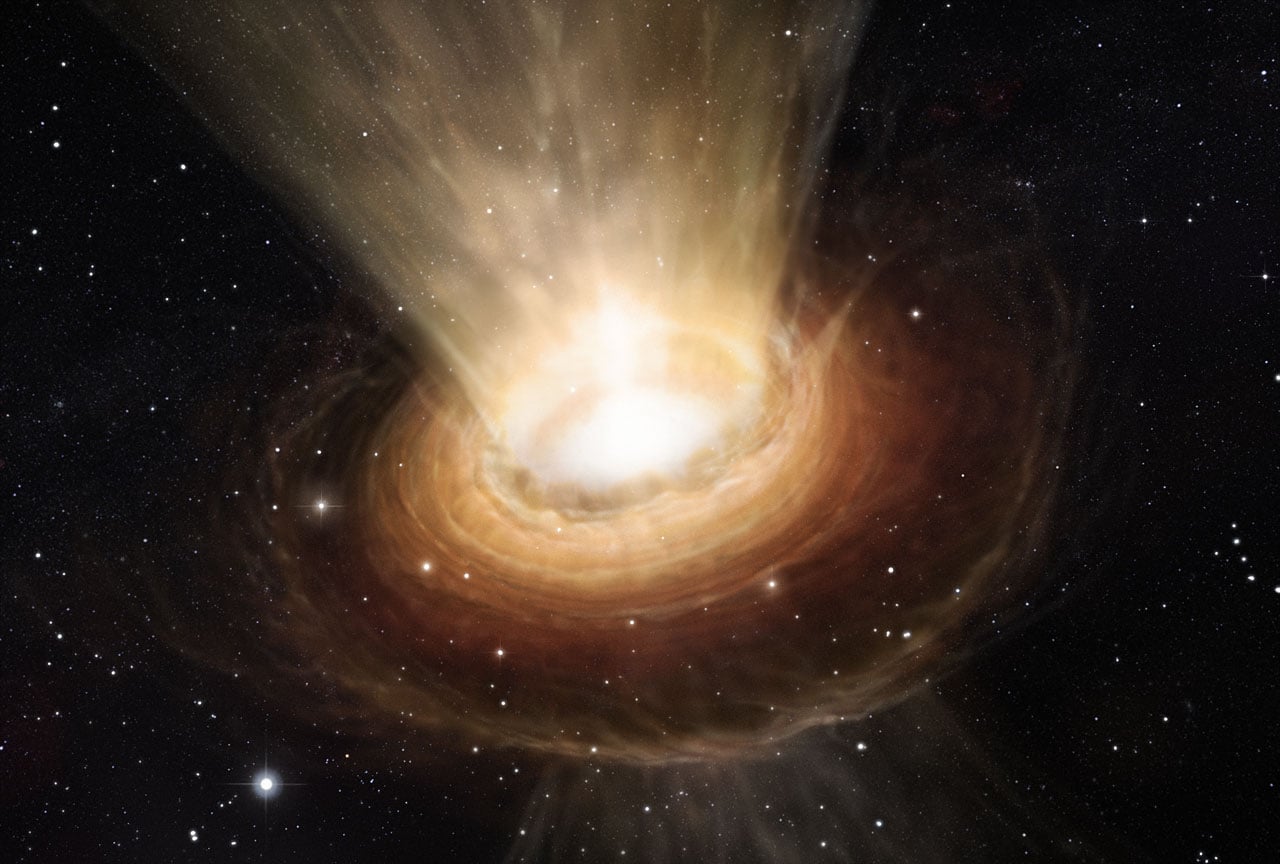
We know the universe is constantly expanding. We also know that gravitationally bound objects, such as solar systems and black holes, seem to be immune to that expansion. But a new paper, available in pre-print on arXiv by theoretical physicists Valerio Faraoni and Massimiliano Rinaldi challenges that assumption. They suggest that black holes can’t just ignore the expanding universe around them. Instead they have to expand along with it. As with many insightful theoretical breakthroughs, it comes at a time of contradictory observational evidence. Thomas Kuhn would be proud. Over the past few years, the James Webb Space Telescope (JWST) and other new observatories have been looking back to the dawn of the universe. And they have been finding supermassive black holes there. Specifically, they found them inside “infant” galaxies which should never have been able to support them. They appear to have formed just a few hundred million years after the Big Bang. However, according to astrophysics textbooks, they should not exist so early. There is a physical speed limit to how fast gas can fall into a black hole, known as the Eddington limit, which, in theory at least, limits the size they should have been able to grow to by the time the JWST observed them. In other words, the early universe was not old enough for these supermassive black holes to get that large. Fraser talks about how black holes can "shine". To understand an alternative solution, we first have to look at how physicists model black holes themselves. Typically, they use the Schwarzschild solution, which was formulated more than a century ago. To make the math easier, it treats the black hole as an isolated, motionless object surrounded by an infinite, empty void that never changes. But if there’s one thing that astrophysicists now know about our universe, it’s that it's not empty, and it's certainly not static. In previous work, Faraoni and Rinaldi had shown that attempting to modify that static condition to a realistic expanding background similar to what the universe actually does results in a physically impossible “naked singularity”. The math simply doesn’t work. To solve this dilemma, they instead tracked the black hole’s apparent horizon - the boundary where gravity becomes so strong that light can’t escape. And then they asked a simple question - does that boundary expand slower, faster, or at the exact same pace as the universe. That might seem like a pretty extreme question to try to answer, but that’s what theoretical physicists are good at. So they set up a series of mathematical models that expanded on the fates of a black hole formed in the early universe. The only mathematically and physically viable outcome occurred when the black hole eventually became comoving with the cosmos - in other words, it expands exactly as quickly as the universe does. Fraser talks about what a black hole would look like. While that answer seems simple enough, it has some big implications for our understanding of the cosmos, and especially its history. One logical conclusion is that the supermassive black holes that JWST has been finding in infant galaxies wouldn’t have to grow that large simply by swallowing gas at the Eddington limit. Instead, their seemingly unexplainable size could be driven by the very expansion of the universe itself. Another mystery this theory impacts is a finding from modern-day gravitational wave detectors. Observatories like LIGO and Virgo have found collisions between black holes whose masses sit inside an “upper mass gap” - essentially black holes of sizes where stellar evolution says stars can’t create black holes. If, over time, black holes continued to expand with the expansion of the universe, it could explain why these seemingly out of place black holes exist. To be clear, this does not mean that the universe’s expansion will have any impact on your every-day life. Electromagnetic and gravitational forces hold our world, and our biology, together with forces well beyond what the universe’s expansion can offer. But for black holes, it seems that even their extreme gravity doesn’t offer complete protection for those forces. And while, for now, this theory remains just that, it is testable enough that soon some of these fascinating results coming in from JWST and other observatories should provide ample evidence to prove it. Learn More: V. Faraoni & M. Rinaldi - Black holes become comoving with the universe UT - Quiet Black Holes With a Stellar Companion Raise Questions About How They Form UT - Black Hole Collisions Tell a Tale of Repeating Mergers UT - Another First for the JWST: It Detects Three Supermassive Black Holes in the Same Galaxy
Do Black Holes Grow Along With the Universe? A New Study Says Yes
Full Article
Original Source
Read the full article at Universetoday →KhanList aggregates and links to publicly available news content. We do not host full articles from third-party sources. Always verify important information with original sources.