
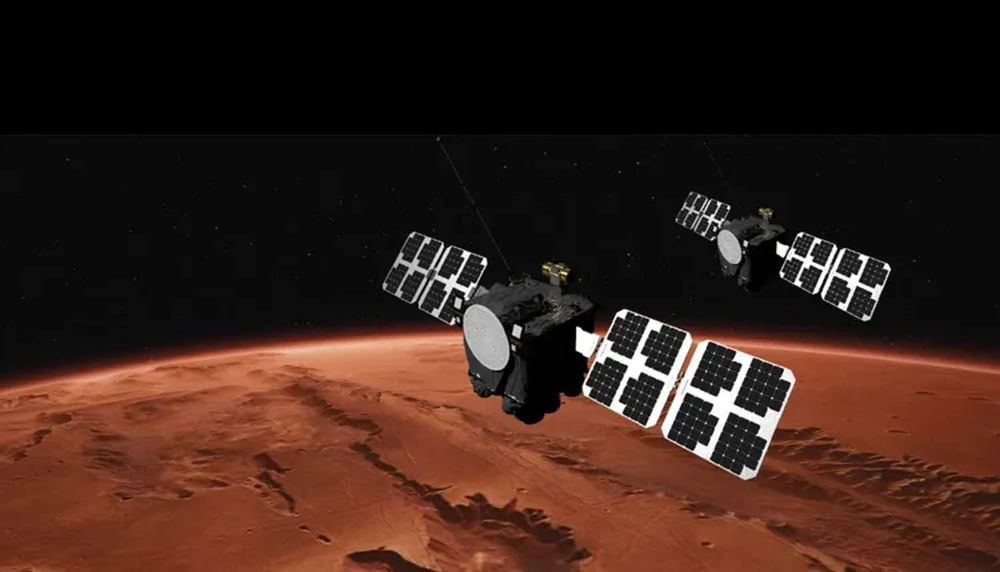
A pair of NASA are spacecraft are about to perform a slingshot maneuver above Earth, and some of us might get to see them. They're on their way to Mars, where they'll dig more deeply into one of the Solar System's puzzles: how Mars lost its ancient atmosphere. The pair are unique, because once they reach the planet, they'll be the first spacecraft to "fly" in formation around Mars. It's becoming clear, if not certain, that Mars was once warm and wet. It may have been habitable, even inhabited by simple life. But something happened and the planet is now cold and dead. To be warm and wet, it must have had a much thicker atmosphere than the thin, CO2 atmosphere it has now. Scientists who study the iron-red world postulate that UV radiation from the Sun drove Mars' ancient atmosphere into space. That only happened after Mars' molten core cooled, and the planet lost its protective magnetic field. Once exposed to the full force of the Sun's UV radiation, the atmosphere was doomed. Though its global magnetosphere is long gone, Mars still has patches of magnetic fields called crustal magnetic fields, or remnant magnetic fields. They aren't created by a dynamo; they're local magnetic fields generated by iron-rich chunks of the planet's crust. When Mars' dynamo failed billions of years ago, these chunks locked-in the magnetic orientation of the ancient crust. These surface fields on Mars also generate similar patches of magnetic fields in the planet's upper atmosphere. All these fields aren't anywere near as strong as the ancient dynamo, but they're enough to work with. This map of Mars' crustal magnetism was created with data from NASA's now-defunct Mars Global Surveyor. In simple terms, it's a colour-coded map of the magnetic strength. Blue is weak, red is strong. Image Credit: By NASA - Public Domain. While the broad picture of Mars' atmosphere loss is clear, the gritty details are not. The NASA spacecraft on their way to orbit Mars are called Escape and Plasma Acceleration and Dynamics Explorers (ESCAPADE). They're twins, named Red and Blue, and they'll measure how the solar wind interacts with the remnants of Mars' ancient magnetic field. Soon the spacecraft will approach Earth. At their closest, they'll be between about 965 to 1,770 kilometers above the surface, and they'll use their thrusters to boost their speed. Those boosts will combined with Earth's gravity, and they'll slingshot their way to Mars. The first will do so on November 7th, the second on November 9th. These trans-Mars injection burns will last about 9 minutes and will increase their speed from about 10.14 km/s to 10.78 km/s. That's an increase of more than 2,000 km/hour. These maneuvers are necessary because ESCAPADE didn't launch in the usual Mars launch window. Those windows occur about every 26 months. So the spacecraft had to loiter near the Earth-Sun Lagrange point 2 for a while, then approach Earth and use these burns to power their way to Mars. This led to some bonus science, where the spacecraft flew through and observed Earth's magnetotail. They were the first spacecraft to do so, and those observations will be shared soon. A natural question arises about ESCAPADE: Why are there two spacecraft? Solar wind interactions with magnetic fields can change on very short timescales. A single spacecraft wouldn't be able to tell if changes it observes are due to changes in these interactions, or changes in its position. A pair of spacecraft flying in formation removes this uncertainty. NASA calls this formation the "String of Pearls." This animation shows the ESCAPADE spacecraft in their String of Pearls formation above Mars. The spacecraft will fly the same orbit at varying distances from each other. But that's just for the first part of the mission, Science Phase A, which will last about 6 months. In Science Phase B, ESCAPADE's Blue and Red units will work more independently. Blue will lower its orbit to about 7,000 km and Red will raise its orbit to about 10,000 km. That will last about 5 months, until the end of ESCAPADE's nominal science mission. The spacecraft should remain in operation for many years after that, and NASA will have some decisions to make then. The spacecraft will be visible to some observers on the ground, though a telescope will almost certainly be needed. They'll present as a pair of dim, refrigerator-sized objects moving against the starry background. Not super-exciting, but interesting nonetheless. It's eerie to think about a planet like Mars losing its habitability and dying. It tells us something about the search for life, and about Earth. There may be multitudes of planets that were habitable for short periods of time—maybe hosting simple life—that were extinguished before any complexity could arise. It puts life on Earth in perspective for its rarity. Earth has been habitable for billions of years, and, against probabilities, complex life has fluorished for hundreds of millions of years, even longer depending on which definition is used. Having one of these extinguished planets next door is a rare opportunity to understand how this happens, and ESCAPADE will take full advantage of that opportunity.
NASA's Twin Spacecraft Will Execute Powered Slingshot Maneuvers on Their Way to Mars
Full Article
Original Source
Read the full article at Universetoday →KhanList aggregates and links to publicly available news content. We do not host full articles from third-party sources. Always verify important information with original sources.