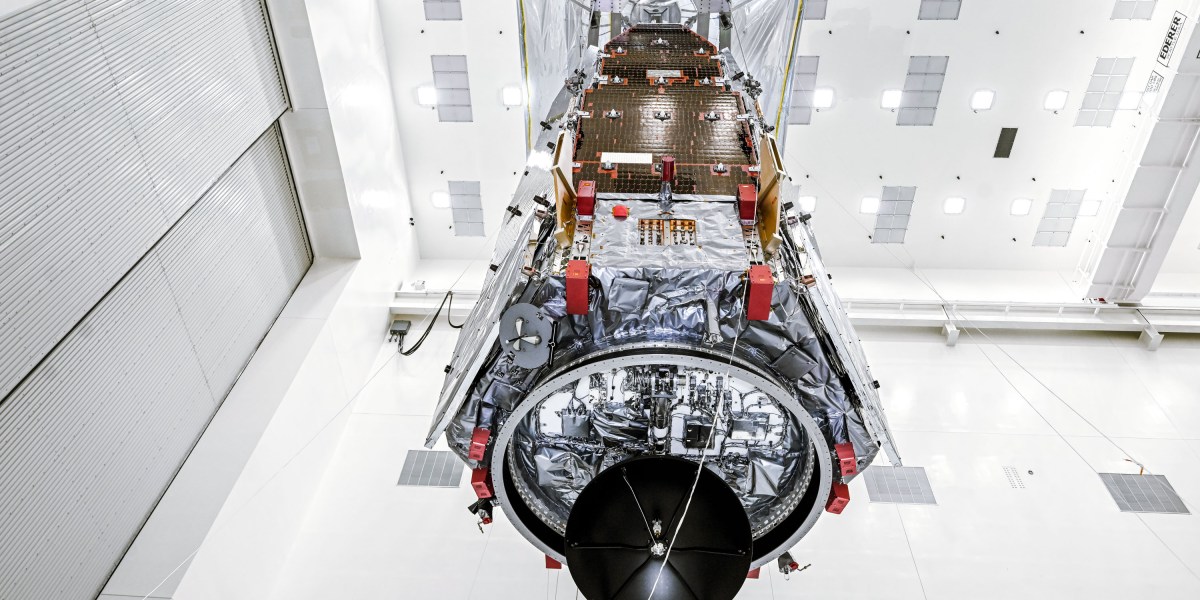
At the end of August, NASA is set to launch the Nancy Grace Roman Space Telescope from Kennedy Space Center in Florida. Its quest is to help us better understand how the universe works, from the glue-like dark matter that keeps galaxies together to the elusive dark energy that drives the expansion of the cosmos. But Roman could also serve another purpose: defending Earth from killer asteroids. In September, a multi-institutional team of planetary scientists and astronomers will outline how the space telescope is uniquely placed to scan asteroids, and provide information about their trajectories, sizes and compositions. Roman, named after NASA’s first chief astronomer, is equipped with a super-wide-angle, 300-megapixel infrared camera, allowing it to see a large patch of space at any one time—roughly 100 times larger than the Hubble Space Telescope. That will allow it to discover thousands of new planets, tens of thousands of exploding stars, and survey over one billion galaxies in remarkable detail. Roman was not built for this purpose, but last summer, it was (once again) threatened with significant funding cuts by the Trump administration. “My colleague Rick Cosentino [a planetary scientist at NASA] said to me in July 2025 that we need to show what Roman can do for planetary defense as a way to further increase the visibility of the mission with lawmakers and taxpayers,” says Bryan Holler, a researcher at the Space Telescope Science Institute in Baltimore, Maryland. Holler and his colleagues’ proposal, which will be presented at the Europlanet Science Congress at The Hague in The Netherlands, reveals that Roman’s epic field-of-view and infrared vision allows it to spot small asteroids up to 60 feet long. This is comparable to the asteroid that exploded above the Russian city of Chelyabinsk in 2013, unleashing the force of 500,000 tons of TNT and sending 1,500 people to the hospital. Roman’s software will need some tweaking to spy space rocks. The telescope, as designed, will see through – and beyond – the solar system in order to gather the clearest possible pictures of the rest of the universe. “Streaks, whether caused by cosmic rays or glitches or asteroids, are caught by the software and discarded,” says Andy Rivkin, a planetary scientist and planetary defense researcher at Johns Hopkins Applied Physics Laboratory in Laurel, Maryland. But astronomers could go in, study those streaks and pick out those they identify as asteroids. Even with those potential adjustments, Roman won’t be an asteroid-finding wunderkind on its own. Its strength lies in complementing the James Webb Space Telescope (JWST), another observatory that’s built to peer at galaxies and stars at the far reaches of the universe. It can also intensely focus on a single asteroid, when needed—as it did last year, playing a key role in tracking 2024 YR4, which was briefly the most dangerous asteroid ever discovered. “But Roman’s field of view is much bigger,” says Rivkin. That means it could look at multiple questionable asteroids very quickly. “Roman can provide infrared observations of more asteroids than JWST could hope to observe in a reasonable amount of observing time,” says Holler. If those asteroids are found to be benign travelers, we can relax. But if they might collide with Earth, other telescopes—including JWST—can follow up from Roman’s observations. Those observations could give experts the information they need to assess the likely damage of an upcoming asteroid strike—or to launch a mission to attempt to swat an asteroid away. “Roman will sample such a large volume of the cosmos that we’ve long known it will offer vast opportunities for a range of additional science,” says Alise Fisher, the astrophysics communications lead at NASA Headquarters in Washington D.C. NASA’s Planetary Defense Coordination Office, and its partners across the world, are chiefly worried about asteroids 460 feet long and larger. Around 25,000 of those are estimated to have near-Earth orbits, and just over half have yet to be found. Should one hit a city, much of it would be destroyed or irreversibly damaged in a heartbeat. Astronomers estimate that there are also 230,000 or so 165-foot-long asteroids orbiting close to Earth, and less than 10 percent have been located. One of those striking a city may not annihilate it, but it would unleash a force comparable to a large atomic bomb, albeit without the radiation. These sorts of asteroids could theoretically be deflected (by ramming a spacecraft into it) or vaporized (perhaps using a nuclear weapon). But planetary defenders need to know where they are first, which is why NASA funds a network of ground-based telescopes designed to seek them out. They work well, but there’s only so much of the night sky they can see, and Earth’s atmosphere peskily gets in their way. That’s why NASA’s launching the Near-Earth Object (NEO) Surveyor space telescope in 2027. By positioning itself between Earth and the Sun, it’ll find many elusive asteroids that ground based telescopes cannot see. And unlike many of its asteroid-seeking cousins, it’ll see in infrared, not visible light. Asteroids not only show up more clearly in infrared, but seeing them through this lens gives scientists a considerably better measure of their size. In a matter of years, it could find 90 percent of the city killer-size asteroids in near-Earth orbits. Telescope teamwork NEO Surveyor is explicitly a planetary defense observatory. But it’ll work with other telescopes with more science-minded missions, including Roman, JWST—both of which conveniently have infrared scopes too—and the Vera Rubin Observatory, which just began its 10-year survey of the entire night sky from atop a mountain in Chile. As part of its inventorying of the cosmos, it’s expected to discover 89,000 near-Earth asteroids. Here’s how they might all work together. Say NEO Surveyor spies an asteroid that, based on a few observations, has a chance of impacting Earth. Then it finds five more just like it. There is a lot of uncertainty about their orbits based on those initial observations. Roman, with its huge field-of-view, could be commanded to look at the corner of the night sky that includes all those asteroids, and in a matter of days it could improve the precision of those orbits by several orders of magnitude. Roman also occupies a different part of space to both NEO Surveyor and the Rubin observatory. “Those slightly different viewing angles will also help narrow orbits down more quickly than if all objects were looking from the same place,” says Holler. Perhaps five of those potentially hazardous asteroids are found to stand no chance of colliding with Earth for the foreseeable future. One, however, might not be able to be ruled out—and that’s when other telescopes, including JWST, could be asked to track it down and study it further. “Telescope resources, whether in space or on the ground, are typically oversubscribed and will not be available to follow up on all [near-Earth asteroids] with a non-zero impact probability when they are first discovered,” says Holler. Roman, then, will help scientists “make sure we follow-up on the correct targets.” Roman’s infrared scope also allows it to offer a decent estimate of an asteroid’s size, and can even tell whether it’s a stony rock, a puffy and watery carbon-rich rock, or a metallic one. “This in turn provides strong clues to the composition and thereby the density and mass of the asteroid, which are important when estimating the impact damage or, less ghoulishly, the effort required to nudge it out of its current orbit,” says Holler. Roman won’t play the lead role in protecting Earth in the way NEO Surveyor will. But while it’s seeking out supernovas and planets scooting around other stars, it will also be doing its part to protect all eight billion of us from a cosmic catastrophe.
NASA’s new dark energy space telescope can also detect killer asteroids
Full Article
Original Source
Read the full article at Technologyreview →KhanList aggregates and links to publicly available news content. We do not host full articles from third-party sources. Always verify important information with original sources.