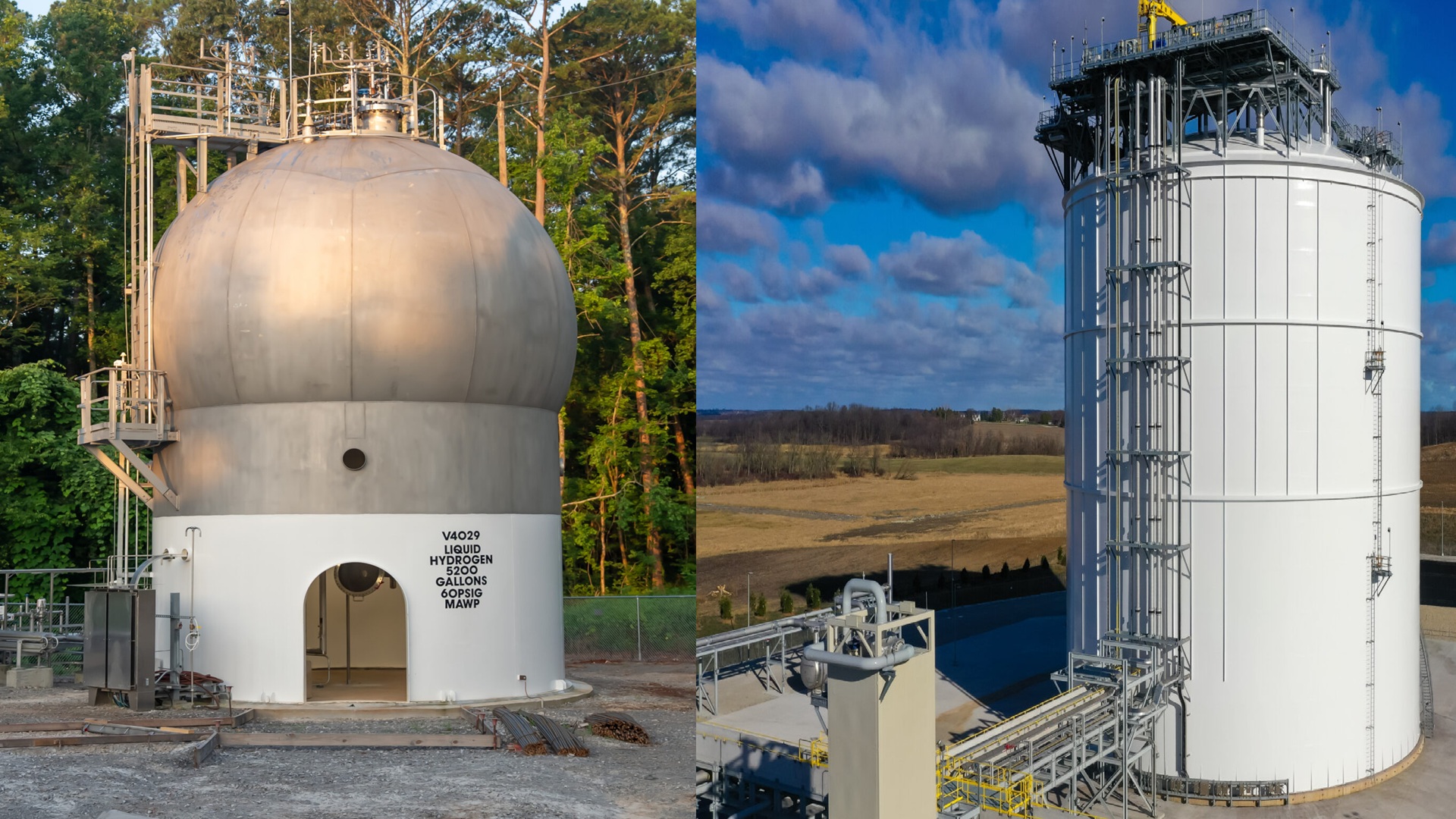
Energy infrastructure giant CB&I has completed the first fill of a liquid hydrogen storage tank at NASA’s Marshall Space Flight Center, testing an insulation approach that could lower the cost of storing hydrogen at large scale. The 20-cubic-meter demonstration tank uses non-vacuum insulation, a technology CB&I is developing for large liquid hydrogen (LH2) storage systems. The company says the approach could reduce capital costs for storage facilities handling large volumes of hydrogen. The tank is installed at NASA’s Hydrogen Test Facility (HTF) in Alabama, where it is now part of the facility’s existing liquid hydrogen infrastructure. Its first successful fill marks the start of testing under real operating conditions rather than only in laboratory settings. The demonstration tank also increases the facility’s total LH2 storage capacity by three times. It can be refilled as often as once a day, allowing researchers to repeatedly expose the insulation system to the extreme temperature changes associated with liquid hydrogen storage. Testing hydrogen storage at scale Liquid hydrogen must be kept at extremely low temperatures to remain in liquid form, making storage a major engineering challenge. Large storage tanks traditionally rely on vacuum-based insulation systems to limit heat transfer and keep the hydrogen cold. CB&I is testing whether a non-vacuum approach can provide a lower-cost alternative for applications that require large amounts of storage. The demonstration is part of a program announced in 2025 involving CB&I, Shell, NASA, GenH2 and the University of Houston. Repeated filling and emptying of the tank will allow the partners to collect data on how the insulation performs through multiple thermal cycles. The setup also gives NASA additional capacity for longer-duration liquid hydrogen testing. “The successful first fill of our demonstration tank marks an important step toward validating a more cost-effective approach to large-scale liquid hydrogen storage,” says Yogesh Meher, Vice President of Engineering at CB&I. “By demonstrating this technology under real operating conditions at NASA’s Hydrogen Test Facility, we are accelerating the path to commercial deployment and helping enable the hydrogen economy at scale.” NASA, CB&I and Shell will evaluate the insulation system over the coming months. The results are expected to provide data needed to determine whether the technology can move toward commercial deployment in large-scale LH2 storage. Six decades of hydrogen storage CB&I has extensive experience building liquid hydrogen storage infrastructure for NASA. The company built its first LH2 storage sphere for NASA’s Gemini and Apollo programs in 1960. Since then, CB&I says it has constructed more than 130 liquid hydrogen storage spheres worldwide. Its portfolio includes the world’s largest LH2 storage sphere, completed in 2022 for NASA’s Artemis program. The latest demonstration is aimed at a different challenge: making large-scale hydrogen storage more economical as demand for hydrogen infrastructure grows. If the non-vacuum insulation system performs as expected through repeated thermal cycles, it could provide another option for facilities that need to store large quantities of liquid hydrogen. The technology is being tested at a facility already used for liquid hydrogen operations, giving the project a direct route from demonstration to potential commercial applications.Recommended ArticlesGet the latest in engineering, tech, space & science - delivered daily to your inbox.With over a decade-long career in journalism, Neetika Walter has worked with The Economic Times, ANI, and Hindustan Times, covering politics, business, technology, and the clean energy sector. Passionate about contemporary culture, books, poetry, and storytelling, she brings depth and insight to her writing. When she isn’t chasing stories, she’s likely lost in a book or enjoying the company of her dogs.
NASA tests new insulation to make large-scale liquid hydrogen storage cheaper
Full Article
Original Source
Read the full article at Interestingengineering →KhanList aggregates and links to publicly available news content. We do not host full articles from third-party sources. Always verify important information with original sources.