
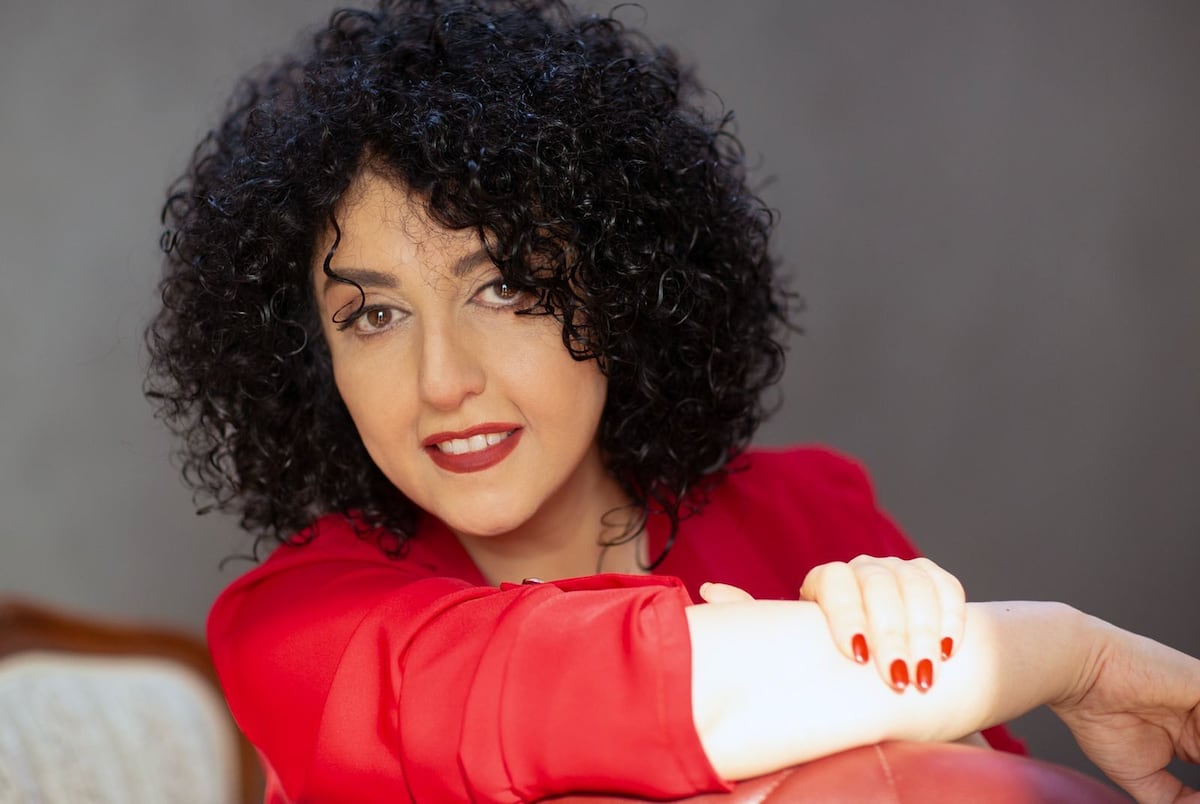
A statue of Justice presides, as if making a statement of principle, over the green room in Tehran where Narges Mohammadi, 54, appears for a video call with this newspaper. It is an act of courage in itself, given that the activist, who was awarded the 2023 Nobel Peace Prize for her struggle for human rights and women’s rights in Iran, still faces a prison sentence of at least 18 years.Mohammadi’s freedom is only a reprieve, a suspension of her sentence granted in May after she suffered two heart attacks in prison. The activist has been arrested 14 times and tried on 10 occasions. In total, she has been sentenced to 44 years in prison and 154 lashes, and has spent 161 days in solitary confinement. She has paid another price as well: she has not embraced her 19-year-old twins, Ali and Kiana, since 2015, when they went into exile in Paris with their father.Mohammadi recently published a memoir she wrote while in prison. The book, A Woman Never Stops Fighting: My Struggle for Freedom, Democracy and Human Rights in Iran, is a portrait of a woman who has spent decades going in and out of prison for refusing to give up her freedom.Question. Your health scare led many to fear for your life. Aren’t you worried that giving this interview could send you back to prison?Answer. During my last detention in Mashhad [in northeast Iran, on December 12, 2025], I suffered very serious injuries. I was hit repeatedly in the head and spent two months in solitary confinement. I was then transferred to another prison in Zanjan, where I received no medical care despite severe lung and heart problems. After my sentence was suspended, I was hospitalized in three provinces of Iran, and I remain under treatment. When I began writing this book in Evin [a Tehran prison notorious for holding political prisoners, from which Mohammadi secretly smuggled out her manuscript], I already knew it would have consequences for me, but I saw it as a duty.Q. The Nobel Peace Prize was awarded to you while you were in that prison. What did it change for you?A. Contrary to the common belief that the Nobel would make life easier for me in prison, the reality was the opposite. The pressure on me and my family intensified in different ways. The prison director himself told me that until I received the Nobel, the decision to provide me with the urgent medical care I needed was partly in his hands. After the prize was awarded, decisions such as taking me to the hospital were made by much higher state authorities. Treatment became draconian, and every statement or protest I joined while in prison brought new convictions [Mohammadi received several additional sentences while already serving time, including one of seven and a half years in prison].Q. In your book, you describe solitary confinement as a tool of torture. In your case, that isolation led you to speak to the walls and the door of your cell.A. Solitary confinement is one of the Islamic Republic’s main instruments of torture, and its purpose is to break a prisoner’s will so that they confess whatever they are being pressured to confess. That is the result of keeping a human being isolated for long periods, with no information from the outside world, no contact from their family, and no exposure to sunlight, which produces spiritual and psychological disintegration. Many prisoners confess while in isolation, a punishment sometimes accompanied by physical torture. Courts then hand down death sentences based on those coerced confessions. Hangings in Iran have increased greatly in recent times, and that makes clear the consequences of isolation. This form of imprisonment is the mother of executions in Iran.Q. How does the Islamic Republic use the death penalty?A. The death penalty is a wound in Iranian society that has lasted 47 years, since the early days of the Islamic Republic. You will know about the executions of the 1980s, but you may see them only as numbers [Amnesty International estimates that, in the summer of 1988 alone, around 4,500 people — many teenagers and leftist activists — were executed in Iran]. For Iranian society, that wound has never healed and continues to bleed with each new hanging. An execution is not only the killing of a human being, but a punishment for an entire society. Lately, Iranians wake up every morning to news of another hanging of a person who was often tried behind closed doors, without a lawyer and on ambiguous charges. Executions in Iran represent the slow death of our society.Q. Some people are hanged in public...A. Authoritarian political systems use any tool to oppress their own people. Do you think that such regimes are unaware of how inhuman such an act is? The reason is that they seek to terrorize a society that no longer tolerates the Islamic Republic. That political system therefore uses all forms of repression at its disposal, including executions and, in their most terrifying form, public executions. Each time social movements have organized protests and voiced their demands, instead of addressing those demands, the response has been repression, prison and executions.Q. You attribute change in Iran to social movements.A. Iranian society is one of the most dynamic in the world. In the last two decades, there have been women’s movements and movements of young people and students that have played a decisive role in creating social awareness. Those movements aspire to secure fundamental rights like those you enjoy: freedom, justice, democracy, equality and much more. And Iranian society has paid a very high price. Workers, young people, students, women and human rights and environmental activists have paid this price. The Iranian people are fighting to achieve democracy and confront tyranny and, although that path takes time, social movements have already achieved a fundamental transformation.Q. Are you referring to the achievements of the Woman, Life, Freedom movement, sparked by the death of young Mahsa Amini in a police station in 2022 after being detained for wearing her veil improperly? Many Iranian women no longer wear the hijab.A. That achievement by a movement led by Iranian women would have required decades of effort under different circumstances. However, with an inclusive social movement, we achieved that advance in far less time, though at a very high price because the repression was severe. That progress, which the regime has not been able to reverse, is one of the things that allow us to imagine a democratic future. The veil law has not been abolished, but that movement has succeeded in establishing a right. That is why the authorities want to destroy it.Q. Your book praises the role of feminism in Iran.A. The role of women in transforming Iranian society has been decisive throughout the country’s history, but especially in the last 50 years. Who led the first mass protest march right after the founding of the Islamic Republic, when Iranian women defied the system because they were being forced to wear the hijab? When Iranian women have resisted the compulsory use of the veil, what they have challenged is the domination of an authoritarian political system that wants to force women to wear the hijab to consolidate its control over that half of the population.Q. What is the significance of this civil disobedience against the compulsory use of the hijab?A. It represents a challenge to domination, tyranny and the usurpation of power. Women’s resistance to a theocratic autocracy should not be confined to the veil [as an item of clothing]. We are facing a strategic issue that is not limited to a religious matter or a women-only issue. It is a matter of deep political significance.Q. What is your view of the war the United States and Israel have launched against Iran?A. I experienced the Iran-Iraq war [1980–1988], as a child. It lasted eight years, and our country suffered enormous losses from which it has not yet recovered. The consequence of that war was also that no one listened to the voices of the thousands of people who were executed in Iran. The human rights and the rights of the Iranian people were forgotten. That bitter experience makes my hatred of wars grow every day.Q. Has the war radicalized the regime?A. The Islamic Republic has become more repressive under the shadow of war. Pressure from security agencies against civil, political, social and cultural activists, as well as against protesters, has increased. In the climate of insecurity that war creates, protests against human rights violations, executions, arrests and imprisonments cannot develop. Under these circumstances, social movements have been weakened.Q. In your book, you denounce how the Islamic Republic tried to blackmail you by using your children. Do female activists suffer this kind of pressure more than their male counterparts?A. Many activist parents who are imprisoned also suffer that pressure, but I believe what mothers endure is worse and reflects the regime’s discrimination against women. Essentially, we are dealing with a misogynistic regime whose nature is hostile to women, and that misogyny appears in every sphere.Q. Iranian authorities have prevented you from visiting your children in Paris. Do you hope to see them again?A. We must never lose hope, but that does not mean ignoring reality or suffering; it means continuing the struggle and not surrendering. One way or another, that struggle will bear fruit, and I hold onto the hope of seeing my children again one day. I don’t know when, but that moment will come.Sign up for our weekly newsletter to get more English-language news coverage from EL PAÍS USA Edition
Narges Mohammadi, 2023 Nobel Peace Prize winner: ‘Iranian society no longer tolerates the Islamic Republic’
Full Article
Original Source
Read the full article at English →KhanList aggregates and links to publicly available news content. We do not host full articles from third-party sources. Always verify important information with original sources.