
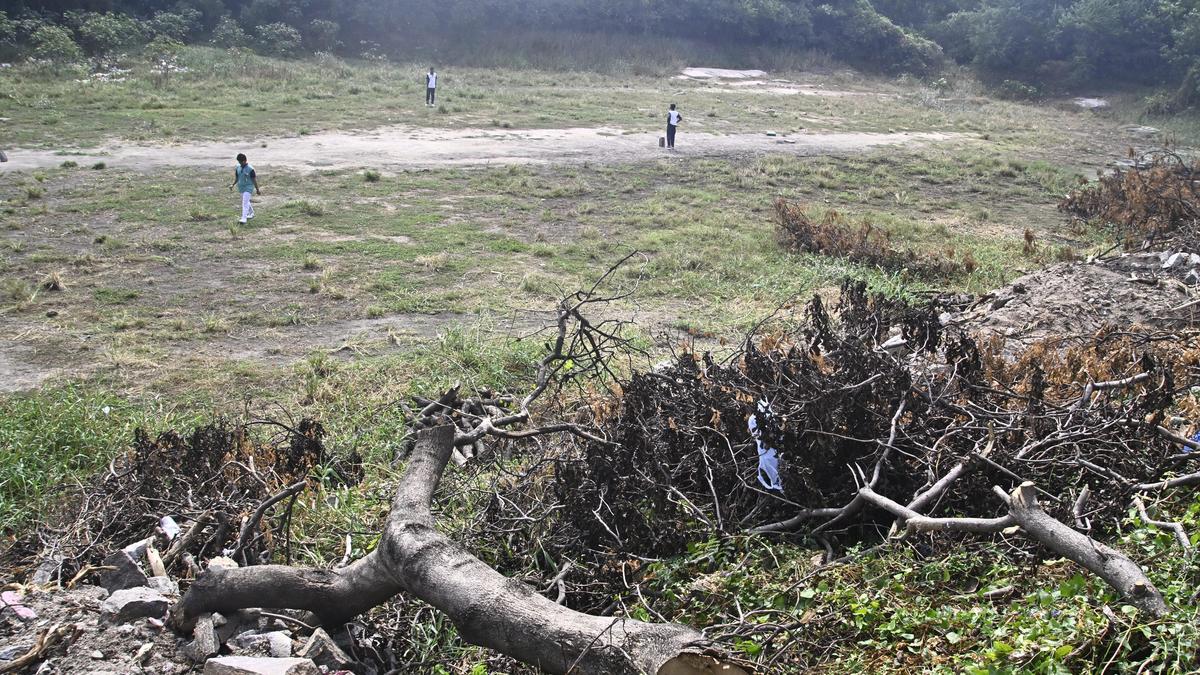
The lake inside the Krishnakath Park in Yousufguda has come a full circle over the past two decades, before the recent announcement by the Hyderabad Disaster Response and Asset Development Agency (HYDRAA) revealing plans to develop and restore the lake.HYDRAA Commissioner A.V. Ranganath is taking special interest in expansion of the lake by four times its existing size, in order to impound the storm water that inundates Ameerpet and surrounding localities downstream every time it rains.Currently restricted to about three acres and divided into three separate ponds with interconnecting canals, the water body is now set to be increased to 12 acres.Work to fell and translocate trees from the park is already underway, with 34 trees marked for felling and 156 for translocation.This initiative will largely reduce the 22-acre park space and drown its lawns, trees, gazebos and other facilities originally established 22 years ago. The project pivots on the argument that the entire park stands on what was originally a lake.The lake, in fact, is a textbook example of how governments squander public money with no attention to sustainability or accountability. A simple search for a sewage treatment plant which has disappeared over the years lays bare the whole story.The Sewage Treatment Plant (STP) was first established way back in 2003-04, with the intention of filling the three ponds constructed as part of the park’s development. The park was launched in 2004, by the then chief minister of the joint state of Andhra Pradesh, N. Chandrababu Naidu.“There was no lake. Before the park, it was a colossal garbage dump. We got down to the daunting task of clearing all the trash in order to build a beautiful park there. Digging very deep, we built strong gazebos with granite, despite objections that the foundations would be at risk due to enormous amounts of rubble underneath. The three ponds were built so as to provide water for the greenery,” shared N. Chandramohan Reddy, who was then the Director, Urban Forestry, of Hyderabad Municipal Corporation.Ramaraju, a senior citizen from Kalyan Nagar remembers a huge 22-acre lake at the location which had actually provided water for the crops.“There was this heavy cascade of water that flowed from the lake through Madhura Nagar, and I remember seeing paddy fields on both sides during 1980s. Eventually with city development, sewage and industrial waste started flowing into the lake, and later it was turned into garbage dump,” Mr. Ramaraju reminisced.G. Satyanarayana, another resident who served as the President of the Federation of Colony Welfare Associations, recalled the story that the garbage heap, when removed, revealed several animal carcasses dumped there over the years.“I was told that the workers collapsed unable to bear the stench. Even after the park was laid, we fought against the garbage dump,” Mr. Satyanarayana said. The dump later became garbage collection centre of the Greater Hyderabad Municipal Corporation.As per the details shared by the engineering officials who worked on the park, an STP was built on the South-West corner of the park with 0.6 million litre treatment capacity per day (MLD), complete with facilities for filtration, aeration and sedimentation. A pipeline was laid from the STP to the lake for treated water. Another pipeline brought fresh storm water from the North-Eastern side, and a 12-feet stormwater drain running through the park emptied into the lake when overflowing.Rank sewage flows through the drain now, though it does not enter the lake. In fact, over the two decades, the lake filled up only seasonally. It stayed dry in summer, as it should, and filled up post monsoon, indicating that the sewage was successfully thwarted from entering it.HYDRAA chief A.V.Ranganath, sharing the ₹7.5 crore development plan for the lake, informed that a brand new STP with a capacity to treat 1-2 MLD sewage would be built inside the park, in order to bring purified water to the expanded lake. He has no inkling about the previous STP, nor about the stormwater drainage links to the lake.The STP which slipped into oblivion now, remained defunct for most part of its existence owing to lack of maintenance. It was still under reckoning till 2021, as vouched by a Central Pollution Control Board report which mentioned it as ‘non-operational’. There was no information from GHMC about de-commissioning the STP.The location of the STP now falls into the garbage transfer station managed Hyderabad Integrated Municipal Solid Waste Limited (HIMSW) which is a special purpose vehicle launched by Renvion-- a freshly rebranded version of the Ramky Enviro Engineers Limited. Entry into the facility is strictly manned.An analysis of the Google Earth satellite images reveals that the STP was filled up starting from May, 2021, and structures of the transfer station were raised on it. Compound wall separating the transfer station from the STP was pulled down. Incidentally, 2021 was also the year when the transfer station was handed over to the HIMSW.When queried about the STP, Renvion replied through their Public Relations agency, that the waste collection centre was handed over to HIMSW in 2021, which developed a modern transfer station within the premises given by GHMC. All the necessary approvals for the improvements were vetted and approved by GHMC and EPTRI. Renvion categorically denied the existence of any STP in the transfer station. A query to the GHMC Commissioner R.V. Karnan remained unanswered.
Mystery of a missing sewage treatment plant tells the tale of the lake in Krishnakanth Park
Full Article
Original Source
Read the full article at Thehindu →KhanList aggregates and links to publicly available news content. We do not host full articles from third-party sources. Always verify important information with original sources.