
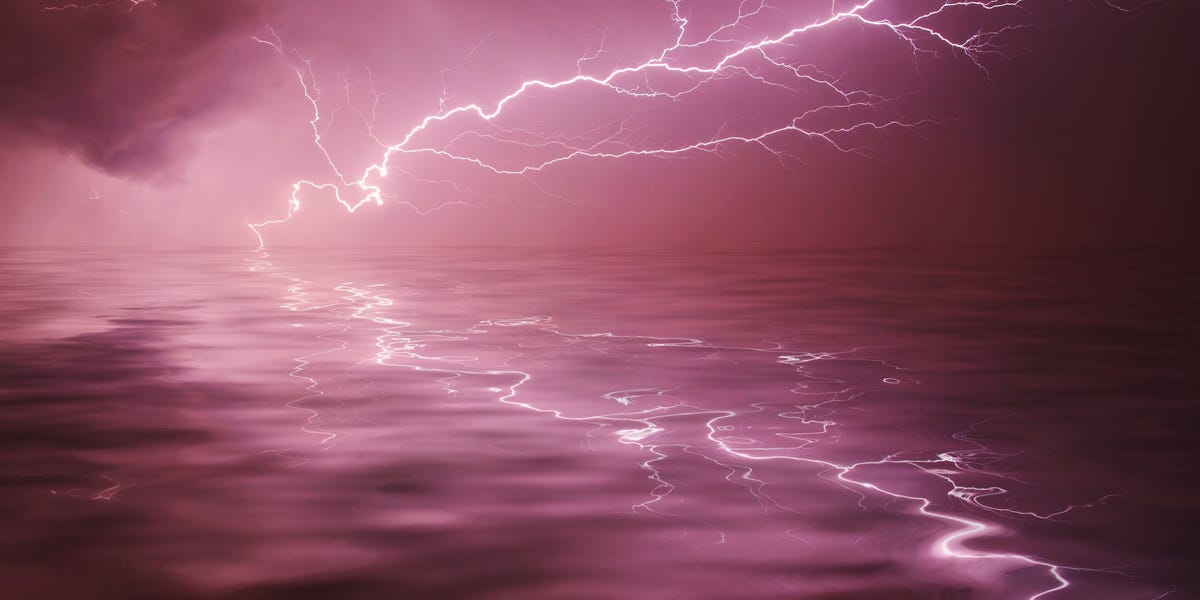
5 min readHere’s what you’ll learn when you read this story:Te lapa is a phenomenon in which light flashes underwater like a linear bolt of lightning, but there’s been much debate and confusion over what causes it.Some theories suggest that, despite saltwater being an excellent conductor, certain conditions in the depths make it possible for electricity to build up until it’s discharged.Another theory, though a less likely one, is that te lapa could be produced by bioluminescent microbes known as dinoflagellates, which glow in response to pressure waves.In the Pacific Ring of Fire that reaches from Sumatra and Java in the west to waters off the coast of Chile in the east, streaks of light materialize beneath the ocean surface and vanish as fast as they appeared. They light up the ocean without a storm in sight. This phenomenon, known as te lapa or “the flashing,” is thought to have been used by ancient Polynesian wayfinders to navigate across the ocean. What exactly causes it, though, has remained a mystery for thousands of years.Aliki Koloko Kaveia, late chief of the Taumako people on the isolated island of Taumako in the Solomon Islands, was a descendant of the legendary voyager Lata and learned how to navigate from his father and elders from a young age. He passed on this knowledge through the Vaka Taumako Project. When cultural anthropologist Marianne George met Kaveia in 1993, she also became one of the few from outside the Ring of Fire to see te lapa with her own eyes. It wasn’t the same skeletal hand of lightning that reaches down from thunderclouds in the sky, but a flash that shot through the depths, so ephemeral that it was described by Kaveia as a torch that was lit and instantly blown out. She was intrigued but couldn’t explain the cause.Something else George observed was that te lapa apparently stemmed from submerged land. It was because of this, she learned, that voyagers sought out these flashes to guide them towards land at night, but the forces behind what they saw were a mystery even to them. She wasn’t the first outsider drawn to that mystery. Decades earlier, David Lewis—a doctor from New Zealand who sailed 2,200 miles from Tahiti to New Zealand using nothing but a chart and a sky map—had met Kaveia and traditional navigators from other islands, documenting their methods in his 1972 book We, the Navigators. But where Lewis catalogued the practice, George chased the cause. She has traveled to Taumako again and again with a mission to find the source of the lights, and though she tried to make sense of te lapa in a 2013 study published in Time and Mind, she was unable to come to a conclusion.“Various scientific facts and theories about bioluminescence and electromagnetic phenomena are noted for the study of te lapa, as are possible limitations of modern technology, or lack of practical access to it,” she said in the study. Kaveia had told George his theory about the phenomenon. Wayfinders would rely on the swells that rose from deeper storms, often crashing into land and each other, merging into larger swells, or collapsing entirely. Swells that interfered with each other usually meant there was land nearby, which was especially useful when skies were overcast and all that was visible were the curves of waves. What Kaveia thought was that this interference might have focused the light like an enormous lens. That may demystify an aspect of te lapa, but George hypothesized that the constant tectonic shifts in the Ring of Fire, which explain its volcanism, could trigger electromagnetic emissions from the islands, which showed up as phantom lights.If curiosity hasn’t yet revealed what te lapa is, it has at least established what it isn’t. Stars and satellites can’t produce reflections bright enough to explain the flashes. Nor can any known weather phenomenon involving light or electricity—St. Elmo’s Fire, the buzzing bluish-purple plasma, was a leading suspect until researchers realized it can’t occur underwater. Deep-sea research submersibles recently picked up spikes in voltage around hydrothermal vents and volcanoes on areas of the Pacific seafloor with the most electromagnetism. Theories about electrical discharges setting off underwater lightning soon emerged. It seems impossible because saltwater is a strong conductor. Because the dissolved salts in seawater break apart into ions that carry current freely, any electrical charge should dissipate before it can build up—let alone discharge as a bolt.Researchers instead found that some discharges travel as far as hundreds of feet before they fade. Plate tectonics and strange conditions in the deep sea may be the underlying reason for lighting occurring where it isn’t supposed to. Despite how easily the surrounding water can conduct electricity, hypotheses suggest that voltage is allowed to accumulate by insulators such as gas bubbles, incredibly fast temperature changes, and the minerals in plumes of hot water gushing from hydrothermal vents. The electrical charge builds up until it eventually reaches a limit and explodes into the ocean. The discharge releases energy intense enough to break water molecules and spark reactions that fuse atoms into other chemical compounds.Bioluminescence was also dismissed as a cause for te lapa until an experiment by Harvard professor and researcher John Huth brought it back into question. As part of his Underwater Lightning Project, Huth bred microorganisms known as dinoflagellates that are known to glow in the dark. He emptied beakers of ocean water swarming with these microbes into a tank, created pressure waves by running a fish decoy back and forth, then switched off the lights and waited a few hours before recording a video. Amazingly, pale blue streaks of light ran through the tank. Whether hordes of dinoflagellates are able to generate the extreme voltage measured by submersibles is unknown though, and it’s probably unlikely.“There is currently no definitive explanation of the origin of te lapa,” Huth said in a 2016 study published in Structure and Dynamics. “One possibility is that it is the byproduct of fish darting in a patch of sea that is rich in dinoflagellates, which emit light in response to pressure waves…further studies would require some kind of imaging device that is sensitive to relatively faint light.Elizabeth Rayne is a creature who writes. Her work has appeared in Popular Mechanics, Ars Technica, SYFY WIRE, Space.com, Live Science, Den of Geek, Forbidden Futures and Collective Tales. She lurks right outside New York City with her parrot, Lestat. When not writing, she can be found drawing, playing the piano or shapeshifting.
Mysterious Bolts of Lightning Are Flashing Deep in the Ocean. Scientists Still Can’t Explain Why.
Full Article
Original Source
Read the full article at Popularmechanics →KhanList aggregates and links to publicly available news content. We do not host full articles from third-party sources. Always verify important information with original sources.