
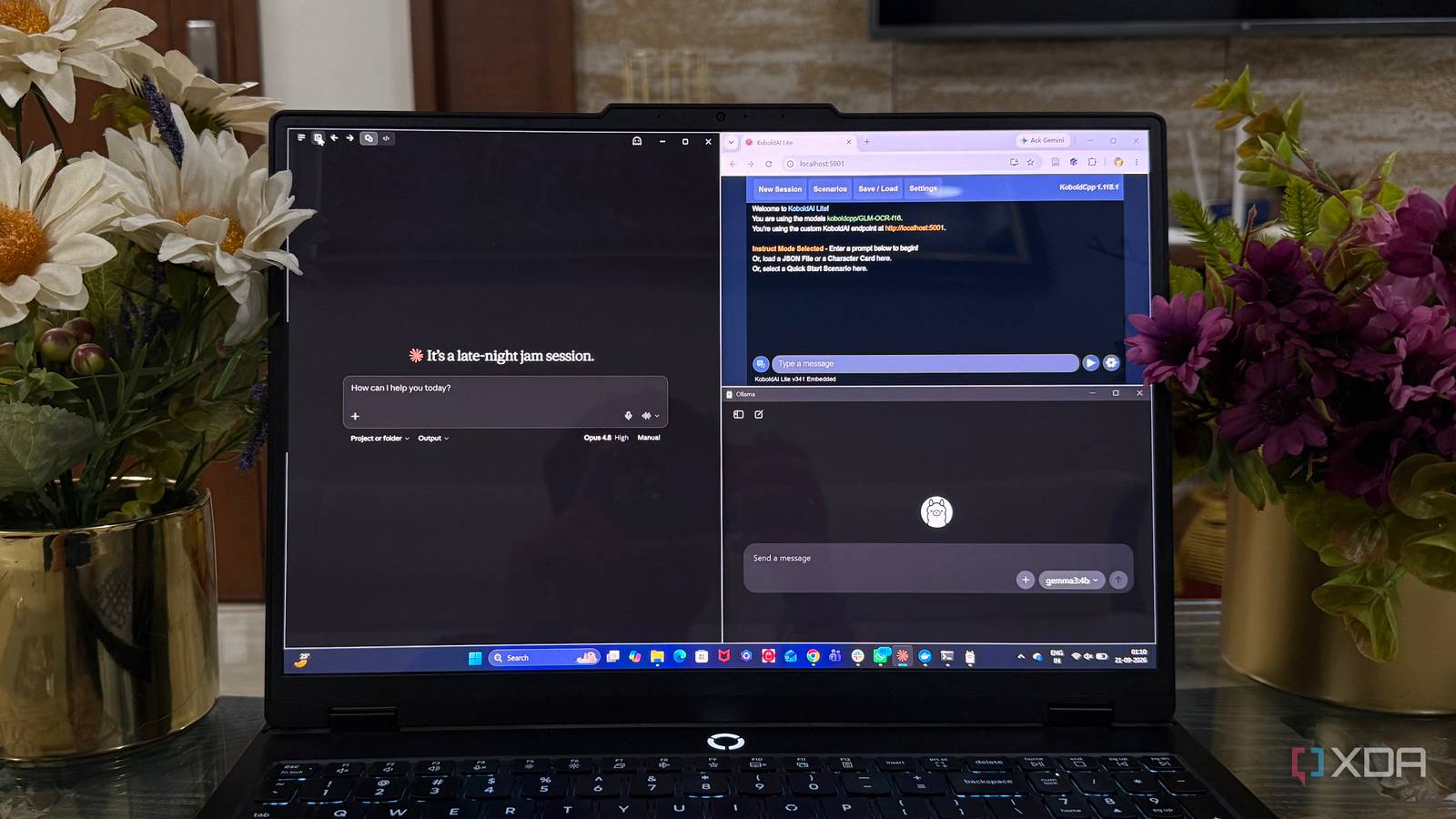
Published Sep 22, 2026, 11:00 AM EDT Beginning his professional journey in the tech industry in 2018, Yash spent over three years as a Software Engineer. After that, he shifted his focus to empowering readers through informative and engaging content on his tech blog – DiGiTAL BiRYANi. He has also published tech articles for MakeTechEasier. He loves to explore new tech gadgets and platforms. When he is not writing, you’ll find him exploring food. He is known as Digital Chef Yash among his readers because of his love for Technology and Food. I used to think a good productivity setup should keep getting smarter. Every time I found a new app, I would look at its AI features and wonder whether they could improve the way I work. That mindset made my setup more complicated than it needed to be. I was adding technology because it was new and interesting, not necessarily because I had a problem it could solve. Over time, I started paying more attention to how I actually used my tools. That made me rethink what productivity meant to me. Surprisingly, the answer involved using less AI, not more. I used to confuse “AI-powered” with better I fell for the AI checkbox For a while, seeing AI mentioned on a product page was enough to get my attention. If two apps offered similar features, I naturally leaned toward the one with an AI assistant, AI search, or some kind of smart automation. I assumed the extra intelligence would make the overall experience better. That mindset changed when I started looking beyond the feature list. An AI label sounded impressive, but it didn't tell me whether the product itself was actually better for what I needed. I began noticing that I was getting distracted by what an app could do rather than looking at how well it handled the things I actually cared about. AI had also become such a common selling point that I stopped questioning whether I even wanted those features. If an app had AI, I treated it as an upgrade almost automatically. Eventually, I realized I had been using the presence of AI as a shortcut for judging software. That wasn't a particularly useful way to choose the tools I wanted in my setup. Sometimes, simple software just wins I started noticing how often I was looking for an AI-powered replacement for tools that were already doing their jobs perfectly well. A basic PDF reader didn't need an AI assistant. My file manager didn't need to summarize anything. Even some of the small utilities I use every day were better left alone. Once I noticed this pattern, I stopped assuming that a newer, smarter-looking alternative would automatically improve my workflow. I began keeping simple tools around when they were already fast, reliable, and familiar. This also changed how I approached small tasks. If I needed to find a file, I used search. If I needed to edit a document, I opened the appropriate editor. I didn't need an AI layer sitting between me and every action. There was something refreshing about opening an application and immediately getting the feature I needed. No prompts, no suggestions, and no extra steps. I wasn't trying to make every part of my setup smarter anymore. I was simply trying to make it work better for me. Removing AI made room for better AI use Less AI made each use matter The less I used AI for routine tasks, the more useful it became for the tasks that actually needed it. I stopped seeing AI as something that should always be running in the background and started treating it as something I could bring in when I needed a different kind of help. I find AI useful when I need to make sense of a large amount of information, compare different options, or turn a rough collection of thoughts into something more organized. It is also handy when I'm learning something unfamiliar and want a quick explanation before digging deeper myself. I also became more comfortable using AI for one specific part of a task instead of handing over everything. Sometimes I only need help brainstorming, checking an idea, or looking at a problem from another angle. That small change made AI feel much more useful. I wasn't using it more; I was using it with more purpose. Removing the unnecessary AI interactions gave me a clearer idea of where it actually belongs in my setup. AI still has an important place in my workflow My flexible AI setup I haven't removed AI from my setup. Instead, I've ended up with a hybrid approach that combines local models with cloud-based AI services. I use tools like ChatGPT, Gemini, and Claude when I want access to more capable models without worrying about what my hardware can handle. At the same time, I keep local models for situations where running AI on my own machine makes more sense. I can experiment with different models, work with local files, and avoid sending everything to a cloud service. Having both options gives me more flexibility than relying entirely on either side. I don't use the same AI tool for everything, either. Sometimes a cloud model is more convenient, while other times a local model is perfectly adequate. The choice depends on the task, the information I'm working with, and how much control I want over the process. That balance works better for me. AI is still an important part of my setup; I just no longer treat it as the foundation of everything I do. AI is another tool, not the productivity strategy My biggest takeaway is that productivity isn't about making my setup as intelligent as possible. It's about building a system that helps me get things done without constantly thinking about the system itself. AI can be incredibly useful, but it doesn't need to be at the center of everything. I now look at it like any other tool in my setup: useful when the situation calls for it, unnecessary when it doesn't. That mindset has made my workflow feel much more natural.
My productivity improved when I stopped treating AI as the answer to everything
Full Article
Original Source
Read the full article at Xda-developers →KhanList aggregates and links to publicly available news content. We do not host full articles from third-party sources. Always verify important information with original sources.