
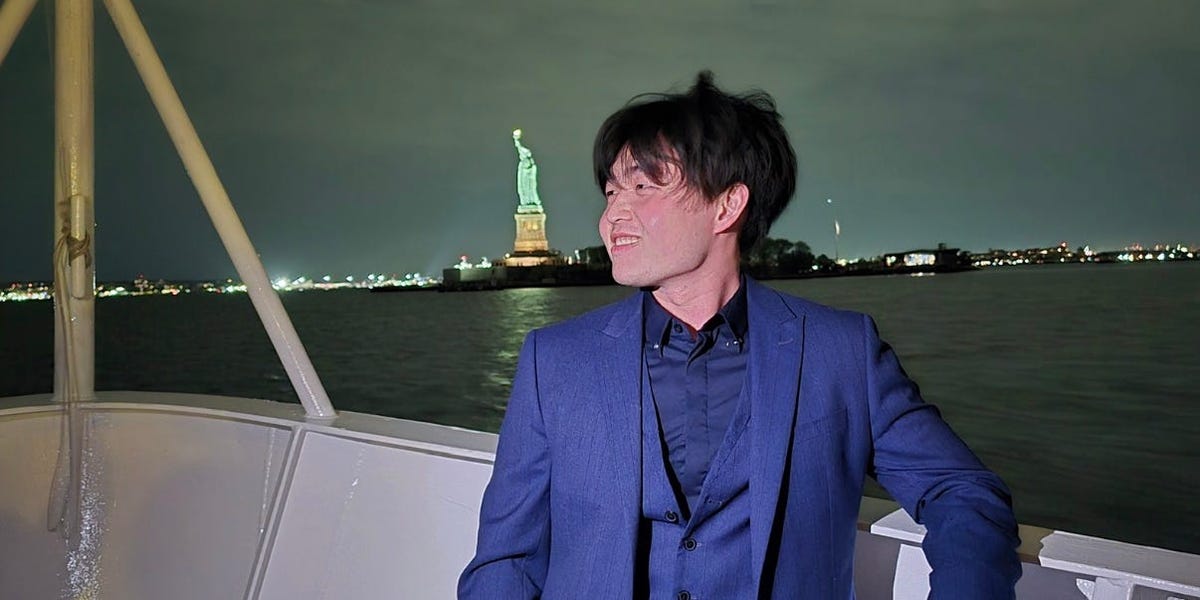
24-year-old Jensen Huang shares a name with the former CEO of Nvidia. Jensen Huang This as-told-to essay is based on a conversation with Jensen Huang, the 24-year-old software engineer and founder of the AI startup Lycana. He is based in Singapore. This essay has been edited for length and clarity.Since grade school, I've known that Nvidia's Jensen Huang exists. I've followed his news forever.When I was young, I really looked up to him. I've been really interested in computing and building stuff for a very, very long time. I remember asking my mom for a GPU when I was 16. It was a GTX 1080. I used it for a lot of gaming, and I did some app-building and programming of my own. An Nvidia GTX 1080 graphics card. Olly Curtis/Maximum PC Magazine/Future via Getty Images I remember being a kid and knowing this technology would blow up. It's come full circle, since I'm now an AI founder.The first time someone in passing talked about my name was when the AI boom was starting. Most of it is: "Oh! Your name is exactly like that guy." Or: "Hey, give me Nvidia stock."The name makes me particularly memorable. When I go to a networking event, if I see someone I've seen one time before, they'll remember me. They'll be like: "It's you! The Nvidia CEO!" 24-year-old Jensen Huang said his name made him memorable. Jensen Huang Most of the job interviews I've had in the last four years have said, "Oh yeah, you're the Nvidia CEO." I think that has given me a particular edge when it comes to employment. I believe that if people can remember your name, that's a huge leg up.When I interviewed for AI companies, some of them would say, "Got any extra GPUs?"My reaction to the Nvidia CEO's resignationMy first thought was: Holy crap, my name's going to be dragged through the mud. To me, he's always been the guy announcing GPUs. It's fairly clean. I don't know if it's a result of my Asian upbringing, but I never thought he'd be capable of doing that.The first reported affair was like, "Holy crap, that's crazy." The second one was like, "I don't even know how to react to that."My opinion of him has definitely diminished. I still think his accomplishments are his and that they're visionary, but that doesn't give him a free pass to do this kind of thing. It doesn't excuse the behavior.My friends come up to me like, "Yo, what are you doing to my stock?" Or, "How many girls is it this time?" It's not that funny, but I don't take it personally.There's no such thing as bad publicity. On a whim, I was like: "Let's say something and be funny." I didn't expect my LinkedIn posts to go so viral. Some commenters are just joking, but others are serious. Some of them think it's actually him and ask: Why did you cheat?I'm not sure that's the best for my image. A future employer may look at that.The problem comes when people think I'm him. I've had friends send me stuff on Reddit and the Chinese social media platform RedNote. Someone took a screenshot of my LinkedIn post and used it to discuss Nvidia on Chinese social media. That was the big one: people who don't know me are putting me in the discussion.My Nvidia shares are in the dumps. It was my most profitable stock for a while, until now.Personally, I don't think it will be that bad. Most interviewers take me at the merit of my character or my skills. Let's pray none of that gets hit by virtue of my name.There are more eyes on what I'm building. I saw a 5,000-viewer spike from visitors who came to the site because of it. A few people bought subscriptions. I applied to Y Combinator and other accelerators from venture capital firms.The personal thesis I have is that some of these venture capitalists choose based on the ability of founders to market themselves. If this is what it takes for them to notice me, then hey, I'm all for it. Read next Business Insider tells the innovative stories you want to know Business Insider tells the innovative stories you want to know Business Insider tells the innovative stories you want to know Business Insider tells the innovative stories you want to know Henry Chandonnet is a senior reporter on the Business News desk. He writes about tech culture, from Silicon Valley's startup class to the everyday AI user. He also closely covers Big Tech and the workplace. Henry previously wrote for Fast Company, where he covered trending tech news. He's written for The Daily Beast, People Magazine, and Vulture.Email Henry at hchandonnet@insider.com, reach him on Signal at henrychand.30, or follow him on X @HenryChandonnet. as told to Tech Startups More Venture Capital
My name is also Jensen Huang. His bad press is bringing me good business.
Full Article
Original Source
Read the full article at Businessinsider →KhanList aggregates and links to publicly available news content. We do not host full articles from third-party sources. Always verify important information with original sources.