
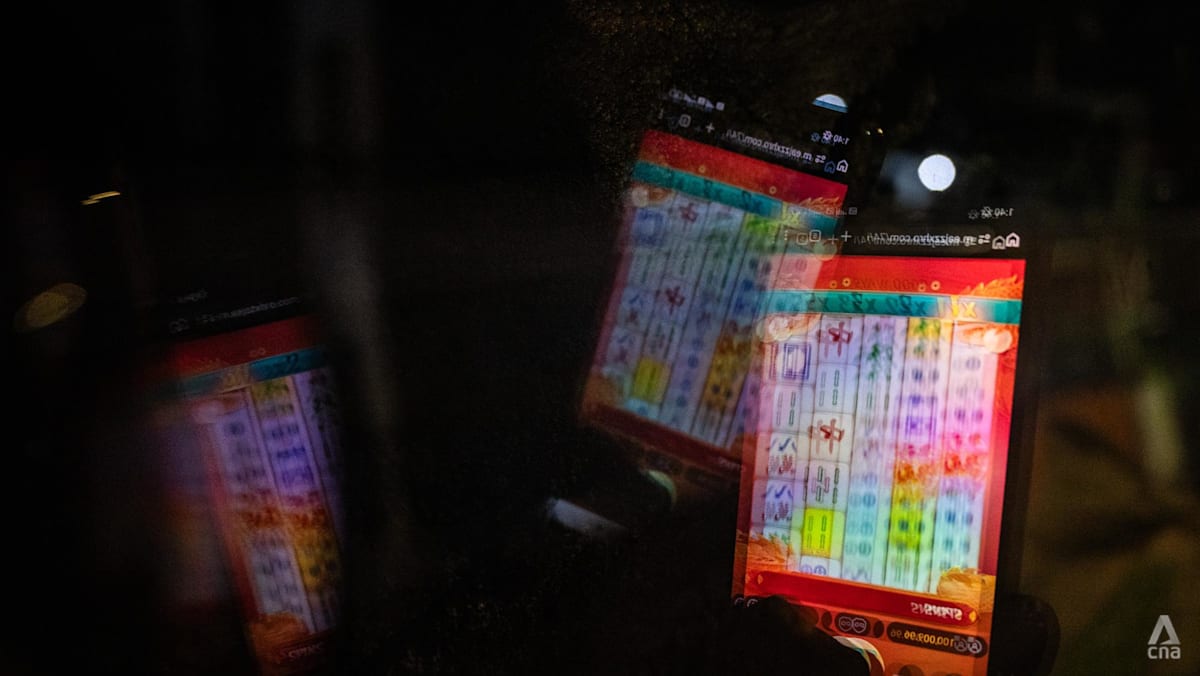
JAKARTA: Payday may still be a week away, but 27-year-old motorcycle salesman Kibo is already imagining what he will do with his salary the second the money lands in his account – log into one of the many online gambling apps on his mobile phone.Maybe this time he will hit the jackpot or score a “max win”- the highest possible payout on a single spin. Or perhaps he will finally land the elusive “1,000x multiplier” he has been chasing. A friend hit such a multiplier before, making the prospect feel all the more within reach. Speaking to CNA, Kibo, who asked to be identified by his nickname, said: “When I haven't played for a while, my hands start itching. It's like you're craving it. You miss hearing the sounds, seeing the fruit symbols and all those colours.” Kibo, who lives in one of Greater Jakarta’s poorest neighbourhoods, said that on average each month he loses about 30 per cent of his 6 million to 7 million rupiah (US$330-US$388) monthly pay to gambling. Even on the rare occasions when he does win, he wagers most of his winnings back in the game.“It's the devil's money,” he said, referring to an Indonesian saying that ill-gotten money never lasts. Gambling addict Kibo says he would lose about 30 per cent of his 6 million to 7 million rupiah (US$330-US$388) monthly wage to his betting habit. (Photo: CNA/Wisnu Agung Prasetyo) Kibo is one of millions of Indonesians caught up in online gambling, a sprawling illegal industry that has become a major social and financial problem in Southeast Asia's largest economy.The government has been fighting an uphill battle to contain the industry as gambling websites and accounts continue to reappear almost as quickly as authorities shut them down.On Oct 8, the Indonesian Communications and Digital Affairs Ministry revealed that between Jan 1 and Sep 11, it took action against 3.6 million gambling websites. The issue has made national news after 11 people were arrested on Oct 4, in connection with an alleged gambling operation running out of a house inside a military housing complex.“The fact that a gambling syndicate could operate from inside a military housing complex, an area expected to be tightly guarded and monitored, underscores the scale of Indonesia's online gambling problem and how brazen some operators have become,” Trubus Rahadiansyah, a public policy expert at Jakarta's Trisakti University, told CNA.The Indonesian Army said the house had been allocated to a colonel who had illegally rented it to civilians. The tenants then allegedly used the property to run an online gambling operation without the officer's knowledge. According to the country’s Financial Transaction Reports and Analysis Centre (PPATK), some 12.3 million Indonesians deposited money into online gambling platforms in 2025, generating 286.8 trillion rupiah in gambling-related transactions.The same agency also said that 71 per cent of gamblers in 2024 earn less than 5 million rupiah a month and about 570,000 were recipients of government social aid programmes.Meanwhile, the Indonesian Communications and Digital Affairs Ministry estimated that nearly 200,000 minors have been exposed to online gambling, 80,000 of whom are below 10 years of age.Yet millions of Indonesians continue to wager money online, sustaining an industry lucrative enough to spawn increasingly sophisticated operations.Experts say blocking websites, freezing bank accounts and arresting operators will only go so far as long as millions of Indonesians remain willing to gamble.“The problem also requires understanding what draws people to online gambling in the first place and why some become addicted despite mounting losses,” Trubus said. The inspection and search of an international online gambling hub in the Hayam Wuruk area of West Jakarta by Indonesia’s Criminal Investigation Department on May 7, 2026. (Photo: Indonesian Police) WHY THEY KEEP GAMBLINGGambling has been illegal in Indonesia for decades, with the government formally passing a law criminalising the practice in 1974 due to mounting pressures from religious groups.However, in the 1980s and early 1990s, the government allowed state-sanctioned lotteries that generated revenue for sports and other programmes, but these too were abolished in 1993 after fierce opposition.But gambling did not disappear. Instead, it largely moved underground, taking the form of illegal lotteries, card games and other illicit betting operations.Betting increasingly shifted online during the COVID-19 pandemic, as movement restrictions disrupted traditional gambling operations. As authorities stepped up enforcement in 2025, gambling syndicates increasingly used smaller transactions to evade detection. It was during this period that Abun, who worked odd jobs at a traditional market in Bogor, 50km south of Jakarta, began seeing gambling advertisements on social media.It was mid-2020, and many people around him were already playing. Curious, the now 29-year-old decided to see what the fuss was about. In a single day, Abun turned a 30,000 rupiah bet into 300,000 rupiah, equivalent to two days' wages.“I became addicted,” Abun, who also wished to be identified only by his nickname, told CNA.The promise of hitting a jackpot worth several months' salary, combined with bets that can start from as little as 200 rupiah, has made online gambling particularly alluring to day labourers and gig workers like Abun.“Everyone was doing it, from store clerks to food cart vendors to buskers on the streets,” he said of the traditional market where he worked. Abun lost his job and government social assistance recipient status because of his gambling addiction. (Photo: CNA/Wisnu Agung Prasetyo) The gamblers whom CNA spoke to said the websites draw on many of the same tools that social media platforms and mobile game developers use to keep users engaged: rewards for returning, progress to complete, bonuses to claim and the constant promise that something better could be just one more tap away.On some sites, gamblers are also contacted by “admins” who encourage them to keep betting, sending messages suggesting they are close to a win and should put in more money.Experts said lower-income Indonesians can be particularly vulnerable to such tactics, especially those with limited financial literacy and few opportunities to significantly improve their incomes.“This is the same reason why smoking or alcoholism is prevalent among low-income demographics,” Made Supriatma, a visiting fellow at Singapore's ISEAS-Yusof Ishak Institute, told CNA.“People are trying to cope with the burdens of life by smoking or gambling.” WHEN THE LOSSES PILE UPAbun said gambling gradually became something he felt compelled to do every day. There were days when he would gamble his entire wage almost immediately after receiving it.The addiction became so bad he started selling his possessions and borrowing money from friends, colleagues and employers.“I thought: ‘I'll gamble this money and maybe it'll multiply’,” he said. But it never happened and instead Abun found himself deep in debt. In 2024, Abun lost his job after his employer discovered that he had used a company loan to fund his gambling habit and was unable to repay it. For some time, he survived partly on government assistance, but before long, he was gambling some of that money too.“This year, the government stopped giving me aid because my bank account was flagged as being involved in online gambling. I don't know how they found out, but until now I haven't received the social assistance again,” Abun said. He added that his mother was also removed from the list of social assistance recipients after he used her bank account for gambling transactions.Under the government programme, around 10 million Indonesians from low-income households, as well as elderly people and people with disabilities who are unable to work, are entitled to between 900,000 rupiah and 3 million rupiah a year.Like Abun, 28-year-old Sal has also lost a steady job as a delivery van driver and his status as a social assistance recipient because of his online gambling addiction.He now survives on odd jobs in and around Jakarta and tries to spend his daily earnings on food and other necessities as soon as he receives them, leaving as little money as possible sitting in his account.“If I have even a little bit of money in my bank account, I would gamble for sure,” said Sal, who also asked CNA not to reveal his full name.But Sal has not quit entirely.Stories of friends and acquaintances scoring big still tempt him back. He said he has instead tried to control his habit by limiting himself to wagering 50,000 rupiah every two weeks.And while he has heard stories of people losing their life savings, sinking into insurmountable debt or even turning to crime to fund their addiction, Sal said those extreme cases have, paradoxically, convinced him that his own addiction “is not so bad”. Gambling addict Sal is trying to quit but stories of friends and acquaintances scoring big are still enough to tempt him back. (Photo: CNA/Wisnu Agung Prasetyo) Kibo is also convinced that his addiction “is mild compared to others” even though he once lost nearly a month’s pay in less than 30 minutes.“I still managed to survive without selling my belongings. But some of my friends have gone crazy because of (gambling addiction). Some have even committed fraud,” he said. “ONCE YOU’RE IN, YOU’RE TRAPPED"Kibo has tried several times to stop. “I even tried locking myself out of my account by deliberately entering the wrong password,” he said.Such efforts never lasted long. Kibo would find himself setting up another account as soon as friends recommended a new gambling site that appeared to be paying out.Over the years, he estimates he has created more than 20 accounts.Kibo said he would often rejoice at news of an online gambling operation being raided, hoping each crackdown might finally put an end to the websites he frequented. Foreign nationals suspected of running an online gambling operation for two months at an office building, walk to be transported after being arrested in Jakarta, Indonesia on May 10, 2026. (Photo: Reuters/Willy Kurniawan) “But as soon as one website is taken down, another one pops up in its place. Sometimes the new website is an exact copy of the old one, just with a different address,” he said.Experts said efforts to choke off the supply of online gambling will achieve little if millions of people like Kibo continue to provide the demand.“Many online gamblers become trapped because they lack an understanding of the financial risks they face,” Achmad Nur Hidayat, an economist and public policy analyst from Jakarta's National Development University, told CNA.Achmad said the government needs campaigns that help people better understand the risks of gambling while introducing them to legitimate ways to save and invest their money.Trubus of Trisakti University, meanwhile, said the government must acknowledge that decades of prohibition have largely pushed gambling underground rather than eliminated it.“Legalising some forms of gambling would bring it out of the shadows and allow the government to regulate it, put safeguards in place and impose heavy taxes on revenues that currently flow through illicit businesses and organisations,” he said.“The biggest challenge lies in convincing religious groups that legalising gambling is far preferable to leaving it illegal.”Another approach would be to treat compulsive gambling like other forms of addiction, with dedicated hotlines, support groups, counselling programmes and rehabilitation services for people trying to quit.“Gambling is not viewed as a mental health issue; it is not perceived as having any impact on mental well-being,” said Made Supriatma of the ISEAS-Yusof Ishak Institute.Instead, he said, gambling tends to be viewed as a social ill and gamblers as morally wayward. “Thus, the policy adopted is one of prohibition.”Kibo agreed that gambling addiction should be treated as a mental health issue.“Gambling is like digging a hole for yourself. Once you're in, you're trapped, and it's impossible to get out without the help of others,” he said.“If only there was someone to talk to, someone who understands the mess we're in, someone who used to be where we are today but has made it out.”For now, having little money in his bank account makes it easier for Kibo to resist the temptation to gamble. But with payday approaching, he is less certain that his abstinence will hold.“I've genuinely been trying to cut down. But if I stop and my friends are still playing, especially when you see someone win big, I get restless,” he said.“Payday is a dangerous moment. That's when you really get the urge to play.”
‘My hands start itching’: Inside Indonesia’s online gambling addiction
Full Article
Original Source
Read the full article at Channelnewsasia →KhanList aggregates and links to publicly available news content. We do not host full articles from third-party sources. Always verify important information with original sources.