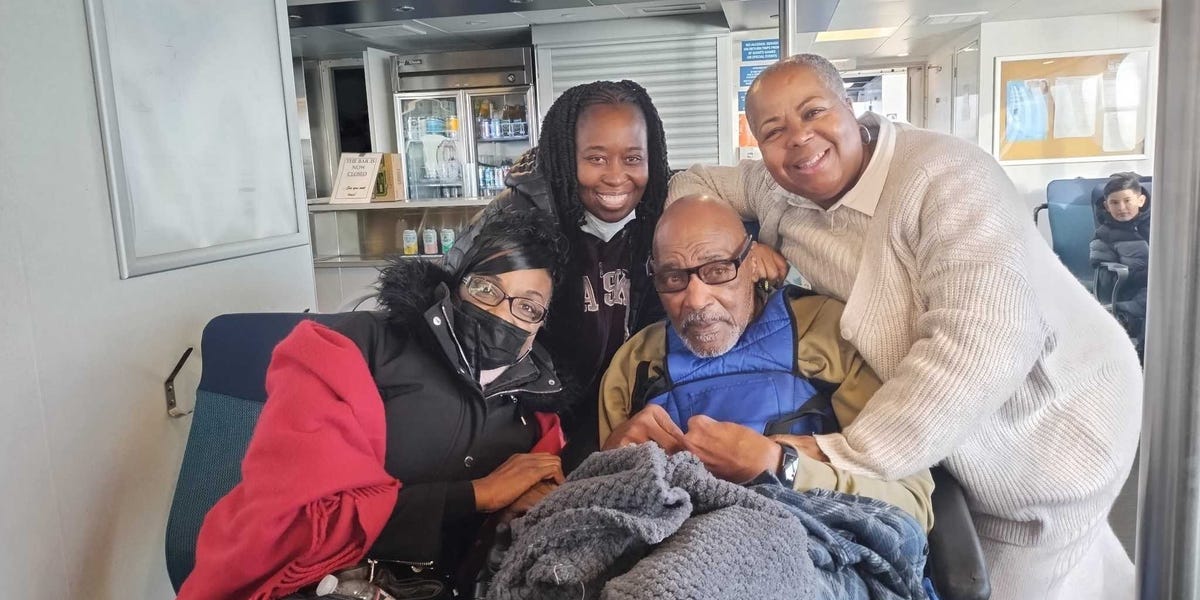
My dad came to live with me after getting sick, and my sister moved in to help. His long-term care costs us over $4,000 a month. Teri Carlyle is caring for her father, who lives with her and her sister. Teri Carlyle This as-told-to essay is based on a conversation with Teri Carlyle, 58, who lives with her sister and father in Vallejo, California. Carlyle said the multigenerational living arrangement has worked well for them and allowed the family to cut costs. This interview has been edited for length and clarity.I've had an amazing life. I knew my great-grandparents, so I know what it looks like to age with dignity and grace. My grandparents were loving and supported us. I've traveled the world, and I'm a director of finance and operations at a nonprofit.My parents were married for 64 years when my mom died. My mom retired from the federal government, while my dad retired from Sears. They owned a motorhome and traveled the country for seven months out of the year. They had joined all these RV clubs.But when my parents got sick, they came to live with me. My parents' health started to declineIn 2021, my father had a stroke. Although he wasn't paralyzed, he started having mobility issues, which put him in a wheelchair. My mom was my dad's primary caregiver.But one day in April 2023, I was at home working when my mom passed out. Little did we know that she had a heart problem. She was healthy for most of her life, and this was completely out of the blue. Her legs started swelling.Both of them needed more formal care, which we knew we had to pay for out of pocket. I rented out my parents' house in 2022, and they both moved in with me. It wasn't until two weeks before she died that we found out how severe her condition was. She was in the ER in January 2024. She was dying, and the doctor didn't know if she had weeks, months, or years left.Luckily, she had the foresight to set up her retirement so that, when she died, my dad would still get a retirement check from her. She was earning around $4,600 monthly, but after she died, it dropped to $2,800. We had to find a way to make up this difference.In May 2025, my father woke up one morning and wasn't able to use any wordsWe went to the hospital with him. He was asleep for three weeks, and we didn't know what was going on. My sister and I didn't leave his side the entire time. Eventually, he started coming back to himself.I now have a caregiver who comes to my house to bathe and feed him, and we have another person come in the evening to do the same. Teri Carlyle said she's encouraged her father to be as active as possible. Teri Carlyle It's a blessing that my parents' house is paid for. My sister's house, which is right across the street, has a very small mortgage. Once my mom passed, we were all overwhelmed, and I told my sister that I couldn't care for Dad by myself, so my sister moved in with me, too.My dad is able to be here with us, and there's always someone around. We know we will never put him in a facility.We hired a caregiver to come in during the dayWe're able to function pretty well. We pay $480 for a monthly personal trainer to work with my father and more than $3,000 a month for caregiving services. There are also insurance costs.We also take him to sporting events, concerts, and movies every now and then.My dad gets Social Security and receives my mom's government pension. I help make up the difference. My brother and his wife usually buy groceries and other things to help out. My sister takes care of some tasks, like hiring a barber who comes to the house.We're trying to find ways to cut costsWe want to sell my parents' motorhome, but it's up to my dad to decide whether he doesn't want it anymore. We know we have to let some other things go, such as his car.I'm also trying to think of other ways to increase our revenue, such as renting out one of our houses — either mine or my sister's.Our bank accounts look different from when our mom was alive, but we also don't want to take on too many responsibilities, like side hustles, that would take away from being with our dad.I realized that we take our elders for grantedWe don't spend enough time with our elders to gain all that we can from them. Everyone needs to have hard and uncomfortable conversations while everyone is healthy, and see what everyone wants for their lives.Younger people should live their best lives because, one day, they might have to come home and take care of their parents, and there shouldn't be resentment that they didn't get to do anything when they had the ability to.People think of caregiving as a burden. I'm living through a beautiful nightmare because it's truly an act of love to be able to take care of my parents and let them see that I love them. Read next Noah Sheidlower is a senior economy reporter with Business Insider. He covers retirement, aging, age tech, and employment trends.Noah reported a months-long series called 80 Over 80 about what working at 80 and older looks like. The 300-interview series includes over a dozen features and chronicles the lives of people like an 81-year-old Home Depot worker battling heart failure, a 93-year-old woman searching for a job, and an 85-year-old bus driver who died at work. The series has been recognized by the National Headliner Awards, New York Press Club Awards, and Deadline Club Awards.In 2024, Noah led a 17-story retirement series on the regrets older Americans have about their lives. He has also reported on how Americans have navigated unemployment, what compels Americans to move, and how mass deportations could impact the economy. He has appeared on SiriusXM Business Radio, Vox, and CBS News to discuss his reporting.Noah received his Bachelor's in Sociology and English from Columbia University. Noah has covered the restaurant industry, transportation, retail, and markets for CNBC, NBC News, CNN, and The Atlanta Journal-Constitution.Contact: nsheidlower@businessinsider.com or 516-304-1352.Popular articlesSome of America's oldest workers hold jobs while battling major health issues81 and working to surviveThey died 'doing what they loved': The stories of workers in their 80s who died on the jobThey're in their 80s, still working, and living paycheck to paycheckWhat work looks like in your 80s for half a million AmericansWhat an extra $500 to $1,000 a month did for 8 familiesA medical crisis derailed their retirement plans. Here's what they wish they'd done differently. as told to Family
My dad came to live with me after getting sick, and my sister moved in to help. His long-term care costs us over $4,000 a month.
Full Article
Original Source
Read the full article at Businessinsider →KhanList aggregates and links to publicly available news content. We do not host full articles from third-party sources. Always verify important information with original sources.